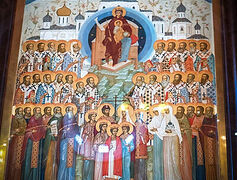
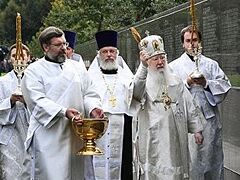
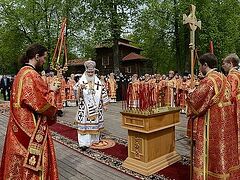
The annual commemoration of the Synaxis of the New Martyrs of Butovo is celebrated on the fourth Saturday after Pascha. Last Saturday, the Synaxis included 332 names. We spoke with Igor Vladimirovich Garkavy, director of the Butovo Memorial Center, about the tradition of venerating the saints of Butovo.
 Igor Vladimirovich Garkavy —Igor Vladimirovich, the Butovo Firing Range is a historical memorial site. What do these words mean to you today?
—The Butovo Firing Range occupies a special place in the historical memory of our people and of the Russian Church. Its significance was noted by President Vladimir Putin at the opening of the “Wall of Sorrow” memorial in central Moscow on October 30, 2017. In his speech he said very simply: “If you do not know what mass repressions are, or do not believe in them, go to the Butovo Firing Range, and you will understand everything.” Indeed, for very many people, including the president, visiting the Butovo Firing Range became a kind of turning point. One realizes that beneath one’s feet, in the trenches, lie more than twenty thousand people, almost all innocently slain, and one is compelled to draw conclusions.
The Butovo Firing Range is the largest officially recognized burial site of victims of political repression in twentieth-century Moscow and the surrounding region. According to a conclusion issued by the FSB in 1993, mass executions were carried out there from August 8, 1937, to October 19, 1938. From documents that have since been studied and published in the form of a “Book of Remembrance,” we now know the names of 20,762 people executed there during that period. These were very different kinds of people, though for the most part they were simple peasants and workers who became victims of the various mass operations conducted by the NKVD under the direction of the Bolshevik Party in the Soviet Union.
The bloodiest and most extensive of these was the so-called “kulak operation,” carried out under secret Order No. 00447 beginning in early August 1937. From that time onward, mass executions took place both here and elsewhere. Among the categories designated for repression in this order were “church people.” This did not necessarily mean clergy, nor exclusively Orthodox clergy, but overwhelming majority were clergy, monastics, and active laypeople of the Russian Orthodox Church. At the Butovo Firing Range, 940 people were executed on church-related charges. From this list we now know of seven bishops, fifteen archimandrites, and around six hundred priests. To date, 332 of them have already been glorified among the saints, and I believe canonizations will continue.
At the Butovo Firing Range, 940 people were executed on church-related charges. Of them, 332 have already been glorified among the saints.
On the one hand, the Butovo Firing Range is a place of remembrance, a place for reflection upon the difficult path our country traveled in the twentieth century, a place preserving the memory of innocent people who suffered during political repression. On the other hand, it is a special place for venerating the podvig—the spiritual feat—of the New Martyrs.
—The Butovo Firing Range is also unique in that it belongs to the Russian Orthodox Church, which established the feast of the Butovo saints on the fourth Saturday after Pascha. Why was this year’s celebration transferred to the fifth Saturday after Pascha—May 16?
—In 2026 the Synaxis of the New Martyrs of Butovo was celebrated on May 16. This is a slight departure from tradition, since the fourth Saturday after Pascha fell this year on May 9. Therefore, with the blessing of His Holiness Patriarch Kirill, the celebration has been moved to May 16, since many people participate on May 9 in ceremonies commemorating the heroes of the Great Patriotic War. The tradition of celebrating the Synaxis of the New Martyrs of Butovo began in 2000, when more than one hundred saints of Butovo were glorified. At that time His Holiness Patriarch Alexy II established the date of the feast and blessed the clergy of the Moscow Diocese and the surrounding dioceses to gather there for a solemn Divine Liturgy.
Every year on the fourth Saturday after Pascha, a service headed by the Patriarch is celebrated there. The Divine Liturgy is served outdoors literally upon the graves of the martyrs—the burial trenches—just as the Christians of the first centuries once did. The Liturgy draws a great multitude of clergy: no fewer than twelve bishops and around four hundred priests come there. It is truly a synaxis, because along with the priests, monastics and laypeople also pray there, numbering around three thousand people in all.
 —At the head of the host of the New Martyrs of Butovo stands Metropolitan Seraphim Chichagov. Seven bishops suffered at the firing range. Why is the name of Metropolitan Seraphim especially distinguished?
—All the bishops executed at the Butovo Firing Range, were remarkable men. Yet Metropolitan Seraphim (Chichagov), even among such extraordinary servants of the Church, possessed truly exceptional gifts, and hierarchs of such stature were rare not only in our own day, but even in that earlier time. He had been a military officer, a writer, and both a secular and church historian. He studied the life of St. Seraphim and was the first to publish a systematic scholarly work on the life of the Elder of Sarov. Before that there had been only separate brochures, which neither covered the entire life of St. Seraphim nor revealed details connected with the history of the Diveyevo Monastery. Metropolitan Seraphim succeeded in studying the Motovilov archive and wrote and published the two-volume Chronicle of the Seraphim-Diveyevo Monastery.
In addition, Metropolitan Seraphim (Chichagov) was an iconographer. Most famous is his image of the Risen Christ—Christ clothed in a white tunic. He painted this image in several versions: for example, in the Alexander Nevsky Lavra the Savior is depicted against a blue background, while in the Church of the Prophet Elias in Obydensky Lane He appears against a dark background.
The metropolitan was also a composer who wrote several sacred musical works. In addition, he was a homeopathic physician who developed his own system of treatment. Metropolitan Seraphim was appointed to various episcopal sees, but what is especially important for us today is his active effort to revive parish life. Foreseeing the approach of the Russian upheaval, he understood that the destruction of the Church and the homeland could be halted only through the renewal of parish life.
While in Orel, the metropolitan developed a new parish statute, and his work formed the basis of the decisions of the Local Council of 1917. Metropolitan Seraphim was a member of the Council commission that created a new version of the parish statute. Moreover, he was a confessor of the faith who endured persecution, served a term in exile, was forced into retirement, and then returned to church life in 1928 when he became head of the Leningrad see. This was no easy cross, for Leningrad was called the cradle of the revolution; militant atheism was being imposed there, and church schism was also present. Yet until 1932 the metropolitan bore his ministry without complaint. He later lived near Moscow at the Udelnaya station, where he was arrested in 1937. On December 11, 1937, he was executed at the Butovo Firing Range at the age of eighty-one.
 Metropolitan Seraphim (Chichagov)
—In the Resurrection Church at the Butovo Firing Range, a side chapel has been consecrated in honor of the Hieromartyr Seraphim Chichagov. There is also an icon of Metropolitan Seraphim there, presented to the parish by the metropolitan’s granddaughter, Varvara Vasilyevna Chyornaya, who later became Abbess Seraphima, superior of the Moscow Novodevichy Monastery. Beside this icon, behind glass, is another icon—that of the Hieromartyr Hilarion Troitsky. Please explain why these two icons are placed together.
—This reminds us of the spiritual bond between these two outstanding hierarchs of the Russian Church. At one time they both served terms of exile in the city of Arkhangelsk, and according to tradition, even lived in the same house there. Both were principled and faithful followers of Patriarch Tikhon who opposed church schisms.
Later, Metropolitan Hilarion was imprisoned in the Solovki labor camp, while Metropolitan Seraphim was “retired” to the Resurrection Monastery in the city of Shuya, from where he was later appointed to the Leningrad cathedra. Metropolitan Hilarion was summoned by Yevgeny A. Tuchkov, an OGPU officer directly overseeing the persecution of the Church, and taken for interrogation to the special political prison in Yaroslavl known as “Korovniki.” There they attempted to persuade Metropolitan Hilarion to cooperate with the authorities, but he refused every form of compromise, and so he was sent onward to the camps. While in transit he died of typhus in the prison hospital of Leningrad on December 28, 1929.
At that time the Metropolitan of Leningrad was Seraphim (Chichagov), and he succeeded in obtaining the body of Archbishop Hilarion (Troitsky) for burial. The cemetery of the Novodevichy Monastery in Leningrad was chosen as the burial place because the metropolitan’s residence was located there. Metropolitan Hilarion was buried with full episcopal honors, clothed in episcopal vestments provided for the burial by Metropolitan Seraphim himself. And when the relics of Archbishop Hilarion were uncovered in 1998, the episcopal vestments of the Hieromartyr Seraphim (Chichagov) were also discovered with them.
Our parish appealed to the sisters of the Novodevichy Monastery in Saint Petersburg in order to obtain a fragment of the vestments and part of the coffin that were uncovered during the opening of Archbishop Hilarion’s relics. There is a tradition that when Metropolitan Seraphim accompanied his fellow bishop on his final journey, he said:
“I shall not have such a grave.”
Indeed, this proved prophetic, for his body rests in one of the burial trenches at the Butovo Firing Range.
Returning to the subject of the icons, I would like to emphasize that these two icons are especially significant for our parish because both have streamed myrrh at different times. The icon of the Hieromartyr Seraphim, given to us in 1997 by Abbess Seraphima, streamed myrrh for ten years, while the icon of Metropolitan Hilarion unexpectedly began to stream myrrh very abundantly in 2020, and I myself witnessed it.
—We know that Metropolitan Hilarion was born into a large priestly family, and that his own brother, Archbishop Daniel Troitsky, was also a confessor of the faith who endured exile and died of typhus in Bryansk in 1934.
—Few people know that the younger brother of Metropolitan Hilarion (Troitsky), Priest Alexei Troitsky, was executed at the Butovo Firing Range. St. Hilarion was born in the village of Lipitsy. His father, Priest Alexei Troitsky, raised three sons and two daughters. In this deeply believing family, two of the sons became hierarchs, while the third son, Alexei, was called up at the beginning of the First World War to attend an officers’ training school and was sent to the front as a junior officer.
After returning from the war, Alexei Alexeyevich followed in his father’s footsteps, receiving priestly ordination in 1918 and serving for a time in Lipitsy. He was twice arrested by the Soviet authorities and served a term of exile in the Komi Autonomous Region from 1930 to 1934. Upon returning in 1935, he was assigned to a parish in the village of Kuzmishchi in the Tarusa district of Moscow Region.
He was arrested on August 24, 1937, and executed on September 23 of the same year at the Butovo Firing Range on charges of “anti-Soviet activity and terrorist sentiments.” He did not confess guilt.
 Priest Alexei Troitsky, photograph from the investigation file.
In our museum we preserve unique relics: a photograph of the future Priest Alexei in military uniform when he was a cadet at the officers’ training school, and a postcard sent from the Solovki prison camp by Metropolitan Hilarion Troitsky to his younger brother Alexei. The return address reads: Kem, more precisely “Kem Transit Point.” Communication between the camp and the mainland passed through the Kem transit station. The postcard is dated 1927. It contains no confidential information, but it is a touching greeting from the camp to a beloved brother.
All three brothers faithfully served the Church and became confessors of the faith.