About the Theological Faculty in Prešov, the practice of Confession, Orthodoxy in Slovakia, child-rearing, and Europe.
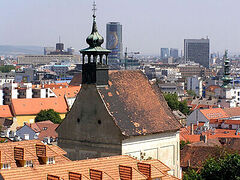
 Church of St. Alexander Nevsky in Presov
It takes a long time to get from Bratislava to Prešov, and you have to do a layover. First, you take a train for more than five hours to the Kysak station, and then take a local train for 15 minutes to Prešov. Prešov is the third-largest city in Slovakia, with a population of just over 90,000. Prešov can rightfully be considered the center of Orthodoxy in Slovakia—the city is home to the residence of Metropolitan Rostislav, the Primate of the Church of the Czech Lands and Slovakia, the Cathedral of St. Alexander Nevsky, and the Orthodox Theological Faculty at the local university.
Since my trip to Prešov was short, I didn't plan to have many meetings here. The main goal was to visit the faculty, get acquainted with its work, and talk to the management. As someone who is deeply involved in science and teaching, I always find it interesting to engage in conversations with individuals who have academic research and teaching others as an integral part of their lives, their calling, and their mission.
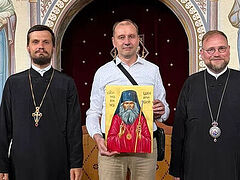
However, the Dean of the Faculty of Theology at Presov University is not only a scholar and teacher. He is also a priest who serves as the rector of the Church of St. Clement of Ohrid in Spišska Nová Ves.
Archpriest Stefan Pruzhinsky was born in the family of a priest, in the town of Levocha, 60 kilometers from Prešov. He received his education at the Theological Faculty of Prešov University, where he defended his master's and then his doctoral dissertations. He also studied in Thessaloniki, in the Greek language. He was ordained as a priest in 1996. Father Stefan has five children of his own, and he has adopted one child.
In addition to his position as dean, the priest also teaches the New Testament and the practice of Confession (known as “ispoved“ in Slovak).
***
 Archpriest Stefan Pruzhinsky
“As part of this subject, students study how to receive Confession and about everything related to it,“ explains Father Stefan. “We primarily rely on the works of the Greek theologian Saint Nicodemus of the Holy Mountain. However, we also use other sources, including information about the history and practice of Confession in other Churches. The main goal is to teach students how to conduct Confession properly, as a full-fledged spiritual life cannot exist without proper Confession.
—Father Stefan, in the context of the subject you teach, I would like to ask you for your opinion on the two approaches to Confession that exist in the Orthodox world. In the Russian Church, it is customary to confess almost before every Communion, but the Greeks, for example, do not have this rule. Which practice is the most appropriate and in line with the spirit of the Gospel?
—I believe that the practice of frequent Confession, even before each Communion, is very beneficial. As a rule, Christian believers love Confession and look forward to the opportunity to confess. Of course, it is very important to have a priest who is happy to see people coming to Confession and who does not find it burdensome. In this case, believers will gladly come to Confession. If people come to Confession regularly, they learn about Confession, explore their inner lives, and gain a deeper understanding of it.
But if a person comes rarely, he sometimes does not know how to confess, does not see his sins. Sometimes people simply say: “I have not killed anyone, I have not stolen much of anything“ —and this is where Confession ends.
Sometimes people just say, “I didn't kill anyone, and I didn't steal anything big,” and that's where the Confession ends.
Once, during a pilgrimage to Serbia (where there is no practice of frequent Confession), we were in a monastery, and our people confessed there, even before the beginning of the Liturgy. One monk asked: “What are you doing?” and when I found out, I lamented that they had not had the opportunity to confess for 3 years. If a priest does not regularly confess, then Confession as a phenomenon begins to disappear.
I remember when I was in an Orthodox parish in a certain country, I won't say which one. I wanted to confess, but the priests didn’t know how to do it, they didn't even remember the absolution prayer. Later, a bishop who came to Slovakia was able to perform the confession... It’s a treasure to have regular confessions before each communion!
—So, in a parish where the priests didn't know how to administer Confession, people went months without receiving it?
—Maybe even for years... Although proper Confession is very important for a Christian, and a person who approaches Communion should not approach Confession formally, but rather by examining their inner life. Many people who approach the Holy Chalice without proper repentance become ill, and some even die.
—Do you think it makes sense to tell your sins in detail during Confession? For example, if you have offended another person, should you also mention the words you used to insult them? And what should you do if your sins keep recurring from Confession to Confession?
—It is necessary to speak precisely about the sins that have been committed, but at the same time not to give details… In the conditions of our sinful nature, the repetition of sins is inevitable. Unfortunately, we will continue to repeat them. However, if a person regularly confesses, it means that they are working on themselves and trying to do something about it. The treatment of sinful nature requires many years, even decades. Sometimes, people may have conditions where it is not beneficial for them to receive Communion, as they do not have any acts of repentance and are unable to stop committing serious sins. Then we agree that the person does not receive Communion for several months, although they come to Confession. Then, when repentance appears, we allow Communion. However, it is very important that the person agrees with this decision, as forcing them may alienate them from the Church.
 At the entrance to the Faculty of Theology in Prešov
The Faculty of Theology is a structural unit of Prešov University, so it is subject to the general rules of the higher education system in Slovakia. Father Stefan has been the head of the faculty for over 7 years, since 2019.
“Of course, we have to follow all the rules issued by the Ministry of Education,” says Father Stefan. “For example, I encourage my professors to publish an article in a journal that is included in the Scopus or Web of Science databases at least once a year. If they do not comply with this requirement, it means that they are not fulfilling their duties as a university professor to the full extent. However, many of our professors are priests who have parish responsibilities, so it is not always possible to meet the formal requirements. But these requirements are important for accreditation, as our diploma is recognized in all EU countries. Our teachers receive their salaries not from the church, but from the university.
—What language is the course taught in?
—In Slovak. We offer Greek, Russian, and English as foreign languages to our students. Most students choose Greek, while Russian is second in popularity, especially among doctoral students. We have a well-equipped Russian-language scientific library, making Russian a valuable resource for research. Our students can choose between two departments—theology and social work. The majority of students opt for social work, as it is more appealing to non-Orthodox students.
—So a significant number of your students are non-Orthodox?
—Yes, there are very few Orthodox Students in Slovakia—one percent. However, the faculty is the center of Orthodoxy in our country, like Mount Athos in Greece or the Holy Trinity-St. Sergius Lavra in Russia. In Slovakia, there are no full-fledged monasteries at all, only one hermitage with one monk in it. Therefore, the theological faculty became the center. Future priests study here, choir directors, iconographers, and the most active parishioners. There are also open lectures for all comers, and scientific conferences.
 On the premises of the Theological Faculty of Presov University
About Orthodox and Uniates
Slovakia, like Western Ukraine, is a territory where many Orthodox Christians were often deceived or forced to convert to Catholicism disguised as Orthodoxy through the “Eastern Rite.” After the Unia of Uzhhorod in 1648, almost all Orthodox parishes became Uniate (although this was a long process). Catholicism was actively supported in the Austro-Hungarian Empire, which included the Slovak lands.
A turning point came in the 1920s: Uniates, especially those who had traveled to the United States (mass labor migration was taking place), learned that they did not belong to any Orthodox jurisdiction and therefore could not be considered Orthodox.
“It was a shock for them,” says Father Stefan. “The Uniates returned to Slovakia and built Orthodox churches. About 20,000 Greek Catholics became Orthodox more than 100 years ago. However, in 1950, the communist authorities banned the Greek Catholic Church. To remain in the church, the Uniates began attending Orthodox services. Some of them gladly accepted Orthodoxy, but many did so with hatred, simply because there was no other option. Eighteen years later, in 1968, when the ban was lifted, many formal Orthodox Christians returned to the Unia. Some former Uniates remained in Orthodoxy. However, some of those who returned to the Unia became haters of the Orthodox Church. For some reason, we Orthodox Christians were blamed for the 1950 ban, although the decision was made not by us, but by the communist authorities of Slovakia.
Nevertheless, after 1968, many Orthodox and Uniates served in the same churches, taking turns. Then, after the “velvet“ revolution of 1989, the Uniates began demanding that the churches be exclusively in their possession, without the presence of the Orthodox. However, in many places, the Orthodox communities had made significant contributions to the maintenance and repair of the churches. The government made a wise decision in this situation. The “controversial“ churches were transferred to the Uniates, while the Orthodox received funding for the construction of their own churches. 127 Orthodox churches were built with the support of the government. Since then, relations between us and the Uniates have generally become peaceful and quiet.
—But there’s not a mass return of Uniates to Orthodoxy anymore?
—No, there isn’t, although there are always cases when Catholics and other non-Orthodox people convert to Orthodoxy. They show interest in our worship and the teachings of our Faith. The reasons vary, but this is not a widespread phenomenon.
In order for children not to leave the Church, parents must first of all live sincerely as Orthodox Christians
“In order for children not to leave the Church, parents must first of all live sincerely as Orthodox Christians,“ says the priest. “The children will accept this. I was very pleased when my children, as adults, said that their childhood in the family was very beautiful, that it was engaging, and that they had very happy memories. My confessor advised me: As you try to be with other people, be also in the home. Without hypocrisy. It's not about pretending to be a saint in public and living a non-Christian life at home. If a Christian is with Christ everywhere, including at home, then everything will be fine, and children will love it.
—In Slovakia, as far as I know, children can also study the Fundamentals of Orthodoxy in secondary school, which I believe is a good addition to home-based instruction in the faith…
—Yes, that's true, and according to the law, it's enough to have one Orthodox student to open such a course. However, in practice, it can be different. For example, in a school near my parish, the principal required at least seven students. There were twelve students, so the course was opened. We rely on textbooks written by our authors, who are usually affiliated with the Faculty of Theology. Of course, all these textbooks are in Slovak.
About Ukraine and Europe
At the end of our conversation, I cannot help but mention the pressing issue of Ukraine. Slovakia shares a border with Ukraine, and as a result, there are many refugees from the east who have fled the horrors of war. These people bring their ideas, thoughts, pain, and loss to Slovakia. Many of them are devout Orthodox Christians, although not always from the Ukrainian Orthodox Church.
 Photo: St. Rostislav's Church in Bratislava —Yes, Ukrainian refugees are indeed becoming part of our communities, and we are supporting them as much as we can. However, there have been some tensions in some parishes due to the fact that we serve in Church Slavonic (which some Ukrainians did not like), but these cases were few and far between. Currently, there are no major difficulties. Of course, we are concerned about the catastrophic split in Ukrainian Orthodoxy. I don't think anything will help us now, except for leading a normal Christian life, believing, confessing, praying, and working well for the benefit of society.
—By the way, since Slovakia became a member of the European Union in 2004, have you noticed any negative changes related to pressure from Brussels on gender issues and the like
—Indeed, there has been a lot of harmful propaganda that can harm children and their health. I think this is all demonic and inhumane, and it is directed against God and humanity. I hope that God will help to prevent this unchristian pressure from increasing excessively. Moreover, some countries have already realized the harmfulness of this “gender“ approach.
I would like to point out that I have never met a person in my life who would be sympathetic to such things. This is true both in secular and, of course, in religious settings. People with even a modicum of common sense understand this. Thankfully, the Slovak society maintains a healthy level of conservatism in this regard and does not want to be influenced by harmful external factors.