An icon with saints depicted in the borders has a specific designation accepted in scholarly literature: an icon “with margin saints” (s paleosnymi svyatymi). Interestingly, images of God’s saints are found more often in the borders of icons of the Mother of God—such as the Kazan, Tikhvin, Vladimir, and later icons including the “Unexpected Joy”—than elsewhere. More rarely, such “patronal” saints appear on icons of Christ, and only infrequently on icons of the Twelve Great Feasts. Among feast icons, the most common subject for this arrangement is the Nativity of the Mother of God, where the depiction of holy women served as a prayer for the gift of children.
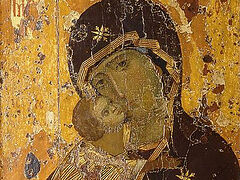
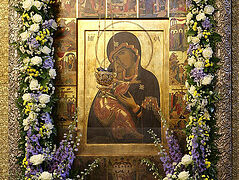
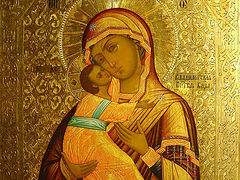
The Vladimir Icon of the Mother of God, the revered twelfth-century wonderworking image preserved in the State Tretyakov Gallery, was reproduced in countless copies. The borders of the ancient prototype did not contain images of saints; however, they already appear on the earliest known copies. On the borders of several outstanding icons, one finds depictions of the Twelve Great Feasts or scenes from the Narrative of the Icon of the Mother of God. There is also a group of monuments characterized by the inclusion of saints in the margins, dating from the fifteenth to the early twentieth century.
 The Vladimir Mother of God, with miracles in twelve border depictions of saints The earliest examples exhibit a more complex iconographic program for the placement of saints: alongside feast scenes, they may include the Archangels Michael the Archangel and Gabriel the Archangel, as well as other iconographic variations. There was a custom of creating icons as votive offerings to a particular monastery. In such cases, the borders of the icon would depict the venerable founders of the monastery and the patron saints of the donors themselves. During the Synodal period, the donors of such icons could even be ukaznye poslushniki—novices officially enrolled on a monastery’s staff. These were generally small icons, kept in the sacristy, or else gathered together into separate icon ensembles within the church. This tradition may be compared to what was often seen after churches reopened in the late 1980s. Large numbers of family icons were donated to churches, and in order to find a place for them within the church interior, the smaller icons were frequently arranged in a frame around a larger central image. Count Yury A. Olsufyev, who was engaged in cataloguing ecclesiastical antiquities both before the Revolution and under Soviet rule (and was later executed by the Soviet authorities), wrote: “The heavy doors of the sacristy are opened, and before our eyes appears a considerable collection of icons (about five hundred), chiefly of the Mother of God, beginning with examples of early painting... Many of them are donations to the monastery from people of various ranks and stations: monks and nuns, merchants and monastic workers, boyars, princes, and princesses...” It is noteworthy that the collection of the Church-Archaeological Cabinet of the Trinity Lavra of St. Sergius preserves a sixteenth-century icon with the Solovetsky Wonderworkers depicted in the margins. The history of this icon is difficult to trace with certainty, but it is believed that it may have been intended as a donation to a church or monastery dedicated to the Solovki Wonderworkers.
 The Vladimir icon with Sts. Zosima and Savvaty of Solovki in the borders. Third quarter of the 16th c. old.mpda.ru The Vladimir icon the Mother of God of 1660 was created for the Florishchev Hermitage by the renowned icon painter Simon Ushakov together with his pupil Andrei Vladimirov as a memorial offering for the salvation of their own souls, as well as for their parents and relatives, as the inscription on the icon states. In the oval medallions on the borders are depicted the Archangels Michael and Gabriel, along with seven saints. Among them, Sts. Pimen the Great and Andrew of Crete are the heavenly patrons of the two icon painters who created the image.
It should be remembered that many Russians were known by their secular names, yet regarded as their heavenly patrons the saints in whose honor they had received a different, baptismal name. This was the case with Simon Ushakov, whose baptismal name was Pimen.
As for a seventeenth-century icon preserved in the Yaroslavl Art Museum, it has been suggested that it was painted in memory of the confinement of the boyar Fyodor Romanov, father of the future Tsar Michael I of Russia, in the Siya Monastery in 1601. There he took monastic vows and later became Patriarch with the name Philaret. On the borders of the icon are depicted Theodore Stratelates and Anthony of Siya.
The intercession of the Most Pure Virgin and the saints is the central theme of the Vladimir Icon of the Mother of God with saints in the borders. An example dating from the mid-sixteenth century, preserved in the collection of the Rostov Kremlin Museum, comes from a rural church in the village of Uslavtsevo. The saints are depicted along the right and left borders, generally arranged in pairs according to their rank of sanctity: Sts. Nicholas the Wonderworker and Alexiy of Moscow; the military martyrs Theodore Tyron and Theodore Stratelates; the martyrs Tatiana of Rome and Anastasia the Deliverer from Bonds; as well as the Apostles.
The arrangement of the saints recalls the Deisis tier of an iconostasis—all the heavenly figures are likewise turned toward the center and pray there “for the human race.” At times, the two traditions became intertwined: an icon originally commissioned for private devotion would later be donated to a church or monastery. Some ancient churches remain living witnesses to this custom. In the Cathedral of the Exaltation of the Cross in the famous village of Palekh, many such small pyadnitsa icons can still be seen today on the walls and pillars. On the borders of a nineteenth-century icon of the Vladimir Mother of God, produced in the Belousov workshop in Palekh (now in a private collection), are depicted the Guardian Angel and the martyr Sophia of Rome.
Icons with “associated” or “margin” saints could also serve as a parental blessing. An icon from the K. A. Savitsky Penza Art Gallery, The Vladimir Mother of God with Saints in the Borders (I-31), bears the following inscription on its reverse: “With this icon, Elena Arkadyevna Glebova blessed her grandson, Mikhail Petrovich Glebov.” In the homes of wealthy families, such icons were often kept in special rooms known as obraznitsy (“icon rooms”) or cross chambers.
Other icons are associated with donations from noble and even royal patrons. In the local tier of the iconostasis of the Smolensk Cathedral of the Novodevichy Convent there are two such copies. To the right of the south doors of the iconostasis stands an icon whose four corners contain depictions of the Four Evangelists together with their symbols. The image is covered with an openwork gilded riza, and the Evangelists are placed in arched panels similar to those containing the Twelve Great Feasts depicted in the borders. It is believed that this sacred image was donated by Tsarevna Sophia Alekseyevna. On the borders of an icon dating from the 1560s–1570s, now in the collection of the Central Andrei Rublev Museum of Ancient Russian Culture and Art, are depicted St. Basil the Great and the martyr Salome. On the reverse is a nineteenth-century ink inscription: “In 1508, from the family of the boyars of Grand Princess Solomonia, it passed into the Denisov family...” Solomonia was the first wife of Vasily III of Russia, and the saints depicted on the icon were the heavenly patrons of this princely couple. It was for this reason that they were represented on the icon with margin saints.
 The Vladimir icon in Novodevichy Convent The earliest copies of the Vladimir Icon of the Mother of God are closely connected with the veneration of Russia’s great saints—the hierarchs of Moscow and St. Sergius of Radonezh. An icon dating from the first quarter of the fifteenth century, originally from the chapel of St. Sergius of Radonezh near the Ilyinsky Gates (a chapel belonging to the Trinity Lavra of St. Sergius), bears on its borders an image of the Wonderworker of Radonezh. By our time, however, the image survives not as painted decoration but only as an incised outline scratched into the surface. Even in high-quality reproductions, this drawing is scarcely visible. Nevertheless, scholars believe that the icon once stood near the shrine of St. Sergius in the ancient cathedral of the Trinity Lavra.
The Volokolamsk Icon of 1572 is a copy of an ancient twelfth-century icon, supplemented with a depiction of a crown and forehead ornament reproducing the jeweled adornment of the celebrated wonderworking image. It was commissioned by Malyuta Skuratov-Belsky, a prominent figure among the oprichniki of Ivan IV of Russia. The icon was donated to the St. Joseph of Volokolamsk Monastery and intended for the gate church dedicated to the Meeting of the Vladimir Icon of the Mother of God, a church that still exists today under a different name.
This icon, now preserved in the Central Andrei Rublev Museum of Ancient Russian Culture and Art, bears on its right and left borders images of the Moscow hierarchs Sts. Peter and Jonah of Moscow, whose relics rest in the Dormition Cathedral, Moscow Kremlin. The choice of these attendant saints points to the icon’s connection with the principal place of veneration of the ancient wonderworking image—the Dormition Cathedral of the Moscow Kremlin.
Also worthy of mention is an icon of 1514 from the same cathedral, painted for its chapel dedicated to Saints Peter and Paul. On its borders are figures of Byzantine and Russian hierarchs (holy bishops), and together with the Twelve Great Feasts depicted there as well, these images reinforce the theme of the liturgical glorification of the wonderworking icon.
 Vladimir icon for St. Joseph of Volokolamsk Monastery The largest museums of Moscow and St. Petersburg preserve works of ecclesiastical art that once belonged to the pre-Revolutionary collection of Pavel F. Karabanov. Karabanov collected Russian antiquities in all their variety, and his “particular passion” was for objects associated with pious domestic life. Although many of these works are now dated to later periods than was once believed, they continue to be admired for the unique refinement of their revetments and the artistry of their painting.
One such icon, The Vladimir Mother of God, preserved in the Moscow Kremlin Museums, survives beneath a nineteenth-century overpainting. Its gilded revetment, adorned with almandine garnets, frames the figures of four hierarchs depicted in the borders. This icon continues the tradition of portraying the first hierarchs of Moscow on copies of the Vladimir Icon of the Mother of God, although here St. Nicholas the Wonderworker appears alongside Peter of Moscow in place of another Moscow metropolitan.
A number of icons celebrate saints who enjoyed particular veneration in a specific locality or diocese. An icon from the second half of the sixteenth century originating from the Sophia Cathedral, Novgorod, now preserved in the Novgorod State Museum-Reserve, survives beneath later overpainting. On its side borders are depicted the Novgorod archbishops Nikita and John of Novgorod, together with St. Barlaam of Khutyn (as well as St. Sergius of Radonezh).
Another icon, dated 1707 and preserved in the collection of the Vologda State Museum-Preserve, bears an inscription on its reverse attesting to its origin: “This icon was painted in Veliki Ustyug...” The inscription also records the name of the icon painter, Boris Deomidov, who created this work glorifying local saints. Among the six ascetics represented in the borders are the Blessed Fools-for-Christ Procopius and John of Ustyug, who were especially venerated in the city “upon the Dvina River.”
 An icon from the collection of P. F. Karabanov in the Museum of the Moscow Kremlin The creation of copies of the Vladimir Icon of the Mother of God is closely connected with Christian piety. The earliest copies were produced after the icon’s transfer to Moscow in 1395, when, through the prayers of the people of Moscow, the city was miraculously delivered from the invasion of Timur. The very idea of depicting saints in the borders of the icon arose originally from the theme of the intercession of the Queen of Heaven together with the host of Russian saints on behalf of the Russian land during times of “barbarian invasions” and “sorrowful years.” In later centuries, the image came to be associated with deliverance from natural disasters and with the protection of the household and family life. As a result, copies of the icon began to include depictions of locally venerated righteous ones, patrons of earthly labors, holy unmercenary healers, and family saints. According to contemporary practice, wedding icons may likewise bear on their borders images of the heavenly patrons of the bride and groom entering into marriage. The possibility of enriching a revered icon with additional figures in its borders makes it possible to express a wide variety of pious traditions—monastic, familial, local, and universal within the Church. Through these margin saints, the icon becomes not only a representation of the Mother of God, but also a visual testimony to the particular community, family, or spiritual heritage under her protection and seeking her intercession.