Most readers are aware that June 1 is International Children’s Day. But few people know of another holiday dedicated to children—the International Day of Innocent Children Victims of Aggression, which falls on June 4. In the history of Orthodoxy, there have been many cases when children became holy martyrs for Christ and the Orthodox faith, suffering severe torments.
Today, for the commemoration of St. Dmitry of Uglich, we present this article on children who have been glorified as saints in the Orthodox Church.
 The massacre of the Holy Innocents
14,000 Holy Innocents (feast: December 29 according to the old calendar) were killed by order of King Herod and became the first martyrs for Jesus Christ. Herod was enraged when he heard that the King of the Jews had been born in Bethlehem. He ordered the extermination of all infants in and around Bethlehem under the age of two. Thus what the Prophet Jeremiah had predicted came true: Thus saith the Lord; A voice was heard in Ramah, lamentation, and bitter weeping; Rahel weeping for her children refused to be comforted for her children, because they were not (Jer. 31:15; Mt. 2:16–18).
When we read about the feats of the martyrs, we often find an indication that among them were women and children, or the addition “and with him his household.”
Many children were killed in the first three centuries of Christianity, when the persecution of Christians reached a huge scale. In the second century, Sts. Meletius Stratelates, Stephen, John, Serapion the Egyptian, Kallinikos the Sorcerer, Theodore and Faustus, and with them 1,218 soldiers with their wives and children, were martyred (feast: May 24). In the early fourth century, the holy Martyrs Eustochius, Gaius, Probus, Lollius, and Urban were brutally tortured and then beheaded, along with women and children (feast: June 23). They were slain, but they did not renounce Jesus Christ.
Under the Roman Emperor Maximian (284–305), the holy Martyr Babylas and his eighty-four young disciples died for their faith (feast: September 4).
The holy Martyr Cyriacus was only three years old when he was killed for professing faith in Jesus Christ. Cyriac and his mother Julitta, an early widowed noble Christian woman, lived in the city of Iconium in Asia Minor in what is now Turkey. When St. Julitta was seized and tortured as a Christian, she stood firm and did not renounce Christ. The executioners inflicted these torments on her in front of her baby Cyriacus, who was crying and screaming: “Let me go to my mother! I am a Christian, too!” The ruler of Iconium grabbed the boy, climbed to his place on a high rostrum and flung him onto a long row of stone steps. St. Cyriacus struck the sharp edges of the steps and died. This happened in about 305 (feast: July 15).
 The Seven Youths of Ephesus
The holy Seven youths (or Sleepers) of Ephesus lived in the third century (feasts: August 4 and October 22). The Roman Emperor Decius, a notorious persecutor of Christians, summoned the youths to him and ordered them to renounce their faith in Christ. The youths Maximilian, Iamblicus, Martinianus, John, Dionysius, Exacustodianus (Constantine) and Antoninus refused. Then Decius decided to free them, assuming that after some time they themselves would renounce their beliefs. The young men left the city and hid in a cave, where they prayed hard and prepared for martyrdom. Emperor Decius ordered the entrance to the cave to be sealed by large stones so that the youths would never come out again. The Lord put the youths to sleep for two centuries. When they miraculously awakened, the holy Emperor Theodosius II the Younger (408–450) spoke to them. He specially came to Ephesus to see this miracle. Many people gathered to see the resurrected youths with their own eyes. After the conversation with Theodosius the Younger, the holy youths lay down on the ground and fell asleep again. This time, until the universal resurrection.
 Holy Martyrs Faith, Hope, Love, and their mother Sophia The widow Sophia and her daughters Faith, Hope and Love (feast: September 17) fervently believed in Christ. When the mother and her daughters were brought to the Roman Emperor Hadrian (117–138) for trial as Christians, he ordered them to offer sacrifices to the pagan gods. All the maidens refused to do so, and Hadrian ordered to torture them. The young sisters were burned over an iron grating, thrown into a red-hot oven and into a cauldron with boiling tar. After all the tortures, they were beheaded. Their mother St. Sophia, who had witnessed the torments of her daughters, buried the bodies of Sts. Faith, Hope and Love three days later and departed to the Lord at her daughters’ grave.
Four holy youths: the future Prophet Daniel and Ananias, Azariah and Mishael (feast: December 17), were sent to Babylon. Many Jews were taken captive there after the conquest of Jerusalem by the king of Babylon. The boys began to be taught pagan wisdom and prepared for the positions of officials at the royal court. But they firmly adhered to the commandments of the True God, observed fasts and led a strict lifestyle. The Lord gave them all wisdom, and St. Daniel was bestowed the gift of clairvoyance. The youths adamantly refused to recognize an image of the Babylonian King Nebuchadnezzar as a deity. For this, Ananias, Azariah, and Mishael were cast into a burning furnace. The flame rose above the furnace, while the youths stood among the flames in the furnace absolutely unharmed, fervently thanking the Lord. An angel of the Lord came down to them right into the furnace—he extinguished the flame and saved the boys’ lives. After seeing this miracle, King Nebuchadnezzar ordered the boys to come out of the furnace and himself praised the True God.
 The Prophet Daniel and the Holy Youths Ananias, Azariah and Mishael The holy Martyrs Theodore the Varangian and his son John lived in Kiev in the tenth century (feast: July 12). They were killed by pagans, because St. Theodore refused to give them his son to be sacrificed to pagan idols. Theodore boldly confessed his faith in the Lord Jesus Christ. In the twelfth century, St. Simon, Bishop of Vladimir and Suzdal, called Sts. Theodore and John “the first Russian citizens of the Heavenly City”—they became the Russian protomartyrs. Subsequently, on the site of their martyrdom, the holy Grand Prince Vladimir Equal-to-the-Apostles built the Tithe Church of the Dormition of the Most Holy Theotokos.
The Righteous James of Borovichi (feasts: May 22 and October 23), the Wonderworker of Novgorod, in adolescence took upon himself the difficult ascetism of feigned “foolishness for Christ”. The Lord glorified him after his death. On the third day after Pascha 1540, an ice floe floated against the current of the Msta River to the village of Borovichi (now the second largest city in the Novgorod region) in the land of Novgorod, on which there was a coffin without a lid, and in it the body of a young man. Fearing blame for the death, the local peasants began to push the ice floe away from the bank with poles, but it kept coming back. This was repeated three times. That night in a dream the old villagers saw the youth, whom they had seen in the coffin on the ice floe in the afternoon, and he said to them: “I am a Christian like you. Don’t chase me away! My name is James, and I was named after St. James, the brother of the Lord.” After that, the inhabitants of the village of Borovichi placed the holy boy’s relics first at the chapel, and in 1544 they were translated to the Church of the Holy Spirit (now the Monastery of the Holy Spirit and St. James of Borovichi) in Borovichi. During the translation of St. James’ relics, many sick people were healed.
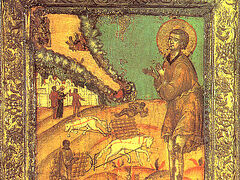
 Righteous James of Borovichi. A nineteenth century icon. Novgorod Let us also mention the Righteous Artemius of Verkola (feasts: June 23 and October 20). He lived in the sixteenth century in a remote village in what is now the Arkhangelsk region, was kind and loved prayer. The boy died in the field from a lightning strike, and the peasants decided that he had been punished for his sins. Therefore, the villagers did not bury him, only covered the boy’s body with birch-bark. Thirty years later, St. Artemius’ body was found incorrupt, and healings from diseases occurred from his relics. The villagers realized that these were the relics of a holy boy.
Among the holy children are not only peasants, but also offspring of royal bloodlines.
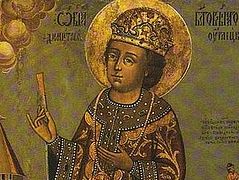
On October 19, 1582, Tsar Ivan IV the Terrible’s youngest son, Tsarevich Dimitry (feasts: May 15 and June 3), was born. When in 1584 Tsar Ivan died and his eldest surviving son Fyodor Ivanovich ascended the throne (1584-1598), the prince’s advisers and guardians sent the young Dimitry, along with his mother, to the city of Uglich (now a picturesque town in the Yaroslavl region), fearing that Dimitry’s relatives might use his name and overthrow Fyodor. According to a popular (but still not confirmed) version, the future Tsar Boris Godunov (1598–1605) decided to eliminate a young rival from his path and sent assassins to Uglich. On May 15, 1591, according to the same version, they stabbed the eight-year-old Dimitry to death in the courtyard of the palace in Uglich and then were torn to pieces by the crowd. Tsarevich Dimitry was buried in the palace Church of the Transfiguration of the Lord in Uglich. There are many healings from various diseases at his tomb, especially from eye diseases.
Subsequently, Tsarevich Dimitry’s name was used by various impostors who passed themselves off as the “miraculously survived Prince Dimitry Ivanovich”, which effectively caused the beginning of the Time of Troubles in the early seventeenth century. To prove that the False Dimitry I (ruled from 1605 to 1606) was an impostor, the new Tsar Vasily Shuisky (1606–1610) ordered Tsarevich Dimitry’s relics to be transferred from Uglich to Moscow. On June 3, 1606, the holy passion-bearer’s relics were found absolutely intact. They are kept at the Cathedral of the Archangel Michael of the Moscow Kremlin to this day.
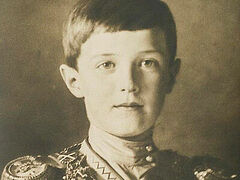
 Tsarevich Dimitry of Uglich Among the holy children who intercede for us in the Heavenly mansions is the holy Passion-Bearer Tsarevich Alexei Romanov. The heir to the Russian Imperial throne was born on August 12, 1904. He became the family’s favorite. Everyone noted the boy’s generosity, kindness and sensitivity. One of his tutors said: “There is not a single vicious trait in the soul of this child. His soul is the most fertile breeding ground for all good seeds.” St. Alexei loved people and tried to help them. He used to say: “When I become the Tsar, there will be no poor and unhappy people. I want everyone to be happy.”
Shortly after his birth, he was diagnosed with an incurable hereditary disease, hemophilia, which constantly threatened his life. In 1912, the Tsarevich’s condition worsened so much that the doctors predicted his death. But Tsar Nicholas II, when asked about his son’s health, would reply humbly, “We trust in God.” The Tsarevich and the Grand Duchesses were simple and approachable with others, because they themselves were brought up simply and strictly. The Royal Family loved Russia very much and could not imagine living abroad. Their closest servants recalled, “To this day, we have not seen such a noble, compassionate, loving and righteous family and will probably never see such a one again.”
On the night of July 16–17, 1918, the Imperial Family was brutally murdered in Ekaterinburg. By Divine Providence, the holy Royal Martyrs were taken from this earthly life together as a reward for their boundless mutual love, which had firmly bound them into one inseparable whole.
The holy children left our world early, in most cases dying a martyr’s death. They have already matured in the spiritual realm, becoming wiser than any of us living today.