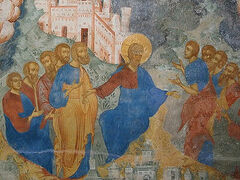
The Sermon on the Mount. Artist: Vladimir Makovsky, 1892
More Than Nine
Once an Orthodox Christian begins studying the Law of God, sooner or later each one stops before the majestic beginning of the Sermon on the Mount. Blessed are the poor in spirit… Blessed are they that mourn… (Mt. 5:3, 4)—these words sound like a ladder leading from the earthly to the Heavenly. St. John Chrysostom described the Beatitudes as a “golden chain” of virtues. It is generally accepted that there are exactly nine Beatitudes. However, a careful reading of the Gospel shows that Christ pronounces the word “blessed” much more often, and in very different circumstances.
The question arises: how many Gospel Beatitudes are there, and why aren’t they all included in the Sermon on the Mount?
The First Surprise: Matthew and Luke
Even in the parallel passages of the Gospels, the number of Beatitudes varies. The Gospel of Matthew has nine of them (Mt. 5:3–12), whereas there are only four of them in the so-called “Sermon in the Plain” in the Gospel of Luke, and they are formulated differently (Lk. 6:20–23). Exegists explain this difference by the purposes of the Evangelists. The Apostle Matthew, who wrote for Jewish Christians, shows Christ as the new Moses, the great Lawgiver, and gives a complete, systematic set of spiritual laws of the Kingdom of God—the nine steps. The Apostle Luke, addressing pagan Christians, emphasizes the practical, social aspect of the teaching: woe to the rich, blessed are the poor in spirit, etc. But the Lord also used the word “blessed” on other occasions, outside of both Sermons.
The Other Beatitudes: A Treasure Scattered through the Gospels
There are a number of sayings in the Gospel where Christ calls people “blessed” for specific spiritual states not listed in the Sermon on the Mount. They are as follows:
1. Blessed is he, whosoever shall not be offended in Me (Mt. 11:6). It is about the blessedness of firm faith that does not waver at the sight of Christ’s humiliation or the difficulties of the path of salvation. It is not included in the Sermon on the Mount, because there the Lord taught the general principles of morality, but here He addresses the specific doubt of St. John the Baptist (Mt. 11:2–3).
2. But blessed are your eyes, for they see: and your ears, for they hear (Mt. 13:16). This is the blessedness of being able to receive revelation spiritually. Not everyone who listens hears, and not everyone who looks sees. The Lord calls the disciples “blessed” for becoming worthy to know the mysteries of the Heavenly Kingdom. To know in the Biblical context means not only to perceive some theoretical information, but also to experience and partake of what is Known, graciously accept It into your heart, and love it with all your being.
3. Blessed are they that have not seen, and yet have believed (Jn. 20:29). These words were spoken after the Resurrection of Christ to the Apostle Thomas. This Beatitude is addressed to those who live after the Ascension of the Savior and have not seen Him with their physical eyes, but believe in Him no less strongly than those who saw Him. There is no such Beatitude in the Sermon on the Mount, since the event of the Resurrection and Thomas’ doubt about it had not yet occurred.
4. Blessed is the womb that bare Thee, and the paps which Thou hast sucked (Lk. 11:27). A woman from the crowd exclaimed this, admiring the Mother of the Lord. Christ does not reject these words, but raises His disciples to a higher level: Blessed are they that hear the Word of God, and keep it (Lk. 11:28). Here it is not the relation by blood that is praised, but obedience to God. Obedience begins with listening to God’s commandments attentively and ends with their practical fulfillment.
In addition to the Gospels, a similar saying is found in the Revelation: Blessed are they that do His commandments (Rev. 22:14). This is a repetition of the previous Beatitude of Christ, pronounced, however, on behalf of the Church of the end times. This gives the Beatitude a prophetic and Apocalyptic sound of promise.
Why Weren’t They Included in the Sermon on the Mount? The Fathers’ Explanation
If Christ is God and taught the fullness of truth, why didn’t He include all these Beatitudes in the Sermon on the Mount? St. John Chrysostom1 and Blessed Theophylact of Ochrid2 give a clear answer to this question.
Firstly: the Sermon on the Mount is not just a collection of individual sayings, but a complete masterpiece of moral teaching. Each of the nine Beatitudes is a step growing out of the previous one: Spiritual poverty gives rise to mourning, mourning to meekness, meekness to righteousness, and so on. This is a ladder that cannot be shortened or supplemented with new elements without destroying its harmony.
Secondly: elsewhere in the Gospel, the Lord does not act as the Lawgiver on Mt. Sinai, but as a Shepherd and Teacher Who applies the general law to particular cases. Blessed are they that have not seen, and yet have believed is not a new, eleventh commandment, but a pastoral consolation and encouragement for all the future generations of Christians, a practical application of the nine Beatitudes to a specific historical situation.
Thirdly: according to St. Gregory of Nyssa,3 the teaching of Christ is one whole. The Sermon on the Mount can be compared to the sun, and the other Beatitudes to the radiance of the sun in different facets of life. In one case is praised faithfulness in doubt, in another purity of the eyes that see the mysteries of the Kingdom.
Why Are the Beatitudes “Scattered” through the Gospels? The Main Mystery
There is also a deeper, theological answer to the question of why the word “blessed” can be found in different chapters, and not just in the Sermon on the Mount. The Beatitudes are not just moral rules or a ladder of virtues. They are the main unifying theme of the entire Gospel, its leitmotif. Christ did not come to earth to give yet another code of laws, but to bring Bliss itself—fullness of joy, peace and life with God. Christ Himself is Bliss incarnate.
The Beatitudes are “scattered” throughout the Gospel because the whole life of the Lord Jesus Christ—from the Nativity to the Ascension—is the revelation of blessedness. His every word, every action, every miracle, and every contact with the sick or sinners radiates the blissful Divine life that He brought into the world. Therefore, it is no coincidence that the Sermon on the Mount, His parables, conversations with the Pharisees and the consolation of the Apostle Thomas are permeated with the same good tidings: “Blessed…” The Lord does not tire of convincing people: blessedness is real and possible here and now, because He is always with us by grace.
St. Gregory Palamas4 teaches that the uncreated energies of God, which make Christians partakers of the Divine nature (cf. 2 Pet. 1:4), are the same grace that transforms believers. It is this grace, granted by Christ, that is true bliss. The Beatitudes are not a prerequisite in order for God to love us. They are a description of the state that we enter when we unite with Christ. And since Christ is present in every Gospel event, the word “blessed” naturally sounds throughout the New Testament.
If the Lord had confined Himself to just listing the Beatitudes in the Sermon on the Mount, we might have thought that bliss was some distant ideal attained by great efforts at the end of the Christian path. However, by “scattering” the Beatitudes throughout the path of His earthly ministry, Christ shows us that it is not the case. Bliss is not somewhere far away—it is already here and now. Bliss is Christ Himself, His Divine grace. It is easy to attain bliss: it is enough to meet Christ personally, believe in Him, enter His Church and receive His grace in It here and now. The Lord is only waiting to make us blissful: Behold, I stand at the door, and knock: if any man hear My voice, and open the door, I will come in to him, and will sup with him, and he with Me (Rev. 3:20).
Bliss in Christ
The Gospel is not a legal code where each commandment is numbered and strictly fixed in its specific place. It is the living voice of Christ, which is heard in the Sermon on the Mount, in the conversation with St. Thomas, in His answer to the unknown woman in the crowd, and in the final book of the Scriptures. The fact that the Lord pronounced the word “blessed” many times and in different circumstances testifies to the inexhaustibility of the love of God and that bliss is not hidden in the distant future—it has already been given to us in Christ, and in the Church as His Body.
All the Beatitudes do not just enumerate the rules, but open the path to Christ. The bliss that permeates the Gospel does not point to an abstract ideal, but to a living Person Who is the Way, the Truth, and the Life (cf. Jn. 14:6).
Therefore, Orthodox Christians do not seek bliss in a lifeless list of prescriptions, but in personal communion with the Savior, in the Church sacraments, in prayer, and in the faithful fulfillment of works of love. The life in Christ is one continuous bliss—sometimes hidden under the cross of earthly suffering, but bearing within itself a foretaste of the life of the age to come.