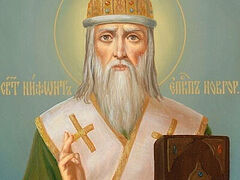
On June 12/25, the Russian Orthodox Church honors the memory of St. Arseny of Konevets (†1447).
 St. Arseny of Konevets In the second half of the fourteenth century, a boy was born in Veliky Novgorod into the family of a coppersmith and named Arseny. From a young age his father taught his son all the wisdom of smithing. Already in adolescence Arseny, hardworking and responsible, surpassed his father in this difficult trade. The young man worked a lot, as hard physical labor did not trouble him at all. He distributed some of the money he earned for his work as alms to the poor.
However, Arseny’s soul longed for something else: from childhood his devout parents taught their son to pray, fast, attend church, read the Holy Scriptures, and do good works. Therefore, soon St. Arseny went to the Lisitsky Monastery1 near Veliky Novgorod and took monastic vows with the same name Arseny. There the young and robust monk performed physically difficult obediences, devoting a lot of time to prayer. The saint lived at this monastery for eleven years, but he did not find a spiritual father among its brethren. And St. Arseny made a difficult decision: to go to Holy Mount Athos. The fact that the Lisitsky Monastery had contacts with the Athonite monasteries helped him realize his dream. The abbot of the Lisitsky Monastery, with whom St. Arseny shared his desire, replied to him:
“I bless you for this good undertaking. You will go there with the Athonite elders who came to visit Novgorod and are now going to travel back.”
The abbot loved St. Arseny, because he was kind, humble, meek and industrious, but he understood that the God-loving young monk should see the traditions and life of the Athonite monasteries.
Soon the monk arrived on Mt. Athos and began to live at the Russian St. Panteleimon’s Monastery. Abbot John became his spiritual father there. St. Arseny again labored hard physically—in the kitchen and in the bakery—learning obedience, humility, and unceasing prayer. After a while, the Lord granted the diligent and humble monk the gift of compunction and grace-filled tears. There, on Mt. Athos, St. Arseny’s smithing skills came in handy. He made church utensils and agricultural tools for the monastery. St. Arseny’s fame as a skilled smith soon spread throughout Holy Mount Athos and beyond, and people from all the Athonite monasteries began to come to him with requests to make something.
The saint resolved to leave St. Panteleimon’s Monastery and become a wandering monk on Mt. Athos. For three years he lived in many monasteries of the Holy Mountain, working as a smith and receiving the blessing of many Athonite elders—not money or food.
All this time, a new dream was maturing in St. Arseny’s soul: to return to his motherland and build a monastery for his prayerful life somewhere in a deserted spot beyond Novgorod. And he left a good memory of himself on Mt. Athos.
Monk Arseny came to the Abbot of the Russian St. Panteleimon’s Monastery John and shared his plans with him.
Abbot John replied to the ascetic:
“I am happy to bless you for this difficult feat. With the name of the Lord, you will overcome everything. Go back to Russia.”
 Russian St. Panteleimon’s Monastery on Mt. Athos
St. Arseny visited all the Athonite monasteries for the last time and took the blessing of the elders, asking them for their holy prayers for him and his future labors. All the Athonite elders blessed St. Arseny and promised to pray for him fervently.
Before his departure, St. Arseny told Abbot John:
“May the monastery, which, with God’s help, I want to set up in my homeland, be built according to the precepts of Athonite monasticism?”
Abbot John blessed one of his closest spiritual disciples with an icon of the Mother of God. St. Arseny venerated this icon with reverence and carefully accepted it from the abbot’s hands. Subsequently, this icon became the main relic of the monastery founded by St. Arseny and was named the Konevets Icon of the Mother of God.2
Monk Arseny returned to his native city of Veliky Novgorod. He immediately turned to the Archbishop of Novgorod and asked for his blessing for the construction of a new monastery. The archbishop was surprised by his request and told Arseny:
“But you are still too young, you have no experience of living in the desert, and you have no disciples to help you set up a new monastery.”
St. Arseny replied to the hierarch:
“Your Eminence, you are right—I don’t have all that. But I do have the blessing of the elders of Holy Mount Athos and their prayers for the construction of the new monastery.”
And St. Arseny told the archbishop about his three-year stay on Mt. Athos. After that, Vladyka blessed St. Arseny to found a new monastery. He wondered where St. Arseny wanted to establish it, and the monk replied, “Like many other Russian monks, with God’s help, I would like to build a monastery on an island on Lake Ladoga.”
The archbishop helped St. Arseny gather everything necessary for his long voyage and found him helpers to build a monastery together with the saint.
After some time, the monk and his companions arrived in a boat at Konevets Island.3 They stopped there because of heavy rain and a tempest, after which St. Arseny told his companions, “Now let’s go further north and find a more inaccessible island.”
They set off again, but a violent wind turned their boat back southwards. And once again, Konevets Island was on their way, and as they approached it, everyone in the boat heard a bell ringing that could not have been on the island. Then St. Arseny told his companions, “It’s Divine Providence. The Most Holy Theotokos Herself wants us to stay here.”
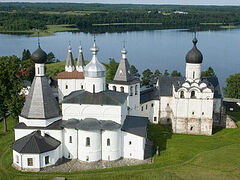
 The Konevets Monastery of the Nativity of the Theotokos
Monk Arseny and his companions started exploring the island. They erected a cross on the hill and built a dwelling.
Soon St. Arseny’s companions went back, and the ascetic lived here alone for a year, spending all his time in prayer.
The Archbishop of Novgorod sent to Konevets Island everything necessary for the construction and maintenance of the monastery—everything for church worship, food, and building materials.
For some time, Monk Arseny stayed on the island on his own, gradually getting acquainted with the locals, who were pagans. They appeared there mostly in the summer and grazed their herds of horses. One day, Philip, a fisherman who made friends with St. Arseny, led the monk to a massive “sacred stone”,4 by which the locals sacrificed domestic animals, commonly horses, to pagan gods. That’s why the island was named Konevets (the Russian word “kon’” means “horse”). After numerous conversations with St. Arseny, Philip realized that paganism is dangerous for the human soul. He requested of the saint, “Let’s clear our island of this place of idol worship.”
Arseny gladly supported his new friend. At first, he prayed for a long time, then took the icon of the Mother of God, which Abbot John had given him on Mt. Athos, and performed a prayer service at the site where sacrifices were offered. From that time on, there were no more pagan sacrifices there.
The local inhabitants expected that their gods would punish St. Arseny for this. But he continued to live happily; and the crows, which had lived at the former pagan site to feast on horsemeat constantly sacrificed to idols, gathered in a flock and flew north with a loud cawing. In 1393, St. Arseny built a chapel on this site.
The monastic community on Konevets Island, which St. Arseny had built, gradually grew, and in 1398 Archbishop John of Novgorod blessed the establishment of a cenobitic monastery in honor of the Nativity of the Most Holy Theotokos there. Pilgrims flocked to it from everywhere. St. Arseny welcomed everyone with a meal and comforting conversation. He was no longer alone—other monks had joined him. St. Arseny became its first abbot: he introduced strict discipline in the monastery, and eating was allowed only in the common refectory.
 St. Arseny of Konevets The saint made another journey to Mt. Athos, as he did not want to lose the living bond with the elders of the Holy Mountain and asked for their prayers and blessing for the new monastery. While he was away, the Konevets monks, experiencing severe hardships and hunger, were about to leave the island. Then the Most Holy Theotokos appeared to Elder John in a vision and said, “Tell the brethren that Arseny will bring many kinds of food to them soon.”
And, indeed, soon the saint brought provisions and everything that was needed to equip the monastery. The loaded ships approached the island directly.
In 1421, Konevets suffered a major flood. The water even flooded the monks’ cells, so that the brethren found themselves knee-deep in the water. St. Arseny prayed to the Queen of Heaven for a long time and in a dream saw his friend Philip the fisherman helping him erect a barrier wall around the monastery.
The next day, after asking Philip where he had been the day before, the man of God learned that Philip had already begun the construction of a dam around the monastery. Thus it was miraculously revealed to St. Arseny what his friend was doing and what his monks needed to do quickly to escape the flood. And the brethren built new claustral structures, new cells, and a new Church of the Nativity of the Theotokos on an elevated place on the island.
In 1446, St. Euthymius II, Archbishop of Novgorod and Wonderworker (1429–1458; feast: March 11/24), visited the Konevets Monastery and presented St. Arseny with a klobouk (a stiff, cylindrical head covering with a black veil for the monastics and bishops).
On June 12/25, 1447, St. Arseny fell asleep in the Lord, reaching a ripe old age.
The Konevets Monastery of the Nativity of the Mother of God, founded and organized by him, continues to live according to the strict rule of the Athonite monasteries.
In the sixteenth century, the Life of the Venerable Arseny was written by Varlaam, Abbot of the Konevets Monastery. His holy relics rest at the lower Church of the Meeting of the Lord of the monastery’s Cathedral of the Nativity of the Theotokos.