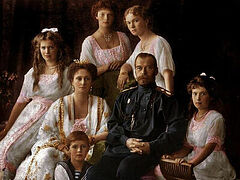
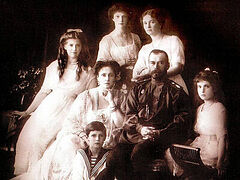
The First World War, turmoil and the Revolution, the fall of old Russia, the collapse of age–old foundations, civil bloodshed, the path of martyrdom of the Church and millions of Russian people, and the tragic death of the Family of the last Russian Emperor are topics that continue to attract interest. Historians, political analysts, writers and cinematographers over and again turn to various aspects of that troubled period in the history of Russia. The debate rages on, and efforts to uncover the truth continue.
One writer who has tackled this complicated subject is Sergei Sergeyevich Kozlov from Tyumen, a laureate of the Patriarchal Literary Prize, who recently turned sixty. We are beginning our talk about creative work, a writer’s responsibility, and the novel, The Romanovs: Loyalty and Betrayal, which has gone through several printings. Our conversation is also interesting because this work formed the basis for the script of the TV series of the same name and a feature film, which is being released in cinemas across Russia this year.
 Sergei Kozlov, laureate of the Patriarchal Literary Prize and author —Your book, The Romanovs: Loyalty and Betrayal, is quite voluminous. For whom was it created? How did you view your reader? Whom did you address? And who did you particularly want to be heard by?
—It is for everyone. My co-author and chief editor Dmitry Mizgulin literally hung on my arm. “We should make the book interesting for everyone. Do less of your intellectual bells and whistles; the language should be understandable to both a professor and a housekeeper,” he said. And our historical consultant, the brilliant historian and archivist Vladimir Khrustalev, was responsible for the realism. He has been studying the history of the Romanov family for over fifty years, and “held back” my fantasy and imaginative thinking.
Yes, I really want the younger generation to discover the book so that they can get a picture of the dramatic history of our Motherland in their minds, see the movements of secret forces, and understand the true meaning and price of faithfulness and betrayal. The main thing that they should understand is this: the great truth of Fyodor Dostoevsky, who experienced the transformation from the path of a revolutionary to that of a Christian writer and literally walked it with a Gospel in his hands.
 The Romanovs: Loyalty and Betrayal, a book by Sergei Kozlov. Komsomolskaya Pravda Publishing House, 2021. Photo: chitai-gorod.ru The saddest thing is that in 1991, in the much-suffering Soviet Union, soaked in the blood of millions, betrayal was repeated exactly according to the same pattern… One move of a complex master plan took down a great empire. Why? Because it had been built without God. Some will argue: “But in 1917, the empire was Orthodox.” I agree, but with a few reservations: the empire, through its direct betrayal and indifference, abandoned the Imperial Family (to which it had sworn an oath of allegiance) to suffering, and even some hierarchs of the Church supported the mad spirit of the Revolution. Subsequently, many of them were destined to become confessors and martyrs… But late repentance is better than no repentance at all (and Judas’ tree). And then our “blue blood” wrote tearful memoirs about the Russia we had lost.
Russian history is a sad confirmation of the popular wisdom that the road to hell is paved with good intentions and that you never know what you have until it’s gone…
And a little more about the book. Attentive and discerning readers will see dozens of so-called “coincidences” in it. Such combinations of circumstances, names, and titles inevitably make you think about how well thought-out the whole action is. But all these figures are ridiculous in the face of Eternity, because they leave God out of their plans.

And we all need to look out the window more often; or if we look at the TV or computer screen, we should try to discern which angel of the Apocalypse is sounding his trumpet instead of rushing forward with naive idiotic delight about technological progress and artificial intelligence into yet another abyss of hell…
And it should be kept in mind that the book of Revelation by St. John the Theologian is the most optimistic book… And I hope that the book, The Romanovs: Loyalty and Betrayal, is an interesting book—a hope that has so far been confirmed by readers’ interest in it. And together with the film, they complement each other.
***
Since the novel is the nucleus of the screenplays of two new films (a TV series and a feature film), our talk will be incomplete if we don’t ask the author some questions on the project’s concept, and its producer, Oleg Alexandrovich Urushev:
 The producer Oleg Alexandrovich Urushev. Photo: Pskov.kp.ru —Oleg Alexandrovich, since it is a complicated subject, we can expect a wave of criticism from different sides, and not only from people who have a traditionally negative attitude towards St. Nicholas II and the “tsarist regime”. Everything is clear here in advance. What motivated you personally to make the film, The Romanovs: Loyalty and Betrayal?
—The novel of the same name by the writer Sergei Kozlov from Tyumen has already become a bestseller with a circulation of 30,000. The Komsomolskaya Pravda publishing house has printed 10,000 copies (a film tie-in edition) for the film release. The literary basis of the novel is the script of a twelve-episode film series.
The feature film script (120 minutes) was made as well. Its plot covers the period from 1912 to 1918: the First World War, the February Revolution, exile to Tobolsk, and the brutal murder of the entire Royal Family and people close to them by the Bolsheviks in Ekaterinburg on July 17, 1918.
Being immersed in the imperial theme, I am outraged by the unfair underestimation of the role of Nicholas II. Unfortunately, the film director Andrei Konchalovsky (quite recently) did not avoid this either in The Chronicles of the Russian Revolution. Everything is quite primitive in his TV series; the Tsar is a “weakling”, Lenin is a “schizophrenic”, and so forth. Communists always strove to justify their terror by the “weakness of Russia and the Tsar”. But both the French and the British did an enormous job in demonizing Nicholas II’s image, justifying their betrayal and whitewashing the selfish treachery of King George V, the Emperor’s cousin.
 A still from the film, The Romanovs: Loyalty and Betrayal
Soviet historians simply slandered the last Russian Emperor. Russian Railways builds about 200 miles of railways per year in Russia today, while over 300 miles were built annually under Nicholas II! He actually united a huge country from Vladivostok to St. Petersburg into a single whole! Nicholas II was the founder of the Russian submarine fleet and Russian military aviation, which required the advancement of engineering. Under him, the first plans for the construction of the underground railway and the state electrification plan appeared. Don’t forget that at that time, Russia was the world’s largest wheat-producing country, a record that we brought back to Russia only under Putin! There was the a very high level of education in rural areas. Nicholas II was the most democratic of the Romanovs; the State Duma was created by him as the first elected Parliament. And there are plenty of such examples! As for the historical perspective on Nicholas II, Metropolitan Tikhon’s (Shevkunov’s) position resonates with me. He outlined it in detail in his book and film, The Fall of an Empire: The Lesson of Russia. And many forget that Nicholas II ascended the throne at the age of twenty-six and ruled for twenty-seven years!1 A weak Tsar would not have reigned so long in Russia.
We position our film as a warning. It is no coincidence that there are two words in the title that stand side by side: “loyalty” and “betrayal”. Of the twenty-five generals, only two did not betray the Emperor—Hussein Khan of Nakhichevan and Count Fyodor Keller. Twenty-three generals broke their oath!!! Of course, ten days later, many regretted it, but it was too late… That’s why we want to convey a message to modern viewers: Very much (both then and now) depends on loyalty in the country. But the most important point is that it is never possible for anyone to build happiness on blood and betrayal. And even more so on the blood of children. Paradoxically, many streets in Russian cities still bear the names of Bolshevik murderers. There are streets named after the “bloody stoker” Pavel Khokhryakov in Tobolsk, Perm and Ekaterinburg.2
 A still from the film, The Romanovs: Loyalty and Betrayal
—When you started and continued work on the film, you sought the blessing, help and advice of the clergy and hierarchs of the Russian Orthodox Church. Please tell us more about it.
—Our main historical consultant is the historian and archivist Vladimir Khrustalev. Under his editorship, all the letters of St. Nicholas II, Tsarina Alexandra Feodorovna and Grand Duke Mikhail were published. Among our consultants are also Metropolitan Evgeny of Ekaterinburg and Verkhoturye; Hieromonk Ignaty from the Moscow Sretensky Monastery, the initiator and inspirer of numerous projects dedicated to the Romanov family; Svetlana Sidorova, Director of the museum complex in Tyumen; and Olga Taratynova, director of the Tsarskoye Selo complex.
Our project was supported by five metropolitans: Metropolitan Evgeny of Ekaterinburg and Verkhoturye, Metropolitan Varsonofy of St. Petersburg and Ladoga, Metropolitan Dimitry of Tobolsk and Tyumen, Metropolitan Methodius of Perm and Kungur, and Metropolitan Pavel of Khanty-Mansiysk and Surgut.
We take a very careful approach to historical documents. We shot in historical locations: the Tobolsk Kremlin, the Peter and Paul Fortress in St. Petersburg, the Alexander Palace near Tsarskoye Selo, the Ekaterina Park and the Cameron Gallery within the Tsarskoye Selo Memorial Estate, and the Museum of the Family of Emperor Nicholas II in Tobolsk, where the Royal Family spent their final nine months of exile. As Tobolsk residents note, “our city tried to save the Romanov family.”
 At the shooting area
—What is the fundamental difference between the TV version (the series) and the feature film that is gearing up for release?
—The film is a biopic, a 120–minute family story, which is to be released in cinemas across the country on September 24, 2026; and the twelve-episode film series is a historical detective story, including the attempt by Russian officers to save the Royal Family in Tobolsk. The TV series will be broadcast by Russia’s Channel One after the main evening news broadcast.
The family of Nicholas II was canonized by the Russian Orthodox Church as Holy Passion-bearers. We approach this moment very carefully. But, of course, there are some temporary digressions in the film. At the same time, it should be noted that the study of history does not stand still—new documents are being published.
The plotline of the series is built around the theme of work by intelligence services. Indeed, at that time the UK special services killed several very influential pacifists in Europe who had prevented the outbreak of war between Russia and Germany. Britain needed a war that would weaken both countries, making the UK a winner again. The confrontation between the UK, French, and Russian intelligence services was very intense—and this is also shown in our film.
 A still from the film, The Romanovs: Loyalty and Betrayal
—But there may be criticism regarding the similarity or dissimilarity of actors playing the roles of historical figures; it is almost inevitable, no matter who tackles this topic and the historical period, and how.
—The director of our film is Vasily Chiginsky. He once shot a wonderful short film, “Attack of the Dead: Osovets,” which was viewed over 20 million times online. He also directed such films as: Lev Yashin. The Dream Goalkeeper; Hero 115; The First after God; etc.
We have a star-studded cast. We were aiming for historical similarities, but we don’t run a lookalike show!
With the blessing of Archimandrite Alexei (Vylezhanin), the wonderful actor Vitaly Kischenko plays the role of St. Nicholas II; Hieromonk Alexander (Serpeninov) blessed Sergei Tezov to star as the court physician St. Eugene Botkin; Denis Propalov, who received the blessing of Archpriest Alexei Rokhmanov, was approved for the role of Tsarevich Alexei; Xenia Kutepova stars as Tsarina Alexandra Feodorovna. The film features Sergei Stepanchenko, Dmitry Dyuzhev, Ivan Kolesnikov, Ekaterina Guseva, Dmitry Mulyar, Vladimir Almazov, Yuri Kuznetsov-Tayozhny and other famous actors.
 A still from the film, The Romanovs: Loyalty and Betrayal Our main partners include the Cinema Fund, Channel One, and the SIBUR integrated petrochemical company. The film is being shot with the support of the government of the Tyumen region and of Governor Alexander Moor personally, along with the Perm Film Commission. The film’s distributor is Nashe Kino. We collaborated with many of our partners on the film “Tobol”. In Tobolsk, where it was shot, the tourist influx has increased many times over! The new film was shot in the cities of the All-Russian Imperial Route. I am certain that there will be far more tourists after the premiere of This film.
—Who would you recommend to watch your film first?
—Our film is for the whole family! We hope to get a “12+ rating”. We managed to make the shooting scene symbolical and figurative, without blood.
This is a film about the great love of Sts. Nicholas and Alexandra and other members of the Romanov family.
Viewers will learn the truth about the murder of the Family of the Russian Emperor Nicholas II, and why the Serbian Orthodox Church canonized him and his family back in 1938.
***