Have you ever been to St. Petersburg? I lived there for the first twenty years of my life and I adore that city. A proud handsome city which tamed the treacherous Neva River with granite. It’s so beautiful that it takes your breath away! Granite embankments are a monumental feat of engineering. Anyone who knows the history of the city’s construction will understand what I mean. Try to build something on a swampy and marshy land! The embankments of the central part of the city are especially admirable. The Neva Embankment on the Spit of the Basil (Vasilievsky) Island is a world-acclaimed masterpiece. One of those who built these magnificent structures was the young Baron Ferdinand Ivanovich Taube (1805–1870), who had just graduated from the Institute of the Corps of Railway Engineers. No, he is not the hero of my story—his grandfather is. I just want readers to understand the significance of the pedigree of St. Agapit. He is a fruit of the union of two glorious families.
 Ferdinand Ivanovich married Elizaveta Ivanovna Vashutina (1827–1893).1 Her father was Major General of Artillery Ivan Ivanovich Vashutin (1791–1837), a Russian military commander who received the Order of St. George, 4th class. This award, the Imperial Military Order of Greatmartyr George the Victorious, was the highest military award of the Russian Empire. Only 10,000 people were awarded it in the Russian Empire. Not so many, considering that the population of the Russian Empire, according to the 1897 census, was about 125 million. The Order was abolished in 1917 and was not restored until 2000. Its ribbon—the St. George ribbon—is now symbol of Russian Victory.
Seven children were born in the family of Ferdinand Ivanovich and Elizaveta Ivanovna. One of them was Mikhail, the father of the future New Confessor Agapit. Mikhail Ferdinandovich graduated from the Institute of Railway Engineers. It was his father’s alma mater, which had slightly changed its name. Mikhail Ferdinandovich initially followed in his father’s footsteps. Ferdinand Ivanovich built the embankments of the Neva River, and Mikhail Ferdinandovich conducted technical surveys for the construction of railways. He was a professor of mathematics, a theorist of neo-Slavophilism and the author of works on problems of philosophy, logic, theory of knowledge (epistemology), religion, and the history of Russian original thought. An active member of the monarchist Black Hundred Movement, he married Anna Alexandrovna Baranova and they had five children. The fourth and youngest son was Mikhail; and now we have reached the subject of my narrative.
The future St. Agapit was born into a noble family on November 4/16, 1894. On November 21, the Holy Church celebrates the Synaxis of the Archangel Michael and the Other Heavenly Bodiless Powers. Obviously, this is why the newborn was baptized with the name Mikhail, combining in this name both a tribute to his father, also Mikhail, and hope for the protection of the Archangel Michael.
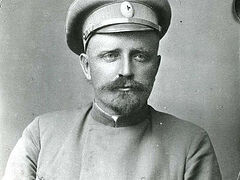
Young Baron Mikhail Taube was a very gifted boy. He had an exceptional aptitude for science. He was fluent in French, German, English, Italian and Latin. He graduated from classical school with honors and entered St. Petersburg University (Department of Law). However, the First World War prevented him from finishing his studies. Mikhail was then in his third year. He enrolled in artillery courses (let’s recall his great-grandfather, General Vashutin), and after these courses he received the rank of officer and went to the front. He fought for a year and a half. In the summer of 1917, he was seriously wounded and hospitalized in St. Petersburg, which had been renamed Petrograd. Mikhail regarded that turn of life as an opportunity to continue his education at the university and applied for admission as an auditor. On November 14, 1918, Baron Taube was enrolled as a student. But he never managed to finish his studies—exactly three months later, on February 14, 1919, he was drafted into the Red Army.
At first, Mikhail was given desk jobs: inspector of the Commissariat of Supply, head of communications, staff adjutant, or clerk. But soon he was sent into battles. And he couldn’t avoid a moral tragedy there. Near Narva, Mikhail had to fight against Yudenich’s army, where his older brother fought…
After the Civil War, Mikhail entered the Petrograd Theological Institute. But even there he was not destined to complete his education—the institute was closed in 1923.
Mikhail went to Optina Monastery, which was officially closed. Even the “agricultural artel,” under the guise of which monastic life had simmered from 1918 to 1923, didn’t function anymore. But there was the Optina Monastery Museum, managed by Lydia Vasilyevna Zashchuk. We know her as the holy New Martyr Augusta and commemorate her on January 8. Schema-Abbess Augusta, a hereditary noblewoman and the keeper of all that had been saved from looting and destruction in Optina, was arrested in a group case against the former monastery in 1937 and shot the day after the Nativity of Christ 1938. It was she who invited Mikhail Taube to Optina, where he became the head monastery librarian.
Mikhail had access to all the treasures of Patristic literature amassed by the holy monastery for over half a century. He set about studying these treasures vigorously. His official duties included sorting and cataloging. He didn’t just sort books: he read and studied them. The depth of his study of Patristic literature was used in another duty as head librarian—to hold guided tours around the museum for visitors. Those who came on these tours never left indifferent. Gifted by nature, a great intellectual, well-read in Patristic literature and practically imbued with it, Baron Taube spread a living, fervent faith in Christ among the people the Lord sent him in his work.
 Baron Mikhail Taube Even Ushakov, the Secretary of the People’s Commissariat for Education, could not resist. He wrote in his report: “I spent two hours with him… His stories about the meaning of one or another ancient book, painting, or other thing are such that when you leave the museum you cannot help but say, ‘How much Religion has done for culture and how sad it is that it is now being suppressed.’” After such a report, Ushakov himself could have been arrested, so he added at the end of the document: “Can someone who is on close terms with monks and does not miss a single church service be the museum curator? It seems that it would be more profitable and more useful to have an unlearned specialist than such an ‘overly learned’ one.”
Not only dis his studies of Patristic literary treasures serve as a powerful catalyst for Mikhail Taube’s spiritual growth and development, but also his personal communication with the bearers of Gospel values. In Optina, Mikhail became a spiritual son of St. Nectarius (Tikhonov; 1853–1928; commemorated May 12) of Optina; and after the elder had been exiled, St. Nikon (Belyaev; 1888–1931; feast: July 8) of Optina took over the young man’s spiritual guidance. It was St. Nikon who tonsured Baron Mikhail Taube a monk with the name Agapit.
In 1925, a new director was sent to the museum who did everything to ensure that Monk Agapit was fired. The museum “was known among the authorities and the population as a relic of the surviving old monastic traditions,” Comrade Karpova wrote to the right people, and, in her opinion, Monk Agapit was to blame for this. Well, from the atheist perspective, she was absolutely right…
The dismissal not only drove Fr. Agapit from his beloved monastery, but also left him without means of subsistence. Now the monk earned his living by teaching foreign languages; fortunately, he knew as many as five of them.
Fr. Agapit, apparently, did not leave Optina for a long time and tried to visit the holy monastery as often as possible. We know from the Lives of other new Martyrs that some of the monks moved to live in apartments in Kozelsk—perhaps Monk Agapit was among them. His Life tells us that he lived in his birthplace, then in Petrograd, and then near Optina. There are mentions of him in reports of the inspectors of the closed monastery, written after his dismissal from the post of head librarian.
Surprisingly, it is from these documents (memos, reports) that we learn the details of the outward appearance and the inner state of the future new confessor. In these reports, we see an ascetic and a man of prayer. Knowing his plight, people would invite him to the table, trying to help him financially; but Fr. Agapit refused food and money. He always stopped in front of a church or chapel, even after they had been desecrated and turned into objects explicitly meant to insult or negate their original purpose, prayed for a long time and made the sign of the cross.
“He was consistently even-mannered and polite, never got annoyed or complained about anything, and generally avoiding talking about himself. Even those who did not know about his tonsure believed he was a monk.” (Fr. Agapit wore plain clothes, as he had to blend in with the crowd, but his firm monastic spirit apparently manifested itself even through non-monastic clothes.) Whenever he heard blasphemous statements, he shuddered with his whole being, and it was clearly visible. People who had no faith in God wrote all these things in their reports. Fr. Agapit even inspired atheists to respect both himself and his faith.
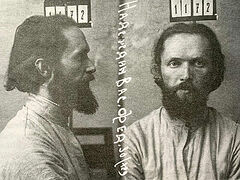
There is one more detail. The reports tell us that Fr. Agapit was put under surveillance. The monk longed for the priesthood, but could not find anyone who would ordain him. He sought advice from his father-confessor, St. Nikon (Belyaev), who wrote him a very informative letter with instructions on who to contact to resolve the issue, but Fr. Agapit was not destined to receive it. On June 16, 1927, he was arrested. Just over three weeks later, St. Nikon was arrested too.
A very telling situation occurred during Fr. Agapit’s arrest. After wearing civilian clothes all that time, he donned monastic garb during his arrest. And he did it with great joy, as Archimandrite Damascene (Orlovsky) writes. If not the priesthood, then he will bear confession of the faith. Fr. Agapit’s soul longed for asceticism for Christ’s sake.
His Life contains an excerpt from the protocol of Fr. Agapit’s interrogation with wonderful explanations by Archimandrite Damascene (Orlovsky). I want to quote this fragment of his Life in full:
“The OGPU2 staff, in accordance with the State ideology of the time, automatically considered monks as members of a counterrevolutionary organization, and therefore all questions concerning their tonsure—who tonsured them, how it was done, and who was present—were not so much religious as organizational and political issues for them. In their eyes, both the person taking monastic vows and the cleric who administered the tonsure were penalized, as they made vows to God, and not to the State. Monastic vows in themselves made monks invulnerable; you could not take away any earthly possessions if a person had voluntarily renounced them, and the threat of a physical death had no power over someone who had already died to earthly life. Insisting on receiving information about all the participants in Fr. Agapit’s tonsure, the investigator asked him, ‘Tell me, when you were being tonsured a monk by Nikon Belyaev, where exactly did it take place and who else was there?’
“Well aware of how the investigator would interpret each of his answers and knowing that it was illegal to ask him about it in the first place, since there was no article criminalizing the monastic tonsure, Fr. Agapit replied: ‘I refuse to give an answer to this question.’
“‘Why?’
“‘Because it concerns my personal life.’
“It was a legally exhaustive answer and according to Christian conscience, and all interrogations stopped there.”

Evaluate the level of intelligence and education of Baron Taube, who studied law at the country’s leading university. To analyze the situation thoroughly, giving it a legal assessment and articulating a meticulously precise answer that put an end to all further questions (being interrogated in the torture chambers of the OGPU, under incredible pressure)—it was a truly masterful move. We will never know what it cost Fr. Agapit both morally and physically…
From the indictment: “He has extensive ties with the major cities of the USSR and, being an employee of the Optina Museum… associates with the counterrevolutionary group of the said museum… and conducts counterrevolutionary agitation and religious propaganda among the broad masses of the rural population... Having close relations with Nikon Belyaev, Taube, as an individual connected to the whole scientific community, provides and uses all ... opportunities for counterrevolutionary activities...”
He spent three years in labor camps. It was the notorious Solovetsky Special Purpose Camp (SLON). December. Navigation was stopped. Fr. Agapit got stuck in a transit camp in Kem (in Karelia). St. Nikon (Belyaev) was there as well. They lived together. Soon Fr. Agapit was sent to the White Sea coast, while St. Nikon remained in Kem.
After the end of his exile, Fr. Agapit was not released, but was sentenced to three more years. He was sent to Arkhangelsk. God’s mercy to His beloved child manifested itself in almost miraculous coincidences: during the transfer, he met St. Nikon (Belyaev) again. And they—a spiritual son and a spiritual father—lived together for a while again, which was a great consolation for both of them. After a while, they were relocated to various places.
In exile, Fr. Agapit recalled their life together with great fondness and affection, and remembered their sad parting, as his Life tells us. Fr. Agapit asked Nun Ambrosia, who came to visit him, to write to St. Nikon, as her letters were always a great comfort to him. Even in exile, he cared for his dear spiritual father and not for himself. It so happened that a day after that conversation, Fr. Agapit was arrested. There was no casual link between those two events; exiles were often arrested right in the forced labor camps to tack extra time onto their prison sentences. It was in 1931; there was a group criminal case involving over twenty people.
During the interrogation, Monk Agapit rattled off: “I do not admit to being guilty of anti-Soviet agitation, since I have never had anti-Soviet conversations on political topics anywhere.”
The indictment: “He was a very close ally of the exiled bishops, participated in helping the exiled clergy, and posed among the peasants as ‘a martyr and an innocent sufferer for the faith of Christ.’”
Three years of forced labor camps: the notorious Mariinsky Camps in the Kemerovo region in Siberia. The saint survived and, after being released, holed up in Orel.
With God’s help, Fr. Agapit survived nine years in total of continuous camps. Not everyone was able to survive this, given the monstrous conditions, inhumane treatment, hard labor, a huge number of infections, constant outbreaks of epidemics, and exhausting hunger and cold.
And in early 1936, when Fr. Agapit was at liberty, he fell ill. He was only forty-two—the age when men are in their physical prime. But the Lord decided that it was time for Fr. Agapit to go home. The saint began to develop tumors one after another. No sooner had one been removed than another grew, already inoperable.
Fr. Agapit felt very bad and suffered from unbearable pain. He couldn’t eat or speak anymore, but he went to church. The monk was not depressed; rather, he was calm and joyful. His landlady, who lived in the other half of the house, recalled later that “he endured his torments with all humility”. He wrote her notes with simple requests. They agreed that when things got really bad, he would knock on the wall to call her. He knocked on July 18, 1936. Before passing away, Fr. Agapit kept looking at an icon of the Mother of God. The landlady said that “his face was focused and meek. Neither pain nor fear distorted it. He didn’t moan, only his breathing slowed.” She witnessed how Fr. Agapit’s soul peacefully departed to the Lord. It happened almost exactly one year before the publication of the infamous NKVD3 order No. 00447, on the basis of which monasticism was to be eliminated without any objective grounds. The Lord saved His beloved child from those horrible events by quietly taking him from his sickbed to His bright abodes.