Life
St. John (Iacob) was a holy hesychast of our days, who struggled for twenty-four years in the Holy Land, in the Jordan Valley and in the desert of Chozeba (also spelled Choziba). This blessed bearer of Christ was born on July 23, 1913, in the village of Crăiniceni, Paltiniș commune, Botoșani county, into a family of pious peasants Maxim and Ecaterina, and was their only child. In Holy Baptism, he was named Ilie, and at home he was called Iliuță. Six months after his birth, his mother fell ill and died, and the baby was left in the care of his paternal grandmother, Maria Iacob, who cared for him like a true mother for ten years.
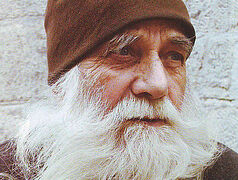
 St. John (Iacob) of Neamț, the New Chozebite In 1916, when little Ilie was three years old, his father died at the front. In 1923, his grandmother also passed away, leaving Ilie an orphan, deprived of the comfort of his loved ones. He was then taken in by his uncle, Alecu Iacob, who had six children of his own at home. Between 1926 and 1932, young Ilie studied at the Mihail Kogălniceanu Gymnasium and the Dimitrie Cantemir Lyceum in the town of Cozmeni near Chernivtsi.
In the summer of 1933, he entered the Neamț Monastery. On April 8, 1936, he was tonsured a monk with the name John (Ioan), and in November of the same year, along with other monks of the Great Lavra (as the Neamț Monastery is often referred to), he set off to venerate the Holy Sepulcher. Afterwards, he settled permanently in the Holy Land, where he struggled in the brotherhood of the Lavra of St. Sabbas the Sanctified (the Mar Saba Monastery) in the vicinity of Bethlehem.
On September 14, 1947, Metropolitan Irinarch ordained him hieromonk at the Church of the Holy Sepulcher; he was subsequently appointed abbot of the Romanian Skete of St. John the Baptist on the Jordan River. After five years of obedience, together his disciple, Monk Ioanichie (Pârâială), he withdrew into the desert of Chozeba in the vicinity of Jericho. There they struggled in St. Anne’s Cave in the Valley of the Chorath Brook, for eight years.
On August 5, 1960, at the age of forty-seven, St. John (Iacob) departed to the Heavenly abodes and was buried in the cave where he had led an ascetic life. Twenty years later, on August 8, 1980, his body was found incorrupt in the grave.
On August 15 of the same year, with the blessing of Patriarch Benedict I of Jerusalem, his relics were translated to the nearby Monastery of St. George the Chozebite and now rest at the church alongside other holy relics.
Deeds and Sayings
This venerable man was chosen by God from his mother’s womb for the Heavenly Kingdom, for from infancy he was manifestly blessed by the grace of the Holy Spirit, being in all things meek like a lamb, humble, silent, zealous for holiness and patient in temptations both internal and external. Then, prayer with tears worked incessantly in his mind and heart. His mother Ecaterina was guided by Christ to lead a blameless life and give birth to her only son on earth, for shortly after giving birth she departed to the Heavenly abodes.
For Blessed Ilie, who was orphaned in infancy, God was a father and the Church a spiritual mother, while his humble grandmother Maria, a widow, raised him and protected him with prayer and love until he was ten.
Old people in the saint’s native village recount that every day his grandmother carried him to nursing mothers for breastfeeding and kept vigil over him day and night until the boy began to speak. And in the summer, setting off for field work, she would put the baby boy into a knapsack so that his head was visible, heave it onto her back, make the sign of the holy cross, and walk with a prayer on her lips and tears in her eyes. There she would seat him in the shade beneath a tree and leave him until sunset. Then she would put him back into the knapsack and carry him home. After feeding the baby boy, she would put him to sleep beneath the holy icons, while she would pray and make prostrations until late at night, according to ancient sacred custom.
The child was gifted with a bright mind, did well at school and brought his grandmother much joy. Over time, the eldress began teaching him prayers, frequently took him to church and asked him to read the Psalter to her, as she was illiterate. Sometimes she would tell him to read the Passion of the Lord to her, while she wept and made full prostrations. The child once asked her:
“Mother, why do you cry so much when I read about the Passion of our Lord?”
And the eldress answered him:
“My darling, you don’t know what tragedy befell our family. I’m not your mother! She departed to the Lord when you were only six months old, and your father was killed in the war when you were three years old. I’m your grandmother, and your grandfather has long been in heaven. Widowed, I wanted to enter a convent, but when you were left an orphan, I gave up that plan in order to raise you. And I cry because I’m old, and after my death you’ll be all alone in this world and an orphan. But have faith in God, always pray to Him, flee from sin and remember us. If you do this, the Mother of God will protect you, and you will avoid many dangers. And in life I can’t wish anything better for you than to become a priest and glorify Christ!”
At the age of twenty, he graduated from the lyceum and, since he was gifted with a bright mind by the grace of Christ, friends and relatives tried to persuade him to study theology and later become a priest. But his conscience and his heart inspired him: “No, I want to become a monk!” And so one day, while working in the field and being tormented by doubts, he began to pray to God to reveal to him what to do. And the saint heard a loud voice from above: “The monastery.” From that moment on, he lost his peace, for the Holy Spirit kept calling on him to go to the monastery as soon as possible and dedicate his life to Christ.
One Sunday in the summer of 1933, when the village youth were joyfully gathering for a wedding, Ilie, God’s chosen one, venerated the icons in tears at the Crăiniceni church, kissed his parents’ crosses at the cemetery and, bidding farewell to his relatives, departed to be betrothed to Christ in the brotherhood of the Neamț Monastery.
On seeing him, Bishop Nicodim, the Abbot of the Lavra (the Neamț Monastery), wondered:
“Why have you come to the monastery, Brother Ilie?”
“Father Abbot, I wish to become a monk, mourn over my sins, pray for my parents who brought me into this world, and unceasingly glorify God.”
“You have chosen a good path, Brother Ilie. If you have humility and obedience, love prayer, and do all that is good, you will easily overcome the temptations of this world and be numbered among the saints in Heaven.”
“So may God help me, Your Eminence Father Superior!”
“Have patience in everything, nourish yourself with the teachings of the Holy Scriptures and the Holy Fathers, and follow the life and advice of the devout spiritual fathers and ascetics of the Neamț Monastery brotherhood. Go to the church, bow before the wonderworking icon of the Most Holy Theotokos, the Patroness of this monastery, and then I will entrust you to the obedience of Father Iov (Job), the monastery apothecary and the most spiritual monk of our brotherhood. Follow, to the best of your ability, his life and advice, do not miss church services and carry out your obedience at the monastery library.”
For three years, Rassophore Monk Ilie served his novitiate under the Venerable Iov (Burlacu), striving to imitate his austere ascetic labors, fasting, stillness, humility, poverty and unceasing prayer. At the library he put all the books in order, read many instructions of the Holy Fathers and gave good counsel to the young novices, so that everyone found benefit on seeing his zeal, wisdom and labors, and he was loved by all in the brotherhood of the Great Lavra.
 St. John the Baptist
The abbot and the spiritual fathers noticed his zeal for Christ, and on April 8, 1936, on Holy and Great Wednesday, Rassophore Monk Ilie (Iacob) was tonsured a monk along with ten other brothers, receiving in the tonsure the name of St. John the Baptist. Two great prophets, Elias and John, the leaders of the eremitic life of the Old and New Testaments, became his teachers, fathers and intercessors in his monastic feats. Both called on him to follow their lives, including fasting, prayer, and virginity, inspiring him to go to the Holy Land—to the great hesychasts of the Jordan Valley. St. Elias the Tishbite transmitted to him the zeal for defending the True Faith and called him to the spiritual ascent of Mounts Carmel and Sinai. And St. John the Baptist inspired him to go to the monasteries of the Holy Land and taught him to call everyone to repentance and to boldly denounce sin—which the future saint did throughout his life in the magnificent poems and instructions that he has left behind.
 The holy Prophet Elias Wounded by Christ’s love for the Life-Giving Tomb in Jerusalem and for the desert life there, in the autumn of 1936, the humble monk John (Iacob) partook of the Divine Mysteries, venerated the icon of the Most Holy Theotokos in church, asked for forgiveness and the blessing from the elder and all the brethren, and set off forever for the Holy Land, protected by the grace of the Holy Spirit, which inflamed his heart with Divine love.
On arriving in the Holy Land, Monk John first of all came to Golgotha and venerated the Holy Sepulcher of the Lord. Then, having partaken of the Body and Blood of Christ, the blessed soldier of Christ walked all over the Holy Land, following in the footsteps of the Lord and his holy patrons, Elias the Tishbite and John the Baptist. At first, he led an ascetic life alone in a cave in the Jordan Desert, then he joined the brotherhood of the Lavra of St. Sabbas the Sanctified in the Kidron Valley, where there were several Romanian hesychasts. In this ancient Lavra, St. John struggled until the summer of 1947.
Here the soldier of Christ John acquired the gift of tears and the prayer of the heart. Here he endured severe warfare and trials from demons, for the evil spirits could not bear the fact that he unceasingly prayed and praised God. Here he was tonsured into the great schema and here too he overcame his invisible enemies through strict and prolonged fasting, exhausting night vigils, the victorious sword of prayer and the shield of humility. As a result, he became so free from passions that he endured all hardships with joy, felt an immense compassion for all creation, and never feared demons, illness, or death.
In the brotherhood of St. Sabbas’ Lavra, St. John performed obediences as a librarian and an infirmarian. At night he stood at services in church, and during the day he worked at the monastery hospital, caring for the sick. He also visited sick monks and hermits in their cells, bringing them food, and treated soldiers wounded in the war who were brought here from the front. He dressed their wounds and comforted all of them with love, while in his heart he ceaselessly prayed and lived by Christ.
On the recommendation of Archimandrite Victorin (Ursache), the Superior of the Romanian Mission in Jerusalem, St. John (Iacob) was ordained hieromonk and for five years served as abbot of the Skete of St. John the Baptist on the Jordan, founded by the Romanian Patriarchate. Here he added new, eremitic ascetic labors to his previous feats, and endured numerous temptations from demons. His rule of life was as follows: during the day he ate nothing until sunset and unceasingly offered up prayers in his heart, while with his hands he labored in the garden to sustain the skete and lovingly received Romanian and foreign pilgrims who came there. At night, he celebrated the prescribed services in church, heard pilgrims’ confessions, and for a few hours retreated for stillness into a cave on the banks of the Jordan, from which he would return in the morning to the skete with a radiant face.
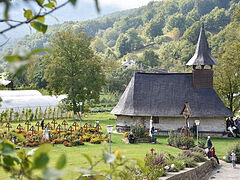
 The Monastery of St. George the Chozebite. Photo: Pemptousia.ro
Burning with love for Christ, in absolute silence and prayer, Blessed Abbot John, together with his disciple Monk Ioanichie, withdrew in the autumn of 1952 to the desert of Chozeba in the vicinity of the Monastery of St. George the Chozebite.
Initially, they struggled for several months in the brotherhood, and then settled permanently in St. Anne’s Cave in the Valley of the Chorath Brook, where other hesychasts also lived as hermits, in order to spend the final years of their lives in prayer alone and communion with Christ. St. John struggled here for over seven years, but no one, not even his disciple Ioanichie, knew all his ascetic feats—they were hidden in God and in the inmost recesses of his heart. For his disciple saw only the saint’s outward labors, such as: all-night vigils, the chanting of the daily cycle of services, the zealous celebration of the holy services at the cave chapel, the reading of sacred books, the translation of the Patristic works, and the composition of spiritual poems for pilgrims who visited him in the cave.
But the feats he performed in his heart, his hidden tears, his struggle with thoughts and evil spirits, his spiritual meditations on things above, and the warmth of the Holy Spirit that set his heart ablaze for Christ’s sake, were seen by God alone, Who accepted them as a burnt offering from St. John the Hesychast, unknown to any mortal.
 Schemamonk Ioanichie (Paraiala) in 1968. Photo: sfioaniacobhozevitul.wordpress.com His disciple recounted the following regarding the ascetic life of this holy hesychast:
“Throughout his illness, he never once groaned or even sighed, but endured everything with serenity and joy. He kept a strict silence, never laughed, prayed unceasingly with his heart, and with immense strength endured pain and worldly privation. He adhered to a rigorous daily routine and fasting, and took the bare minimum of food and drink required merely to sustain life; he deeply loved stillness (hesychia) and solitude, resolutely defended the True Faith, tradition and sacred canons, and always kept his mind fixed on Jesus Christ crucified on Golgotha. He neither thought about nor cared to know anything of this earth. His body, mind, and heart were passionless, ‘dematerialized’, and mysteriously united with God through prayer and the grace of the Holy Spirit.”
Fr. Ioanichie, his disciple, also recounted:
“St. John foresaw the day of his repose and inscribed it on the wall of the cave. Once he had passed away, I dressed him in a cassock, placed the great schema on him (for he was a schemamonk of the Lavra of St. Sabbas the Sanctified), placed an epitrachelion on his chest and laid him on a bast mat. Then I lit three wax candles and an icon lamp, and notified the Abbot of the Monastery of St. George the Chozebite, Archimandrite Amphilochios, with whom he was very close. By his order, the monastery bells tolled for three days, and a litiya was served in the cave.”
 Ascent to St. Anne’s Cave in the Chozeba desert. Photo: Comisarul.ro Regarding St. John (Iacob)’s funeral and the miracle that occurred then, his disciple relates the following:
“On the day appointed for the funeral, the monastery abbot, Fr. Amphilochios, came with several monks and hesychasts who lived as hermits nearby in the caves of the Rouba Desert. They walked up the stairs into the cave, and at ten o’clock on Saturday, August 7, the elder began the funeral service. And suddenly the cave was filled with the birds of the desert, to which St. John used to give breadcrumbs every day. But now they had not come for food—they were sent by God to honor St. John, to mourn him, and accompany his body to the grave.”
Elder Amphilochios related this as follows:
“The birds prevented us from performing the funeral service, flying over our heads, extinguishing candles, closing books, flapping their wings over the saint’s body, and settling on him—on his head, his chest, and his legs—with each wailing in its own way. They didn’t want food; they needed their father, their benefactor, whom they had lost. After the service was over, we laid him to rest in a grave in the cave where other hesychasts had already been buried before, and covered it with a board lid. Only then did the birds fly away and disperse. Then we brought earth, made a clay mortar and sealed the boards to the grave, where the saint rested until August 1980.”
From the day of his burial, the grave of St. John (Iacob) stood almost completely forgotten for twenty years in St. Anne’s Cave. His disciple Ioanichie moved to the Monastery of St. George the Chozebite. Only on certain days, or when Romanian pilgrims came, would they—accompanied by the disciple—ascend the stairs up to the cave, light candles and an icon lamp on his grave, cense, celebrate vespers in the cave, serve a litiya for the departed, ask the great hesychast for help, listen to a brief account of his life as retold by the disciple, strike the semantron, and descend from the cave with tears in their eyes, saying:
“How great the ascetic feat of St. John (Iacob) was!”
 Monk John (Iacob) with his hermit neighbor in the desert of Chozeba, Monk Pavel (right). Photo: Adevarul.ro
In the summer of 1980—on August 8—Orthodox pilgrims led by a Greek Archimandrite who had once lived as a hermit near St. John the Chozebite ascended to St. Anne’s Cave, offered up prayers and kissed his grave. Then the archimandrite recounted:
“I struggled here, not far from this cave, and I deeply loved Father John (Iacob), who was my spiritual father. Afterwards, I went as a missionary to America and knew nothing of him for over twenty years. And then one night he appeared to me in a dream and said, ‘If you want to see me, come to St. Anne’s Cave in the desert of Chozeba and you will see me.’ A month has passed since I saw him in that dream, and I have been restless ever since. That’s why I came to speak with Father John, my spiritual father and friend. I didn’t know that he had departed to the Lord. And now my soul will not find rest until I open his grave to kiss his venerable, much-labored body!”
The abbot of the Lavra, Fr. Amphilochios, reluctantly gave his blessing to open St. John’s grave in the cave. When it was opened, a wondrous fragrance emanated, filling the cave and the hearts of all those present. The saint’s body and vestments were intact, giving off fragrance of holiness. He looked as though he had just fallen asleep. Then everybody fell to their knees and cried out with tears:
“Glory to Thee, O Lord, for this great miracle! The Venerable John the Romanian is a saint!”
Then his holy relics were kissed and censed, candles were lit and the troparion was chanted:
“In thee, O Father, was preserved with exactness what was according to the image; for thou didst take up the cross and follow Christ. By so doing, thou didst teach us to disregard the flesh, for it passes away; but to care for the soul, since it is immortal. Therefore, O Venerable John, thy spirit rejoiceth with the angels.”
And so, having received a particle of the saint’s vestments as a blessing, the pilgrims departed in peace, and his relics remained in the cave until August 15.
 Schemamonk Ioanichie (Paraiala) at the incorrupt relics of his teacher. Photo: Crestinortodox.ro Fr. Ioanichie, his disciple, related that on the eve of the feast of the Dormition of the Most Holy Theotokos, the abbot of the Lavra brought a wooden coffin up into the cave and, together with the other hieromonks, placed his holy body—which was completely incorrupt and fragrant—into the coffin and censed it. On August 15, the patronal feast of the Monastery of St. George the Chozebite, several hierarchs, priests and monks, both Romanians and Greeks, arrived along with numerous Orthodox pilgrims. Then, amid the ringing of bells, the holy relics were brought down from the cave and translated in cross procession to the church of the Great Lavra, where they were placed next to other holy relics. Then forty Divine Liturgies were celebrated so that God might reveal the holiness of his relics. Thus, seeing that his body remained intact and untouched by decay even after this, everyone honored him as one worthy to shine among the Holy Fathers.
Subsequently, several Christ-loving believers made a new ebony coffin for him and placed the precious treasure inside it. Since the summer of 1980 and to this day, countless pilgrims—Romanians, Greeks, Cypriots, Serbs and people from other countries—have been flocking here to venerate him and beg for his blessing and help in the struggles of this life before the relics (glorified by God) of this new saint of the Orthodox Church, who became widely known under the names of St. John the New Chozebite or St. John (Iacob) of Neamț.
His numerous letters and spiritual poems are read with reverence by believers today and lead them on the path of salvation.
Holy Father John, pray to God for peace, for the people you came from, for the monasteries and believers, for the salvation of all the faithful and those who seek the Lord!
 The Incorrupt relics of St. John the Romanian at the Monastery of St. George the Chozebite. Photo: Duhovnicii.blogspot.com