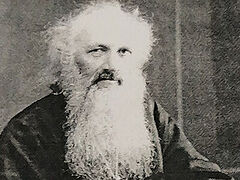
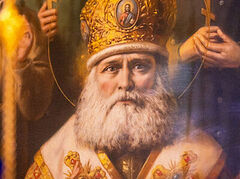
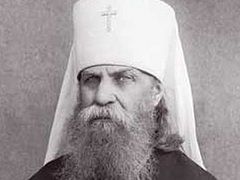
On the feast-day of the New Hieromartyr Benjamin, Metropolitan of Petrograd, the theme of suffering for the faith and confession comes to the forefront. His era was marked by the blood of people who stood firm in their faith. What does it mean to stand in the faith? What does it mean to be a Christian? Why are there forces that find Christianity a hindrance when it preaches love?
 Hieromartyr Benjamin of Petrograd
In ancient times, during the era of persecutions against Christians, the most significant issue was the theme of witness. The Greek word “martyr” translates as “witness”. In the Roman Empire, the cult of the emperor was a form of loyalty for a citizen of the empire; so, recognizing the emperor’s divinity also meant following a certain program and belonging to a specific system of concepts, such as “Roman citizen,” “soldier,” “equestrian,” “plebeian,” and “defender of the state.”
In the same way, Christianity in the understanding of the martyrs was and is a system of values and an adherence to specific concepts: “love”, “truth”, “self-sacrifice”, and “strength” in the true sense. But in the case of the Christian faith, there is also a deeper meaning, which is the preaching of the Kingdom of God on earth. Every citizen has some official symbol that indicates his belonging to a specific state; nowadays it is a passport, whereas previously it was wearing the coat of arms of a nobleman or a king.
What does this official symbol mean—a coat of arms, a flag, a passport and other state symbols? They always denote a certain program that comes along with them. In ancient times, being a Roman citizen was considered an honor; it meant, among other things, that a person had the right to a fair trial. This is one aspect of Roman statehood. The other is aggressive campaigns and the annexation of new territories. For the Germanic peoples, the word “Roman” meant “invader” and “disciplined warrior”. Thus, by calling yourself by a certain name, you first of all declare what program you bring to the world.
The problem with the martyrs in the Roman Empire was precisely this: Roman authority and Roman law were very powerful, logical institutions that sought to systematize all spheres of life in the Roman Empire. A phenomenon like Christianity was a wormhole in these systems that threatened to eventually destroy the entire system, which is ultimately what happened. The most serious questions usually lie in the things that are considered minor details; but great and middle-ranking matters begin with small details. A tree grows from a seed, and the persecution of Christians always first proceeded from “the level of the seed”. In order to solidify the system, you must start small—by changing the consciousness of the people who belong to it.
The main problem during the persecutions of the Russian Orthodox Church in the twentieth century was the same: The authorities promoted a program completely alien to Christianity and the Christian way of human coexistence, which greatly intensified both the persecution and the believers’ resistance. Soviet power pushed the idea of brotherhood and equality as a core principle, but Christianity says that this cannot be built by human hands.
The emergence of the Renovationist Church at that time was like incense that the early martyrs were ordered to throw onto the altars of the pagan gods. At a certain point, Christians were required merely to burn a little incense at the altar, and the authorities would drop all further demands; it was a minimal gesture of loyalty necessary to define a Roman citizen’s civic stance. Nevertheless, many witnesses for Christianity remained steadfast and were executed for that.
In the case of the Renovationist Church, the Soviet authorities proposed a kind of compromise: “Here is a church that the state does not persecute. You do not have to become its followers—it is enough simply not to express your negative position towards it.” Thus, the Soviet authorities demanded silence and the absence of any expressed stance. The value system preached by Christianity was supposed to have disappeared from public view, because the authorities were trying to replace it with their own.
 The last photograph of the defendants led by Metropolitan Benjamin before the verdict was handed down. July 5, 1922
At this stage, it becomes clear what exactly people are building and what they live by, because their entire lives depends on this choice of “trifles”—not only their own lives, but the life of the whole world around them. For Christians, the question of faithfulness is of paramount importance. They don’t say, “We are building the Kingdom of God on earth”, but, “We know that only God is able to give people the love and peace they seek.” And this confession underlies a deep conflict with the Soviet regime.
Why is it so important? Because everything that follows begins with it. Those who believe that equality is above all else will stop at nothing to attain equality, and in the end will not attain it. But he who believes in God knows that God alone rules the world, yet He enters the human world through the will of man. A person’s decision to follow Christ is a movement of faith and of will. Through such a decision, God changes the world in a supernatural way. Yes, the martyr is executed by shooting, but the Church lives on. Yes, vestments and sacred vessels are taken away, but the martyrs serve dressed in whatever is at hand and use mugs as chalices. God’s power is made manifest when man does not prevent it from being made manifest.
Hieromartyr Benjamin was condemned for his sharply negative attitude towards the Renovationist schism. Decisions are laid by God like bricks into the building of the future day. Prayer and witness to the Truth are the material that serves today to build what will be tomorrow, which is why what you confess is so fundamental. If your actions stem from selfishness, then tomorrow’s building will be made of rotten material and will collapse on the heads of those who dwell in it. If you co-work with God and trust Him, then the coming day is built like a fortress, where nothing can threaten those who believe.
Confession of faith is the foundation necessary for the world to stand. Christians have always been asked for little: Give up something insignificant—and you will live, and your loved ones will be safe. But Christians know that there are no trivial things. God is in the details. The great life’s work of many generations is born from the small decision of each individual person. Metropolitan Benjamin and many other confessors of the faith show us this by their example. Therefore, there should be no trivial things in our lives either—confession of faith is a daily, small, yet painstaking and intense labor.