“To live a life is not simply to cross a field,” as the old Russian saying goes. It is a long and arduous journey in which man is a pilgrim traveling toward his own transfiguration. For all of us, like butterflies, will one day leave behind our earthly, perishable shell and pass into another form of existence. August always reminds us of the Transfiguration and of man’s journey toward God, toward the Unfading Light...
One memorable pilgrimage on foot—to the Holy Mountain of Grabarka, the foremost Orthodox shrine in Poland—helped me reflect upon this journey and understand and experience it more deeply. There stands a church dedicated to the Transfiguration of the Lord, as well as the Convent of Sts. Martha and Mary, founded in 1947. This mountain is distinguished by one special, perhaps unique, feature: the multitude of crosses brought there by pilgrims.
Every year in August, the Białystok region—its forests and fields, the picturesque Białowieża Forest, its towns and villages—is filled with spiritual hymns. They are sung by pilgrims. Overcoming exhaustion, the pain of blistered feet, heat, and rain, they make their way to venerate the Holy Mountain of Grabarka. The shrine lies in the Podlaskie Voivodeship, only about twelve miles from the border with Belarus. This is the Polish part of Polesia, known here as Podlasie.
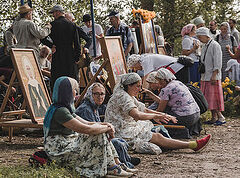
 Pilgrims with clergy of the Polish Orthodox Church
Six Days on the Road to Transfiguration
That year, several sisters of mercy from the St. Elizabeth Sisterhood in Minsk set out for Grabarka together with a group of young people from Belarus. Some of those young sisters are now married and raising three or even five children; others have chosen the monastic path. But everyone still remembers that August…
Along the way, we made numerous brief stops at local churches or beside the wayside crosses found in every village. There we would serve a short moleben together with the local residents. The warmth and hospitality of the people of the Białystok region did so much to ease the hardships of the journey that our weariness invariably gave way to joy whenever we passed through another village or, at the end of the day, settled down for the night in the homes of local residents.
 In good weather, you feel less tired
And the journey truly was difficult. For those of us accustomed to the comforts of city life, walking twenty or twenty-five miles a day seemed almost unimaginable! Yet in six days we covered nearly 125 miles—and came to understand, both in body and soul, what a true pilgrimage really is.
The experience one gains by overcoming hardships and trials is priceless; it cannot be found in books or borrowed from someone else. A sacrifice unto God are a broken spirit (Ps. 51:17). And I can say that, at that stage of my life, the journey to Grabarka became for me a path toward genuine contrition of heart: when you see your own weakness, when exhaustion of body and soul leaves you with only one way forward, only one means of enduring and not giving up—prayer.
The journey to Grabarka became for me a path toward genuine contrition of heart, when exhaustion of body and soul leaves only one way forward—prayer.
Throughout this pilgrimage, I saw an image of our journey through life, and my reflections on it became intertwined with the events of each day.
In the morning, when you are still full of strength after a night’s rest, your steps are light and your eyes delight in the beauty of nature. Then you remember childhood.
By midday, when your body begins to remind you ever more insistently of its weariness, drowning out all other thoughts and feelings, you think of the everyday struggles of adult life. How often along that road there are moments when it seems you have no strength left, when you feel that the next step will be your last and that you will have to stop—or simply collapse…
But to stop means to fall behind and be left alone. Then you begin to implore God for help, because your own human strength is no longer enough. Then you learn to pray in earnest. And a true miracle occurs: through some strength beyond your own, you accomplish what you seemed utterly incapable of doing, without even understanding how it is happening. Of course, some found the pilgrimage easier than I did, for everyone’s strength is different. Each person has his own experience, his own trial.
The pilgrims carry wooden crosses to leave on the Holy Mountain. Some are enormous—far taller than a man—while others are small enough for a child to carry. The entire summit of Grabarka around the church is covered with them, like a forest of crosses.
Each pilgrim’s journey ends by going three times around the Church of the Transfiguration at the summit of the Holy Mountain—and doing so on one’s knees. Some have tears in their eyes, others are smiling, but every face is remarkably radiant with spiritual joy.

When darkness falls, countless candles are lit on the slopes of the mountain, where thousands of the faithful, standing or sitting directly on the ground, take part in the evening service. Their warm, flickering light illuminates the church, the crosses, and the faces of the pilgrims. Let Thine everlasting light shine upon us sinners also, through the prayers of the Theotokos, O Giver of Light, glory to Thee, is heard again and again amid the darkness of the night. And these lights in the darkness seem like a symbol of thousands of hearts burning with prayer.
These lights in the darkness seem like a symbol of thousands of hearts burning with prayer.
On the night of the Transfiguration, on the Holy Mountain of Grabarka, countless people experience with all their hearts a profound sense of unity, something unforgettable and beyond words… Thousands confess their sins before God and receive Holy Communion.
And although the pilgrim encounters many hardships and inconveniences at Grabarka, and although the bustle of this world tempts him with the clamor of the market stalls at the very foot of the Holy Mountain, whoever has come here to pray and to offer unto God a broken spirit will, according to his strength, partake of the light of Tabor and depart renewed!
Why Grabarka Is the Mountain of Crosses
 Pilgrims always carry crosses to Grabarka
The history of the veneration of Grabarka is remarkable. In 1710, an epidemic of cholera broke out in Podlasie. According to tradition, the Mother of God appeared to an elderly man from the town of Siemiatycze. She told him that whoever made a cross and carried it to Mount Grabarka would be delivered from the disease. People carrying crosses climbed the mountain. The epidemic began to subside, and many of the sick were healed. When people in neighboring towns and villages learned what had happened, they too began coming to the holy place. Thus arose the pilgrimage tradition of carrying a cross to the Holy Mountain and leaving it there with prayers for healing and well-being.
Over the years, a remarkable “forest” has grown up on Grabarka—more than 10,000 crosses, each bearing names, prayers, and petitions: for health, for eternal rest, for family happiness, and for countless other needs known to God alone… It is a breathtaking sight.
People continue to come to this day. And they bring ever more crosses—large and small, simple ones and others adorned with colorful ribbons.
The greatest number of pilgrims—tens of thousands—gather at Grabarka for the feast of the Transfiguration of the Lord on August 19. And each year, young people make up the largest part of the gathering. Belarusians, Russians, Ukrainians, Finns, Germans, and Orthodox faithful from various countries of Eastern Europe join the pilgrimage every year. Here the Orthodox Faith unites people of different nationalities living in different countries.
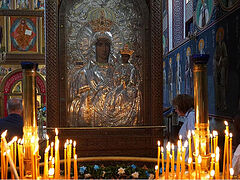
 Before the Supraśl Icon of the Mother of God
Along the pilgrims’ route are the unique churches of Białystok, while some routes pass through the ancient Supraśl Lavra, founded in the fifteenth century. Yet no less moving and memorable are the brief molebens served beside wayside crosses and the services held in village churches. Each rural church has its own distinctive history. Many survived the years of the Second World War, while others were destroyed and later magnificently restored.
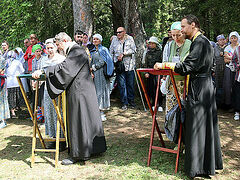
 Moleben at the wayside crosses
Some pilgrims set out from Hajnówka, others from Warsaw. Some begin their journey in Sokółka, others in Białystok. For some, the pilgrimage lasts six days; for others, only one. All the participants in the processions meet on August 18 at the monastery on the Mountain of Crosses.
On August 19, four Divine Liturgies are celebrated at Grabarka, one of them by Metropolitan Sawa of Warsaw and All Poland himself. Great numbers of the faithful partake of Holy Communion. Priests hear confessions throughout the night, and confession can be heard in many different languages. It is truly a magnificent and deeply moving celebration!
Priests hear confessions throughout the night. Confession can be heard in many different languages.
The pilgrims making their way to Grabarka are very different. They are of all ages. Some have made such pilgrimages many times before and are deeply rooted in the faith, while others are undertaking the arduous journey for the first time. For some, the path to faith and to the Church has only just begun, and the pilgrimage to Grabarka gives them a new and unforgettable spiritual experience.
During a true pilgrimage on foot, with all its trials and joys and its atmosphere of prayer, one witnesses how all of this transforms people, inspires them, and strengthens their faith; how it unites people from different countries in a common aspiration—to become purer and kinder, and to draw closer to God and to one another.
Here the Orthodox Faith Is Preserved
The pilgrimage to Grabarka offers a wonderful opportunity to see how our brothers and sisters in the faith live in Poland, how they preserve the traditions of their forefathers and remain faithful to Orthodoxy in a different religious and cultural environment.
The local people welcome the pilgrims—or pielgrzymi, as pilgrims are called in Poland—with joy and reverence. After a brief prayer together, there is a generous meal. In the evening, the pilgrims are given supper and lodging in the hospitable homes of local residents. The care they show the pilgrims is deeply moving, sometimes to the point of tears. Some are comfortably well-off and give generously from their abundance, while others spend their last savings simply to welcome and give rest to the weary travelers making their way to venerate the holy place. Some may have nothing more to offer than a place where the pilgrims can dry their rain-soaked shoes, yet even this they consider an honor and a joy.
 Through villages, forests, and fields...
Here in Podlasie, one hears not only Polish, but also Belarusian, Ukrainian, and Trasianka, a mixed Belarusian-Russian form of speech. At times, Belarusian pilgrims can almost forget that they are abroad; it seems as though they are in some village in western Belarus, talking with their own grandmothers and grandfathers.
Ethnic Belarusians have lived in these lands from time immemorial. Almost all of them profess the Orthodox Faith.
The reason is that ethnic Belarusians have inhabited this region from time immemorial. Almost all of them are Orthodox Christians. According to official statistics, there are more than 500,000 native Orthodox Christians in Poland, although they make up only about one percent of the country’s population. The overwhelming majority of Poland’s Orthodox Christians live in the eastern part of the country. Through the vicissitudes of history and the upheavals of war, these people found themselves cut off from their historic homeland as the borders of the Polish state repeatedly shifted—sometimes westward, sometimes eastward.
Polish Belarusians cherish their faith and hold their national traditions dear. For this reason, they introduce their children to the Belarusian language and the culture of their ancestors not only at home but even in kindergarten. Schoolchildren attend catechism classes, and time is also set aside for the study of Church Slavonic. The festival of Orthodox church music in Hajnówka is widely known.
The largest centers of Belarusian culture are Białystok, Bielsk Podlaski, and Hajnówka. The sheer number of Orthodox churches in this region is striking. There are churches not only in the towns but in virtually every village—sometimes more than one. All are well maintained, either newly built or recently restored.
Since the early 1980s, the Polish Orthodox Church has experienced a period of revival, having been granted rights that enabled it to develop actively. In 1991, it received a legal status equal to that of the Roman Catholic Church. Orthodox young people in Poland are particularly active, and it was therefore only natural that the Brotherhood of Orthodox Youth should be established in 1982. It was this brotherhood that revived the tradition of pilgrimage to the Holy Mountain of Grabarka.