Photo: The Journal of the Moscow Patriarchate
Blessed Afanasy Saiko was a faithful child of the Russian Orthodox Church during the twentieth-century persecutions. Hiding behind the mask of a holy fool, he strengthened people in their faith, comforted them in sorrow, healed them of illnesses, and rescued them from certain death. He remained in the people’s memory as an example of devoted service to God. On May 14, 2026, the Holy Synod of the Moscow Patriarchate added his name to the list of the New Martyrs and Confessors of the Russian Church and to the Synaxis of the Saints of the Orel Diocese (celebrated on September 8).
“Go Ahead—Sophia Will Catch up with You”
Blessed Afanasy Andreyevich Saiko was born in January 1887 in the village of Danichevo of the Rivne district, Volyn governorate (now the Rivne region, Ukraine). At Baptism, the boy was named after St. Athanasius of Alexandria. His mother passed away in 1899 when he was twelve. His father, Andrei Saiko, served as a police officer with the rank of senior vakhmistr (sergeant major); in 1914, he was killed by robbers. It is known that two of Afanasy’ brothers died in infancy, and one of his five sisters became a nun.
In 1905, Afanasy Saiko graduated from the school for Soldiers’ Children of the Life-Guards Uhlan Regiment of His Majesty in Warsaw. From 1905 to 1908, he served in this regiment;1 from 1910 to 1920, he held various positions, including working as a minor clerk and scribe in the cities of Lutsk, Rivne, Priluki, and Sumy. In 1920, after returning to his native village, Afanasy Saiko was arrested by the Special Department of the CHEKA of the 1st Cavalry Army and interned in the Orel Concentration Camp No. 1. Following his release in the winter of 1921, he made the bell tower of the Theophany Cathedral in Orel his home. It was then that he took on himself the spiritual feat of “foolishness” for Christ’s sake. St. Afanasy dressed poorly, went about half-barefoot, and came down from the bell tower only occasionally to beg for alms to feed himself before returning back up. Soon, word of the holy fool spread throughout the city. Fr. Vsevolod Kovrigin, a well-known priest in Orel at the time and the father-confessor of the Convent of the Entry of the Mother of God into the Temple in the city of Orel, learned of the man of God and made his acquaintance. The priest blessed a pious parishioner named Martha to take Afanasy in. From then on, he lived with Martha, helping her around the house by chopping firewood and carrying water.
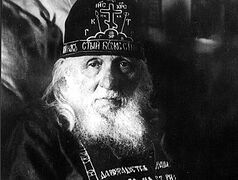
According to the reminiscences of Maria Kirillova,2 who had known the holy fool since 1921 and was the first to collect accounts of his life, Blessed Afanasy was tall and broad-shouldered, with a full black beard and a distinct military bearing. He dressed in a long linen shirt tied with a rope, wore a cross over it, and tied a waffle-weave towel around his neck. Blessed Afanasy sang and read in the choir, possessing a sharp ear for music and a beautiful voice with a wide range; he played many musical instruments, including the guitar and the balalaika, but preferred the violin. He fasted very strictly, could go without food all day long, and never ate meat, eggs, or rye bread.
To an outside observer, his actions and words seemed strange: for example, people often saw him picking up various bits of garbage from the ground—matches, small bottles, or scraps from newspapers. Regardless of their age, Blessed Afanasy addressed all women as “mother.” He explained his appearance in the land of Orel by saying, “Orel has been given to me as my domain.” One could often hear a catchy saying from him: “Eyes are like brakes, the nose is like a steam locomotive, and lips are like trumpets.” Its meaning became clear only with the passage of time. The phrase “eyes are like brakes” meant that the eyes must be held back from temptations and allurements. The expression “the nose is like a steam locomotive” served as a reminder that the human soul must strive for God, never straying from the path of salvation by clinging to temporary things. Lastly, “lips are like trumpets” meant that our lips must pray unceasingly, praising the glory of God from the bottom of our hearts. Guiding his listeners onto the path of righteousness and warning them of potential temptations, St. Afanasy would instruct: “You must know falls [in fact, the saint used the Russian word “padezhi” here, which literally translates as “grammatical cases”, with an allusion to the word “padeniya”, meaning “falls”, or “moral degradation”; both words are spelled and pronounced similarly in Russian]. Falls in life happen out of drunkenness, foolishness, and youth.” He would often say, “Look for the kinship between things—get used to solving riddles.” And if someone failed to understand the meaning of his words, he would add, “Go ahead, Sophia will catch up with you.”
He spoke of Sophia, the Wisdom of God, because it was only through the gift of discernment that his allegories became clear to believers. Few knew that behind his gathering of street garbage—seemingly meaningless to an outsider’s eye—lay a hidden spiritual devotion, expressed through his deep prostrations of prayer. By handing out pieces of trash to people, he provided allegorical answers to the questions that troubled them. Thus, an article headline on a scrap of newspaper would become a long-awaited answer to a tormenting dilemma; a box of burned matches tied with a red ribbon brought a mother the sorrowful news of the death of her son, who had gone missing in the war. Meeting two clergymen one day, Blessed Afanasy handed each pastor a cucumber, telling one, “This is Bryansk for you,” and the other, “This is Livny for you.” Indeed, shortly thereafter, the priests were reassigned to serve in those very cities.
In 1924, St. Afanasy fell seriously ill and almost died. On his recovery, with the blessing of his father-confessor, he entered a monastery.3 What made the situation unique was that, despite the closure of monasteries, monastic communities continued to exist in the Orel Diocese, gathering around local churches. As the Hieroconfessor Nikolai (Mogilevsky; †1955) testified under interrogation, during his tenure as Bishop of Orel from 1927 to 1930, he had blessed Abbot Hippolytus (Nosik) of the former Monastery of St. John the Baptist in Belye Berega (near Bryansk) to tonsure deeply religious individuals who were ready to serve Orthodoxy in monasticism.
“In this way, we revitalized our communities with new monastics. Despite the prohibitions of the Soviet regime, we organized monastic life around the church, essentially creating underground monasteries.”4 The same criminal case stated that “the church at the Afanasyevskoye Cemetery and the Newly Blessed Church5 had practically turned into monasteries, and the services held there were monastic.”6 It can be assumed that this was when St. Afanasy took monastic vows. Together with John Vasiliev—who later became a renowned elder of Lipetsk—and the nuns of the closed Convent of the Entry of the Mother of God into the Temple, Blessed Afanasy provided spiritual guidance to the faithful of the Orel region. Concealing his life behind a façade of outward madness as a fool-for-Christ, he remained faithful to Christ and His Church. He never strayed into Renovationism or any other schism, embodying an image of humility and selfless service to God.
From 1926 to 1931, Afanasy sang in the choir at the newly reopened Holy Resurrection Church, located in the former monastic Afanasyevskoye Cemetery in Orel. He lived with Nikolai Prozorkevich,7 who also provided shelter to Bishop Nazari (Andreyev), who had been exiled to Orel,8 and several nuns. They would tell St. Afanasy about government persecution and their trials and tribulations, wondering if the oppression would ever end. “Pray, and it shall be given to you,” Blessed Afanasy answered them.
In the spring of 1931, Blessed Afanasy, who was staying in the village of Lukyanovka (modern name—Lukyanchikovo) eighteen miles away from Orel, was arrested once again. The arrest was triggered by an informant’s report. It was claimed that the holy fool had been dissuading local peasants from joining collective farms. This was partly true: when people asked Afanasy’ advice on the matter, he would reply: “A collective farm is not your own property; it belongs to everyone. If you join the collective farm, you will not have your own farm. Hold on to your own property.” However, these words were not enough to build a case, so the OGPU (an organization for investigating and combating counter-revolutionary activities) investigator expanded the scope of the charges. The final indictment read as follows: Afanasy Saiko “conducted agitation among the religious masses against the initiatives of the Soviet Government and the Communist Party in rural areas, maintained contact with other reactionary clergy, particularly Bishop Daniel (Troitsky),9 and gathered anti-Soviet individuals around the Church.”10 Despite this accusation, the case soon collapsed and was dismissed due to a lack of evidence. The authorized agent of the first group of the 3rd section of the Voronezh Secret-Political Department of the OGPU found no crime in St. Afanasy’ words.
However, Blessed Afanasy’ freedom did not last long. In 1932, he was committed to the Orel Mental Hospital. A week before his forced hospitalization, he shaved his head and his thick beard. “From now on, I will shave every week,” he replied to his acquaintances’ bemusement. In total, St. Afanasy spent sixteen years in mental hospitals. Remarkably, no matter which hospital he was in, once the local Orthodox believers found out, a true pilgrimage would begin. Some came for advice and help, others simply to visit the holy elder, others passed him letters, and others sent care packages with food. In particular, “politically backward citizens” would stay overnight on the hospital grounds and peer into the ward windows, seeking a meeting with St. Afanasy.
In the Occupation
When the Great Patriotic War broke out, Blessed Afanasy was discharged from a mental hospital. On seeing him, his fellow villagers noticed that he had aged significantly and his hair had turned completely gray. During the occupation of Orel, he comforted his compatriots with special tenderness, inspiring them with gentle guidance and urging them to remain faithful to Christ and never despair, to “walk straight” through life, with the salvation of their souls as their ultimate goal. His allegorical teachings, proverbs, counsel, feigned foolishness, and at times open preaching, served as a source of living water during those heavy years of trial. Finding themselves at a crossroads, many people turned to Christ after witnessing the example of his life, his prayerful gaze full of love, and his pure heart. He began to live again in N. V. Prozorkevich’s house, with his daughter Natalia Zemskaya. (Prozorkevich himself had been executed by shooting in 1937 on charges of participating in a counter-revolutionary monarchist organization). As before, Blessed Afanasy sang in the church choir and helped with household chores. Believers would come across him on the street, still gathering matches, newspapers, and trash—secretly making prostrations this way. People began turning to him again for advice and with prayer requests. When they asked, “Please do not forget to remember us in your prayers,” he would reply, “No one is forgotten, nothing is forgotten.” However, St. Afanasy exposed idle questions with humor and wisdom. People often called out to him on the street: “Afanasy! Afanasy!”, to which he would respond with a cheerful, rhyming quip: “Why are you shouting ‘Afanasy, Afanasy’? Athanas was herding pigs, and Katerina was herding a calf!”
Maria Kirillova, who lived in Orel, recalled once encountering the saint pasturing cows near the Afanasyevskoye Cemetery. He was glad to see her, but on noticing a whole group of women heading his way, he muttered, “Mama, let’s run away!”—and, whipping a cow, quickly vanished behind a hillock with the cattle. It turned out that one of the women wanted to ask the man of God whether she should get a tracking dog to find the thief who had robbed her. Having caught up with St. Afanasy near the cemetery entrance, she was just about to ask her question when he said, “I didn’t take anything from you, I didn’t steal anything from you—why are you following me?!” Nodding at some cow dung, he added, “Why are you putting this dung into my ears?” And without waiting for an answer, he walked away into the cemetery with the cow.11 Whenever people started talking about their intentions, introducing their story with the words: “Tomorrow I want to...” he would interrupt them and sternly admonish, “Don’t touch tomorrow! Tomorrow is not in your power!” Whenever people complained to the saint of pain in their legs, he would reply, “It is not your legs, but your feet that hurt. Who on earth walks like that—without even looking where they are going?” And he would begin swinging his arms left and right. “You mustn’t walk like that—you must walk straight. Come on, stand up straight!” Pacing back and forth like a soldier, St. Afanasy would say, “O Lord, Order my steps in Thy word: and let not any iniquity have dominion over me. Make Thy face to shine upon Thy servant; and teach me Thy statutes (Ps. 118:133, 135)… If you walk this way, your legs won’t hurt.” The saint instructed people to pray to the Mother of God with the prayer, “Open unto us the doors of compassion…”
During the celebration of the Bright Resurrection of Christ in occupied Orel, St. Afanasy visited the homes of believers, carrying icons and singing Paschal hymns. According to eyewitness accounts, many people hid their family icons under their clothing and followed him in a kind of Paschal procession. On multiple occasions during the Fascist invasion, Blessed Afanasy saved people from death, leading them out of their homes to shelters just minutes before bombings began. People frequently turned to him to learn the fate of their relatives who had gone to the front lines or gone missing. For example, when Pelagea—the wife of the warden of the Church of the Akhtyrka Icon of the Mother of God—asked the saint about her son who had been captured by the Germans, Blessed Afanasy handed her a chemistry textbook, saying, “Read, read, delve deep into the pages. Well, pages, a country… Delve deep.” After Orel had been liberated, she received a letter from her son, who wrote that he had escaped from captivity, made his way deep into the country, and was now working at a chemical plant.
In 1943, when the Germans were preparing to retreat they announced that the population of Orel would retreat with them, and anyone who disobeyed faced execution. A day for the general assembly was set. On Blessed Afanasy’ advice, several people hid in the basement of a school building. Sometime later, an SS officer glanced into the basement and sent a tracking dog inside. The dog sniffed around the basement but did not go into the corner where the people were hiding. Thus, those people were saved.
The saint’s clairvoyance was not in vain; through this God-given gift, he guided the faithful towards Divine righteousness, instructing them and shielding them from despair and spiritual sloth. By his feigned madness, Blessed Afanasy concealed his talents so that they would not give rise to pride.
After the War
After the liberation of Orel from the German invaders, St. Afanasy remained free until 1948, when he was once again placed in the Orel Mental Hospital. Around this time, he met Angelina Dmitrievskaya, an archaeologist and junior researcher at the Institute for the History of Material Culture of the USSR Academy of Sciences in Leningrad. After moving to Orel, she got a job at the I. S. Turgenev Orel State Literary Museum. Dmitrievskaya became a true guardian angel for Blessed Afanasy—she visited him in the mental hospital and haunted the thresholds of government institutions, fighting for his discharge.
Reading official documents of the Soviet era, you cannot help but marvel at how they unintentionally portrayed the spiritual feat of Blessed Afanasy and the people’s love for him. “Among the local population, Saiko is considered a prophet, which draws a large number of visitors to the hospital, contributing to the spread of unhealthy rumors and religious prejudices among the population”12 This is an excerpt from a letter written by the administration of the Orel Mental Hospital to the Ministry of Health of the RSFSR in 1950. The letter contained a request to transfer St. Afanasy further away from Orel.
Two cases of the saint’s grace-filled help are known to have occurred in the Mental Hospital of Orel. For instance, before the Great Patriotic War, he healed Elizaveta Dankova from a mental illness. No treatment had helped her; she would lash out at medical staff, rave, and tell those who visited her tall tales about “Stalin’s and Molotov’s wives hiding in the hospital”. After speaking with St. Afanasy, she regained her sanity and peace of mind. When Elizaveta returned home, she became a devout parishioner of a newly opened church, led a pious life, and told everyone about her miraculous healing wrought through Blessed Afanasy’ prayers. Another time, after the war, at the same hospital St. Afanasy told one of the doctors to go home as quickly as possible. On entering, the doctor saw that a sudden flare-up of the primus stove had almost started a fire in which his child could have perished.
When studying the medical reports of psychiatrists who observed “patient Saiko” over the years, it becomes absolutely obvious that St. Afanasy was a mentally healthy person, albeit a bit eccentric. “A calm chronic patient”—this is how one of the doctors at the Orlovka Hospital in Voronezh characterized him. Here is the description of Blessed Afanasy given to him at the Orel Mental Hospital: “He connects events from different chronological dates, is oriented in time and space, correctly names his date of birth, recognized the doctor who had previously treated him, and his behavior is orderly. He shows no signs of delusional disorders or hallucinations… He says that he is in the bishop’s house, but is surrounded by sick people; he suggests improving some patients’ nutrition and is not burdened by his surroundings… He actively assists medical staff with cleaning the ward and distributing lunch.”13
The Tomsk Psychoneurological Hospital provided the following testimony regarding its patient: “He is calm, correctly states his last name, first name and patronymic, but is verbose, and his speech is rather disjointed. He considers the doctor to be his sister, yet at the same time asks for her first name and patronymic; he is not burdened by his stay in the hospital, and no hallucinations are detected. He is harmless and indifferent to being in the hospital…, always content with everything, calm, and conscious.”14 The doctors also noted Blessed Afanasy’ rich vocabulary, which included “many religious and musical terms—God the Father, God the Son, the Psalter, soldier, and officer; he addresses unfamiliar women as ‘mother’ or ‘countess’, considers the patients to be students of a military school, and refers to the medical staff as ‘singing teachers’; he knows the multiplication table well, and possesses a Psalter published in 1887.”15
This testament to “patient Saiko’s” Christian humility runs like a refrain through all of his medical records. Despite being barred from seeing his family, his letters and parcels routinely intercepted, St. Afanasy remained “good-natured, affable, warmly disposed towards other patients, and helpful; when a doctor would enter the room he would hasten to open the door, doing so with a skill of an experienced doorman.”16 A smile constantly graced his face. He also took an active part in the hospital’s amateur performances, playing the violin in the orchestra.
One might wonder, what was the point of keeping St. Afanasy in mental hospitals that were already overcrowded? The fact was that his veneration among believers troubled representatives of the godless authorities. His personality came to the attention of the Ministry of State Security and the Ministry of Internal Affairs. According to their directives, his discharge from medical institutions was prohibited, and his conditions were ever restricted. Highly noteworthy is the conclusion of a medical board that convened in 1954 specifically regarding Afanasy Saiko: “On medical grounds, the patient may be cared for at home; however, because he was referred by the USSR Ministry of Health and twice sent for treatment by the Ministry of Internal Affairs, his discharge should be withheld until the matter is resolved by higher authorities.”17
It was not until 1955 that he was discharged from the hospital. That same year, Blessed Afanasy met with Fr. John (Krestiankin). Their acquaintance was long-standing; Fr. John had known Blessed Afanasy since childhood, and had for many years kept a precious gift from him—a violin. When times became exceptionally difficult, Fr. John had to part with it, but up until his arrest in Moscow in 1950, he kept its case as a special relic. Their reunion took place after both had been released from prison. Lydia Kruchinova, a witness to this meeting, recalled that they embraced and spoke warmly. She was struck that Blessed Afanasy did not play up or speak in riddles. They spoke of faith and piety, and Fr. John sought his counsel.
To prevent another arrest of Blessed Afanasy, those close to him regularly moved him from one residence to another. His addresses constantly shifted between Moscow, Riga, and the Pskov region. His final refuge was a small house at the Snezhetskaya station in the Bryansk region, purchased for him by his spiritual children. He lived there from 1958 until his repose in 1967, occasionally visiting Orel, Bryansk, and Moscow. In Moscow, St. Afanasy would come to pray at the Church of the Deposition of the Robe on Donskaya Street, where he met its cleric, Archpriest Boris Barkov, who later became a frequent guest at the Snezhetskaya station.
On learning that Blessed Afanasy visited Moscow, people began waiting for his arrival to seek his help. One day, a woman with her son, originally from Orel, came to the house where he was staying. It turned out that after finishing his studies in Moscow, the young man was slandered and a criminal case was opened against him. He was sentenced to two years in prison and released for just a few days on his own recognizance. Seeing the convicted young man, Blessed Afanasy said, “You need to wash up to go clean before the authorities.” The youth’s mother was bewildered. The hostess of the apartment then explained to her that he was referring to confession and Holy Communion. Once they left, Blessed Afanasy gathered the newspapers from the table, lit them from an icon lamp and shouted loudly, “A telegram to God! A telegram to God!” A few days later, the case was reviewed, and the young man was acquitted.
Blessed Afanasy knew the approximate date of his repose and dropped hints about it to his acquaintances. For instance, in April 1967, while welcoming his guests, he played the violin and sang: “My boat is light, the oars are large, Santa Lucia, Santa Lucia.” And he added: “January, February, March, April—and off I run!” He moved his bed closer to the front door, and attached a label from a gramophone record to the balalaika hanging on the wall that read, “April Melodies.” St. Afanasy said more than once that the words of Psalm 85 applied directly to him: Bow down Thine ear, O LORD, hear me: for I am poor and needy (Ps. 85:1). Shortly before his repose, the saint said that now Psalm 100 was about him: I will sing of mercy and judgment: unto Thee, O Lord, will I sing (Ps. 100:1).
Blessed Afanasy passed away quietly, without witnesses, on a warm sunny day. It was Friday of Bright Week, May 5, 1967. He was eighty years old. All the local clergy gathered for his funeral; people arrived from Moscow, Mtsensk, Bryansk, and other cities. Blessed Afanasy Saiko was buried at St. John the Baptist (Krestitelskoye) Cemetery of the city of Orel. His grave quickly became a place of pilgrimage. His spiritual children would gather there on the days of his memory: January 18/31—his name day; and April 22/May 5—the day of his repose.
The house at the Snezhetskaya station where the holy confessor once lived has not survived. In 2010, a memorial cross was set up in its place. An information board nearby displays the saint’s life story. On his commemoration days, memorial services were held at the cross before his canonization. Through the prayers of Blessed Afanasy, the Lord continually grants healing to people from both mental and physical illnesses. The life of this saint of God serves as a reminder that in this earthly life, we must seek the Kingdom of God and His righteousness (cf. Mt. 6:33).