On September 6/19, the Orthodox Church Commemorates the Miracle of the Archangel Michael at Chonae (Colossae) in the fourth century A.D.
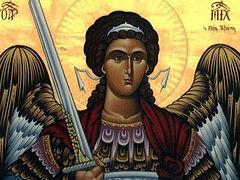
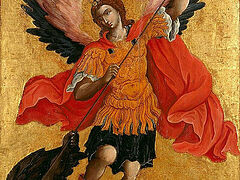
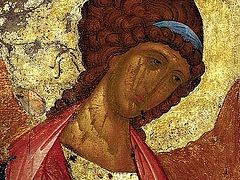
 Commemoration of the Miracle of the Archangel Michael at Chonae (Colossae) The Archangel Michael, the renowned and glorified angel of God, is the Heavenly protector of all Orthodox Christians. In the Bible, he is called the captain of the Lord’s host, and that is also what he called himself (Josh. 5:13–15). That is why the Archangel Michael is referred to as the Archistrategos (Leader of the Heavenly Hosts). In icons, he is depicted in warrior’s armor, holding a shield and a sword or spear in his hands.
The Archangel Michael actively participates in people’s lives. He inspired Joshua to claim the land promised to him by the Lord and take the city of Jericho without a fight. He also visited the Prophet Daniel (cf. Dan. 10: 12–13).
The Archangel Michael has long been venerated in Russia. In the Volokolamsk Patericon, dating back to the early sixteenth century, St. Paphnutius of Borovsk recounts how Veliky Novgorod was saved from the horde of Batu Khan through the Archangel Michael’s intercession.
Before 1917, Russia was home to numerous churches and chapels dedicated to the Archangel Michael. When Tsar Ivan IV the Terrible captured Kazan in 1552, he commissioned the icon, “Blessed Is the Host of the Heavenly King”. This icon depicts the holy Greatmartyrs George the Victorious and Demetrius of Thessaloniki, the Right-Believing Grand Princes Alexander Nevsky and Dimitry Donskoy, and others—all led by the Archangel Michael.
The Turkish province of Denizli is home to a site associated with the Archangel Michael. In the fourth century, it was the location of Colossae, an ancient city in Asia Minor, where a remarkable miracle took place. Following this miracle, Colossae was renamed Chonae, which means “cleft”, or “plunging”.
Founded by the Phrygians in the fifth century B.C., Colossae was established near an extinct volcano called Cadmus (Mount Cadmus; now Honaz Dag). Numerous hot springs of varying temperatures serve as a lasting reminder of the Cadmus volcano. Mineral-rich mountain streams burst forth from beneath the earth, making the local orchards highly fertile and capable of producing bountiful harvests of fruits and berries.
One of the local springs possesses special properties. It was this very spring that St. Michael brought to the surface nearly two millennia ago. This spring became famous for its healing power. Both Christians and pagans came to it seeking cure, and pagans were often baptized by the healing waters. After bathing in this spring, the mute daughter of a wealthy Greek man was healed. Out of gratitude, he built a large church in Colossae in honor of the Archangel Michael. Now, not only the healing spring, but also the active Orthodox church attracted countless pilgrims. This aroused resentment among the pagans, and one day they devised a cunning plan to destroy the church.
The pagans of Colossae decided to dig a single channel for two mountain rivers and direct this powerful flow of water straight towards the church of the Archangel Michael. Archippus the sexton lived at the church during those years. He vigilantly watched the digging of the new riverbed. Archippus feared for the church’s fate but had no way to stop the pagans from carrying out their plan. So he started praying fervently to the Archangel Michael, imploring him to save the church from destruction. The archangel heard his prayer and appeared in Colossae just as the massive torrent of water began rushing down the mountain.
 St. Michael commanded the mountain river to stop, turned it in another direction, and then struck the cliff standing in the path of the raging waters. Millions of tons of water began cascading into the resulting fissure with a terrifying roar. Since then, for 2,000 years, this mountain river has flowed through this cleft instead of its original course. The church was saved.
The townsfolk were so deeply moved by this miracle that they renamed Colossae to Chonae, after the large cleft in the rock where the river flowed. Even Mount Cadmus was renamed Mount Honaz.
Following the miracle performed by the Archangel Michael, the church dedicated to him and the healing spring near it became even more famous in the surrounding lands. Pilgrims arrived in significantly greater numbers: people sought to visit Chonae and see with their own eyes the fissure in the rock where the river water had vanished by the will of the Leader of the Heavenly Host.
However, 500 years after this miracle, an earthquake destroyed the town of Chonae to its foundations, and the residents were unable to rebuild it on their own. Many people perished, and the survivors left to live in neighboring towns and villages. The ruins of Chonae gradually became overgrown with grass. Yet, the Orthodox Church continues to commemorate the Miracle of the Archangel Michael in Chonae every year. This feast day is celebrated across the world.
A few years ago, the Turkish Government decided to begin excavations of the ancient site of Chonae, over which a large mound now rises. Turkish archaeologists are exploring the area and surveying the soil. They have discovered that the ground consists of karst formations riddled with subterranean voids where groundwater actively carves out its paths. This complicates the start of the excavations.
Archaeologists want to find the ruins of the famous church in honor of the Archangel Michael, which would undoubtedly attract many Christian pilgrims from all over the world. The location of the church has not yet been established. Perhaps it lies beneath the hill among the ruins of the town of Chonae. Alternatively, the square marble blocks on the meadow near the hill might be all that remains of it. Beyond the meadow, the remnants of rock-cut tombs are visible. To know for certain that the Church of the Archangel Michael has been found, archaeologists must discover signs of a Christian church. This could be a semicircular altar apse or stone fragments with crosses carved into them. However, it is well known that the church is somewhere nearby and that St. Michael performed his miracle on this very spot. That is why the cleanly split rock beside the town attracts so much attention: it looks as if it had been cut with a huge knife, like butter. It is obvious that the Archangel Michael’s blow was so powerful that it triggered an earthquake and opened a cleft in the rock, which swallowed the powerful torrent of water aimed at the church.
The healing spring of the Archangel Michael under Mount Honaz still exists, and locals and pilgrims still visit it. The spring gushes powerfully from beneath huge stones on one of the mountain’s slopes. Next, the water flows into a small man-made pool, and then flows further to join the surrounding streams. People of various faiths come here to wash their faces and take some water home—everyone believes in its miraculous power. Some even bathe in the pool, despite the signs forbidding it.
 Kaklyk underground cave near the ancient town of Chonae in Turkey
There is another amazing place not far from the ruins of the ancient town of Chonae: Kaklyk Cave. All the local streams flow into it and vanish inside. Perhaps this cave bears witness to the Miracle of the Archangel Michael, because the torrent that he diverted away from the church had to go somewhere without harming anyone.
Kaklyk Cave is astonishing in its sheer scale. It could easily contain a rushing torrent of water. For tourists, staircases have been installed leading downward. A railed path winds between stalactites and travertines. It is advisable to walk barefoot, as you have to tread through mineral water spilling over the walkway and into the depths of the earth. The path is covered in rocky deposits—some rough, others smoothly polished by countless trickling streams. The white travertines form otherworldly scenes, plunging deep underground while streams of water murmur and pour through them into the bowels of the earth. Each flow seems to follow its own unique path. Yet, all these rivers and streams appear to share a single purpose, set for them by the Archangel Michael 2,000 years ago.