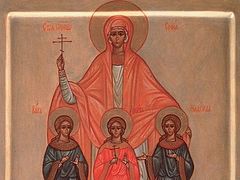
In the history of Christianity, there is a podvig that is difficult for the mind to grasp, impossible to explain with logic, and dangerous to attempt to repeat. Three young girls and their mother in second-century pagan Rome voluntarily accepted a martyr’s death for their faith in Christ. Faith was twelve, Hope was ten, and Love was only nine. Their mother, Sophia, did not dissuade her daughters from this podvig but blessed them for it—and she herself died on their grave three days later. When we read this hagiography for the first time, our heart is seized with indescribably mixed emotions: admiration, horror, bewilderment, and a profound tenderness that moves one to tears.
To us, the people of the 21st century, raised in a paradigm of psychological comfort and personal safety, this podvig seems like something extraordinary, almost impossible. And that is precisely why we need to look closely at it. Not to imitate it, but to understand something essential about the nature of the human soul, the power of motherly love, and what it truly means to raise a child.
On September 17/30, the Orthodox Church commemorates the Holy Martyrs Faith, Hope, Love, and their mother, Sophia. This is one of the most beloved and revered feasts among the people, and it is no wonder that the names of these saints have become almost native to the Russian heart. Yet, behind the familiarity of these names often lies a misunderstanding of the depth of what occurred in Rome in the second century during the reign of Emperor Hadrian. Meanwhile, this very event holds the answers to questions that concern every parent today and anyone who has ever wondered about the nature of true faith, genuine hope, and authentic love.
Sophia, whose name translates from Greek as “wisdom,” was a widow originally from Milan. After her husband’s death, she moved to Rome with her three daughters and settled in the home of a wealthy Roman woman. She raised the girls in the Christian faith—and she did not simply raise them, but named each after one of the primary Christian virtues. Pistis, Elpis, and Agape—so their names sounded in Greek. Faith, Hope, and Love. Sophia did not just give her children beautiful names; she invested the entire meaning of her life into each one. She taught her daughters not to attach themselves to earthly goods, teaching them not through words, but by her own example—through prayer, fasting, and almsgiving to the poor. When the moment came when faith could cost them their lives, the girls proved ready. Not because they were special, superhuman beings, but because their mother had managed to instill in their hearts something stronger than the fear of death.
From the perspective of Orthodox psychology, a striking picture unfolds here. Modern secular psychology speaks at length about attachment, safe environments, and protecting a child from trauma. All of this is correct and necessary. But Sophia shows us something else—an upbringing where safety is understood not as the absence of danger, but as the presence of God. A child who knows from early infancy that there is something more valuable than bodily life gains an inner anchor that no external force can destroy. This does not mean that children should be put in harm’s way. It means that faith, planted in a child’s soul with love and wisdom, is capable of transforming even the most terrifying trial into a triumph of the spirit.
When Emperor Hadrian summoned Sophia and her daughters to the palace, he initially tried to act with kindness. He was astonished by the courage of these young girls, and by their clear and firm answers. He could not comprehend how children could possess such conviction. An attempt to change their minds through Palladia, a pagan instructor in whose house Sophia and her daughters spent three days, was also unsuccessful. Psychologically, this is a striking moment: the Emperor gave them three days in a luxurious palace, hoping that the temptation of wealth and comfort would break their resolve. But Sophia did not use these three days to enjoy luxury; instead, she used them to further strengthen her daughters in the faith. She told them that the hour of their podvig had come, that their immortal Bridegroom was waiting for them, and that the crown of martyrdom was more precious than all earthly treasures. The girls heeded their mother—and prepared for death just as one would prepare for a wedding.
Here we see a crucial psychological phenomenon: The mother did not simply pass down a set of facts about God to her children; she formed within them a comprehensive value system in which the eternal took precedence over the temporary. The children did not fear death—not because they failed to understand what it was, but because the reality of God’s world was more tangible to them than the reality of the earthly world. This is true faith—not intellectual assent to a set of dogmas, but a living sense of God’s presence that makes the impossible possible.
When the tortures began, Sophia stood and watched. She did not intervene, she did not beg for mercy, and she did not try to dissuade her daughters. She prayed and encouraged them. Of the entire narrative, this is the most difficult moment to comprehend. How could a mother stand by and watch her children being tortured? It is crucial to understand here that Sophia was not unfeeling. She was not a fanatic devoid of maternal instinct. On the contrary, the hagiography shows us a mother who loved her children with a love so profound and perfect that this love proved stronger than the instinct for self-preservation or the fear of loss. She understood that if she told her daughters to recant at that moment, she would save their bodies but destroy their souls. And so, she chose the eternal for them.
Psychologically, this is a paradox of the highest order. Normal, natural maternal love seeks to protect a child from any pain and shield them from all suffering. But Christian love, enlightened by grace, sees beyond the visible. Sophia loved her daughters more than herself, and that is precisely why she did not stand in the way of their podvig. This is neither cruelty nor indifference. It is the highest form of maternal sacrifice—surrendering one’s children to God, knowing that they are going to Him rather than vanishing into oblivion.
Faith, the eldest, was the first. She was scourged, her breasts were severed, she was placed on a red-hot iron grate, and she was thrown into a cauldron of boiling pitch. Yet, by the will of God, none of these tortures caused her harm. When they finally decided to behead her, she said, “I will go with joy to my beloved Lord and Savior.” A twelve-year-old girl spoke these words. There is not a shadow of affectation or false pathos in them. Instead, there is the quiet, clear certainty of someone who knows where she is going.
Seeing her older sister’s suffering and death, Hope did not waver. She embraced Faith’s body and wanted to weep, but out of love for Christ, her tears became tears of joy. This is a striking psychological detail: Natural human sorrow was not suppressed but transfigured. It did not vanish; rather, it was transformed into something greater. Hope said to her younger sister, “Do not remain here either, sister; let us stand together before the Holy Trinity.” And she went to her own torture. She was cast into the fire and scraped with iron claws, yet a wondrous fragrance emanated from her wounds, and on her face was a constant smile.
Love, the youngest at nine years old, witnessed everything that happened to her sisters. Her mother prayed for her, saying, “My third branch, my beloved child, strive until the end. You are walking a good path; a crown has already been prepared for you, and the bridal chamber has opened.” The girl listened to her mother and went to her torture. She was stretched on a wheel and beaten until her flesh separated from her bones, and then thrown into a furnace, but the flames did not touch her. After all this, she was beheaded with a sword.
From the perspective of Orthodox psychology, we see in this podvig the manifestation of what the Holy Fathers call “spiritual courage.” This is not natural bravery or a fearlessness based on ignorance or denial of danger. It is a courage born of faith, hope, and love, and it is accessible not only to adults but also to children if their souls are strengthened by the grace of the Holy Spirit. As it is written in the hagiography—for people strengthened by the grace of the Holy Spirit, a lack of physical strength is in no way an obstacle to the manifestation of spiritual power and courage.
But the profoundest psychological lesson of this narrative lies not in the girls’ podvig, but in the that of their mother. Sophia was not subjected to physical torture. The Emperor condemned her to something that was, from his perspective, far more cruel—he released her so that she would live and carry within herself the memory of what she had witnessed. This was a torment of the soul, not of the body. From a psychological standpoint, it is precisely this form of suffering that often proves to be the most destructive. A mother who survives the death of her children, especially under such circumstances, can easily be crushed by guilt, grief, and despair. She might fall into depression, despondency, or bitterness. She might curse God for not protecting, saving, or intervening in these deaths.
Yet, Sophia did not curse God. She did not fall into despondency. She took the bodies of her daughters, buried them on a high hill outside the city, and spent three days at the grave in prayer. On the third day, the Lord granted her a peaceful death. The faithful buried her alongside her children. The Church numbered Sophia among the saints—not for bodily torments, which she did not endure, but for the spiritual torments she bore with faith and thanksgiving.
This is a remarkable moment. Sophia is a martyr not in body, but in heart. Her podvig is one of spiritual endurance, of faithfulness to God in the most unbearable circumstances imaginable. And perhaps it is this very podvig that hits closest to home for us today. Thank God, we do not face such persecutions. Yet, each of us encounters loss, grief, and trials in life that feel unendurable. Each of us stands before the exact same choice Sophia faced: to curse or to accept, to despair or to hope, to retreat or to remain faithful.
Orthodox psychology views psychological suffering not as a pathology to be eliminated at all costs, but as a space where a person can encounter God. Not all suffering is beneficial, and not all of it should be endured passively. But there are sufferings that cannot be avoided—sufferings that must be lived through, and within which the soul, if anchored in faith, attains a depth never known before. Sophia did not live through her grief in isolation and bitterness, but in prayer at her daughters’ grave. She did not run away from the pain, nor did she attempt to numb it. She brought it to God, and God received her soul.
In this context, the podvig of the Martyrs Faith, Hope, Love, and their mother Sophia becomes for us more than just a historical fact or a church tradition; it is a living lesson on how faith transforms the human psyche. Or rather, how it does not merely transform it, but unfolds within it what was originally implanted by the Creator: the soul’s capacity to overcome fear, to love sacrificially, and to remain faithful through suffering.
The Faith manifested by the eldest daughter is not merely intellectual assent to the existence of God. It is a living, experiential knowledge of God that frees a person from the fear of death. In Orthodox psychology, such faith is understood as the highest form of psychological integration, where all the faculties of the soul—mind, heart, and will—are directed toward God and in harmony with one another. A person possessing such faith is not divided or torn apart by inner contradictions. They are whole, and it is precisely this wholeness that grants them the ability to endure what would otherwise shatter a fragmented soul.
The hope shown by the middle daughter is not simply optimism or a belief in a better tomorrow. In the Orthodox understanding, hope is a reliance on God that does not depend on external circumstances. It is not the psychological mindset of “everything will be okay,” but a deep-seated certainty that God is faithful and that His Providence for us is good, even if we cannot perceive that goodness at the present moment. The hope of a martyr is a hope that does not flicker out in the face of death, because it rests not on life experiences, but on the promise of God.
The love manifested by the youngest daughter is neither a sentimental feeling nor a mere attachment. In the Orthodox tradition, God is love, and a person who partakes in this love partakes in God Himself. A martyr’s love is a love stronger than death, a love that does not seek its own, but gives itself entirely. A nine-year-old girl demonstrated this love in its purest, most perfect form, evoking not only our admiration but deep humility. We adults behold a child in whom the love of God was manifested more fully than in most of us over a long lifetime.
And the wisdom (Sophia) manifested by the mother is neither book knowledge nor worldly experience. It is what the Holy Fathers called “spiritual wisdom”—the ability to discern the eternal from the temporary, the genuine from the illusory, and good from evil. Sophia was wise not because she knew much, but because she loved much. Her wisdom lay in raising her children so that they would be capable of this podvig, and in living through her grief in such a way that it became a path to God rather than a departure from Him.
This is the main psychological lesson of the hagiography of the Martyrs Faith, Hope, Love, and their mother, Sophia. Raising children in the faith is not about shaping a set of correct beliefs; it is about creating an environment in which a child’s soul can unfold toward God. Sophia did not force her daughters to believe. She lived in such a way that faith became as natural to them as breathing. She did not tell them, “You must suffer for Christ.” Instead, she said, “Your Bridegroom is waiting for you, and a crown has already been prepared for you.” She spoke these words with such love and such faith that the girls could not help but heed them.
Today, we often ask: How can we raise a child in the faith when the world around us is secular, seductive, and hostile? Sophia lived in pagan Rome, in surroundings that were not merely indifferent to Christianity, but actively hostile. Yet, she did not isolate her children from the world, she did not hide them away, and she did not artificially shield them. She simply lived in such a way that God was more real in her home than the Emperor on the throne. And that proved to be enough.
Of course, we are not called to replicate the martyrs’ podvig. Every era presents humanity with its own tasks. However, we are called to draw from this hagiography that which can guide us in our own lives. And what can help us is this: faith, planted in a child’s soul through love and personal example, is capable of overcoming any fear. Hope that relies on God does not flicker out in the face of the most terrifying trials. Love, which is a gift from God, is stronger than death. And the wisdom of a mother raising her children in God is the greatest force on earth.
The commemoration day of the Holy Martyrs Faith, Hope, Love, and their mother Sophia, celebrated on September 17/30, is not simply a church feast. It is a day when we can pause and ask ourselves questions that we usually turn away from. What are we teaching our children? What are we instilling in their hearts? What value system are we forming? Are we ready, like Sophia, to surrender our children to God, knowing that He will care for them better than we ever could? And do we truly believe in what we claim to believe?
The answers to these questions will not be simple. Yet, it is precisely in searching of these answers that we can find the path to a genuine and not only performative faith. To a hope that does not fade. To a love that is stronger than fear. And to the wisdom that brings all of this to life.
Holy Martyrs Faith, Hope, Love, and your mother Sophia, pray to God for us!