On September 18/October 1, the Russian Orthodox Church celebrates the feast of the Synaxis of the New Martyrs and Confessors of the Land of Vladimir. It includes saints who are known to many believers (such as Martyr Tatiana Grimblit, the Venerable Martyr Ignatius (Lebedev), and St. Athanasius (Sakharov), Bishop of Kovrov, who is especially venerated at the Moscow Sretensky Monastery), as well as those known to only a few. This celebration was established in 2017 with the blessing of His Holiness Patriarch Kirill and appointed to coincide with the feast day of the Hieromartyrs Konstantin Tverdislov and Veniamin Blagonadezhdin. Below we offer our readers short accounts of some of these saints.
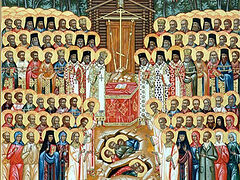
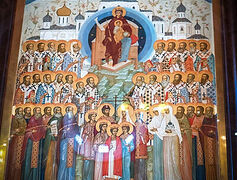
 Synaxis of the New Martyrs and Confessors of the Land of Vladimir
Hieromartyr Konstantin/Constantine Tverdislov (1881–1937), Archpriest
He was born in 1881 in the Vladimir governorate. He had a “seminary” surname, derived from the letters “slovo” (meaning “word”) and “tverdo” (meaning “hard”, “solid”, or “surely”) of the Church Slavonic alphabet. In earlier centuries, such names were bestowed on students of theological schools with the blessing of the church hierarchy. Following the example of his distant ancestor, he entered the Murom Theological School. On graduating, he enrolled in the Vladimir Theological Seminary.
After completing his seminary studies, the future hieromartyr began teaching at a rural school., The students saw in him a “wonderful catechist and father figure who knew how to capture their attention during the Law of God lessons, a deeply devoted and skillful spiritual guide, an eloquent teacher, and an always approachable, kind, and responsive man.” In the summer of 1904, he married, was ordained priest and appointed rector of the Holy Resurrection Church in the town of Yuryev-Polsky (now in the north-west of the Vladimir region), where he began his active preaching ministry. His words, filled with a fervent love for God, were published in the Vladimir Diocesan Gazette. From the ambo he spoke of sincere repentance, living according to God’s commandments, and the necessity of prayer and brotherly love. The priest paid special attention to charity: he organized donations in his parish through a church poor box, introduced congregational singing during services, and assembled a library. At the same time, he taught the Law of God and visited soldiers’ families, “to suffer with the suffering and weep with those who weep (cf. Rom. 12:15), thereby easing the bottomless river of their sorrow.”
In 1916, Fr. Konstantin entered the Moscow Theological Academy (previously, married priests were not allowed to do so). His family moved to Sergiev Posad. He did not study there for long, though, because times were hard, and the Academy was on the verge of closing. Fr. Konstantin returned to the Vladimir region, becoming a cleric at the Cathedral of the Kazan Icon in the town of Vyazniki. In 1928, the authorities intended to shut down the cathedral. The local bishop, future Hieromartyr Herman (Ryashentsev), along with the dean and clerics of the cathedral, were arrested.
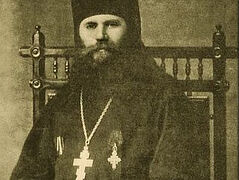
 Archpriest Konstantin Nikolaevich Tverdislov. Photo from the investigation file of 1928
At the end of the year, Fr. Konstantin was arrested as well. He was charged with “delivering anti-Soviet sermons.” He was confined in a lockup as an especially dangerous criminal. In jail, he stood firm and courageous, betrayed no one, and did not plead guilty. He was sentenced to three years of exile in Siberia. After completing his exile, the priest moved to the city of Tambov. From there, he wrote to his family: “How should we live? We must live with resilience and courage, and thus strengthen our will in this direction… Both cheerfulness of spirit and courage are always needed. They are the primary threads of the foundation on which the fabric of our lives is woven.”
In 1934, he was granted early release and returned to Vyazniki. In 1937, Fr. Konstantin was arrested again—this time for holding “prayer services in support of the former reigning Romanov throne” (which is how the indictment labeled the service honoring the holy Martyr Tsarina Alexandra), as well as for “counter-revolutionary sermons” and “anti-Soviet agitation.” In September 1937, he was sentenced to death by firing squad. On October 1, Archpriest Konstantin Tverdislov was executed in the city of Ivanovo.
Hieromartyr Veniamin/Benjamin Blagonadezhdin (1880–1937)
 Hieromartyr Veniamin Blagonadezhdin He was born in 1880 in the Vladimir governorate into the family of a church reader. In 1904, he graduated from the Moscow Theological Seminary, after which he worked as a teacher. Two years later, he was ordained priest at one of the churches in the Vladimir governorate. In 1926, he became a witness in the case of Hieroconfessor Afanasy (Sakharov), who had been arrested for “anti-Soviet agitation.” Together they had celebrated a service, and on that day Vladyka Afanasy called on the faithful not to fear persecution for their faith. In those years, the authorities persecuted with particular cruelty those who spoke openly about these persecutions. At the trial, Fr. Veniamin said in defense of St. Afanasy: “I have not heard him say that in the present day and under current conditions there is persecution for Christ’s faith.”
In 1930, the church where Fr. Veniamin served was temporarily closed. However, with the help of the faithful, the celebration of services continued there. The priest served in that church until his arrest. In September of the terrible year of 1937, he was jailed in the town of Yuryev-Polsky. The false testimonies against Fr. Veniamin stated: “He spread counter-revolutionary defeatist rumors.” The investigation charged him with maintaining a parish choir of women and youth in his church. The interrogations continued. Hieromartyr Veniamin was sentenced to death by firing squad. On October 1, 1937, the sentence was carried out.
Venerable Hieromartyr Makary (Morzhov) of St. Zosima’s Monastery (1872–1931)
The future monk-martyr was born in 1872 in the Vologda governorate into a peasant family and was named Mikhail at Holy Baptism. He studied the Law of God at a parish school. In his youth, Mikhail was drafted into the army, and on his return, he found work as a laborer at a Moscow factory. In 1899, he entered St. Zosima’s Monastery as a novice.1 There, Mikhail became a disciple of the holy Elder Alexei (Soloviev), And with the blessing of the monastery abbot, St. Herman (Gomzin), he became Elder Alexei’s cell-attendant.
In 1903, the young novice took monastic vows with the name Makary (Macarius). According to the recollections of the elder’s spiritual children, Fr. Makary “willingly submitted to the role of becoming Fr. Alexei’s cell-attendant, and remained so until the very end… He was his faithful servant and unquestioningly carried out his far from easy obedience. Fr. Alexei was not only his spiritual father and elder—he was his closest friend for many years. For nearly thirty years, Fr. Makary served him with loyalty and devotion, guarding the elder’s peace, and in the final years, he became like a nurse to him.”
Under Elder Alexei’s spiritual guidance, Fr. Makary learned through experience the virtue of humility and Christian love for one’s neighbor. There is a well-known episode from the Lives of these two ascetics: “Once Elder Alexei was conversing with a student from the Theological Academy. Fr. Makary had just cleaned the samovar, filled it, kindled it, and said, ‘I am going to the chapel to fetch some water; and you, father, make sure the samovar does not boil over.’ During the conversation, Fr. Alexei forgot about the samovar, and because it was boiling so fiercely, it overflowed. On his return, Fr. Makary saw this and said reproachfully, ‘Father, you could not even manage that! Now all my hard work has gone down the drain, and I spent half the day cleaning this samovar!’ The elder fell at Fr. Makary’ feet and begged forgiveness, ‘Forgive me, Father Makary! I have done wrong.’”
Another time, when a visitor was present, the elder called Fr. Makary into his cell. When he came out, he could not hold back his tears. When asked what had happened, he answered, “The elder is asking for my forgiveness.” By his own example, the elder showed his disciple the true meaning of the Gospel words: Take My yoke upon you, and learn of Me; for I am meek and lowly in heart (Mt. 11:29).
 Hieromartyr Makary (Morzhov) of St. Zosima’s Monastery
In January 1923, a liquidation commission arrived at the monastery. By May of that year, the monastery had been shut down and the monks expelled. The icon covers and library books were confiscated from Elder Alexei. The saint and his cell-attendant relocated to Sergiev Posad. In 1927, the elder became bedridden. Fr. Makary stayed by his side constantly until his repose. Following the elder’s repose, Monk Makary was ordained hierodeacon and, shortly thereafter, hieromonk, serving at the Moscow Vysokopetrovsky Monastery for some time.
In 1931, Hieromonk Makary was arrested. For several years, a dossier had been compiled on him in connection with his service under St. Alexei. Many people close to the elder did not escape arrest. So hateful is holiness to the enemy of mankind… During the interrogation, Fr. Makary said: “It is true that I travel to Moscow rarely, but I will not say with whom I stayed, because it is better for me to suffer alone rather than cause trouble for my acquaintances. While in Moscow, I visited churches, but I do not remember which ones. I have no acquaintances in Zagorsk;2 for the most part, I stay at home. Occasionally, when the desire arises, I serve in the churches of Sts. Peter and Paul, at the Kukuevskoye Cemetery, and others.3 The rest of the time I do manual labor, such as clearing snow from yards and chopping firewood.”
Fr. Makary was transferred to Butyrka Prison. The interrogations continued, but he stood firm and did not betray any of those close to the elder. He courageously replied: “I believe that God has allowed the Soviet regime as a consequence of our sins, but a true Christian should patiently endure all persecution and oppression by the authorities. Under the Tsars, sin was less prevalent, so the Church faced no such oppression… At every service during the Proskomedia, I commemorate the Russian Tsars using the general formula from the service book: ‘Remember, O Lord, the most pious sovereigns and emperors.’ As for myself, I ask God to help me be saved. And I believe that even in today’s blasphemous conditions, salvation is possible—if not openly, then through a hidden spiritual feat; for one can pray in secret as well.”
Fr. Makary was charged with “being a member of a counter-revolutionary organization and engaging in agitation aimed at undermining and weakening Soviet power.” He was sentenced to death by firing squad. In June 1931, the sentence was carried out.
The venerable martyr was secretly buried at the Vagankovo Cemetery in Moscow. The Church prays to this saint with the following words of the troparion in his honor: “Shining with the robes of holiness and glowing with the crown of martyrdom, O Divinely wise Makary, good warrior of Christ, cease not to pray for us who honor thy holy memory this day.”
The New Martyrs of Russia show us, contemporary Christians, first and foremost an example of standing firm in the faith despite any suffering. In difficult moments of life, let us remember their podvig and find strength in bearing our cross: “We magnify you, O holy New Martyrs and Confessors of the land of Vladimir, and we honor your precious sufferings, which you endured for Christ our God.”