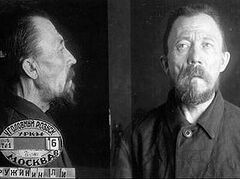
September 2. Hieromartyr Lev/Leo Yershov, Presbyter (1867–1918)
Father Lev’s Final Liturgy
 The Hieromartyr Lev Yershov While Red Army soldiers were transporting the arrested Fr. Alexander Malinovsky to prison, they also arrested Fr. Lev on the way to a church in the town of Krasnoufimsk (in the Perm Governorate). It was a Sunday and a service was underway when the Red Army soldiers burst in and opened fire at random. They pushed through the worshippers towards the altar. Fr. Lev promised to go with the soldiers but asked to be allowed to finish the service. The priest courageously completed the final Liturgy of his life, and after the parishioners had venerated the holy cross, he headed for the exit. The Red Army soldiers seized him, started beating him, and literally dragged him out of the church. On the porch, Fr. Lev saw the arrested Fr. Alexander surrounded by soldiers. The priests wanted to embrace, but this angered the soldiers, who began hitting the priests on the head with rifle butts. In prison, they were placed in the same cell. On the night of September 2, 1918, the priests were bound together with barbed wire and shot to death outside the town.
September 3. Hieromartyr Pavel Yagodinsky, Presbyter (1879–1937)
Father Pavel’s Three Arrests
 The Hieromartyr Pavel Yagodinsky. Photo: senim-online.kz In 1929, Fr. Pavel was arrested for the first time and sentenced to eight months in a corrective labor camp. After his release, he returned to serving at the church in the village of Shugurovo in Mordovia. Fr. Pavel diligently fulfilled his priestly duties: he baptized, conducted weddings, and celebrated funeral services. He inspired many to active work, encouraged them with warm approval, supported the weak, and defended the wronged. In 1930, the church where Fr. Pavel served was closed, and he was arrested for a second time. Following his release in 1933, Fr. Pavel carried out his pastoral ministry in the village of Buzayevo in the Bolshiye Berezniki district of Mordovia. By that time, the priest’s wife had passed away, and he lived alternately with his sons. Each of them had already chosen his own path and settled into the new life.
Once, Fr. Pavel had a conversation with the chairman of the village council, who advised the priest to “leave his profession, renounce his priesthood, and find a steady job.” However, the future hieromartyr replied, “No, I have not renounced my priesthood, nor have I ever thought of doing so. My religious convictions do not allow me to do this—I will die a priest.”
On August 5, 1937, Fr. Pavel was arrested for the third and final time. During the interrogation, the arrested priest confirmed his words that he had no intention of quitting his priesthood, stating, “Although I am a convicted believer, I have never conducted anti-Soviet agitation anywhere.” The NKVD (“People’s Commissariat of Internal Affairs”) Troika extrajudicial tribunal of the Mordovian Autonomous Soviet Socialist Republic sentenced Priest Pavel Yagodinsky to the ultimate penalty. On September 3, 1937, he was executed by firing squad.
September 4. Hieromartyr Gabriel Arkhangelsky, Presbyter (1890–1937)
An Appeal to the Flock against Renovationism
 The Hieromartyr Gabriel Arkhangelsky There were no liturgical vessels left in the rural church—plundered by the atheists—where Fr. Gabriel was sent to serve. With the bishop’s blessing, the priest purchased glassware and continued to celebrate the Divine Liturgy.
Apparently, the church was shut down shortly thereafter, as Fr. Gabriel moved to Penza and, with the bishop’s blessing, began serving at St. Mitrophan Church, which had become the diocesan cathedral. While celebrating memorial services at the Myronositskoe (in honor of the Holy Myrrh-bearing Women) Cemetery, the zealous pastor called on the parishioners of the Renovationist Holy Dormition Church to return under the omophorion of the legitimate bishop—an act the authorities classified as anti-Soviet agitation.
On October 18, 1936, Fr. Gabriel was arrested along with Bishop Theodore and four other priests who enjoyed the bishop’s special trust and supported him in the struggle against the Renovationists: Frs. Vasily Smirnov, Andrei Golubev, Irinarch Umov, and John Khoroshunov. All those arrested, except Fr. John, who received a prison sentence, were sentenced to capital punishment. Priest Gabriel Arkhangelsky was shot on September 4, 1937.
September 4. The Venerable Martyr Ierofey (Glazkov), Hieromonk (1889–1937)
A Monk from a Ruined Monastery
 Fr. Ierofei took the ruin and closure of his beloved Monastery of the Holy Trinity and St. Pavel of Obnora (in the Vologda region) during the years of Soviet godless rule very hard. On April 14, 1924, all the monks of the monastery were ordered to leave and forbidden to come within three miles of it. In one of his poems, Fr. Ierofei wrote:
But then came evil men
And destroyed this beautiful garden of flowers;
All was violently and harshly uprooted
And now the monastery stands, orphaned.
The monks had to seek shelter. In 1925, Fr. Ierofei was accepted into the clergy of the town of Lyubim in the Yaroslavl province. On May 25 of the same year, Bishop Sergei (Melnikov) of Lyubim ordained him hieromonk and appointed him rector of the cemetery Church of the Entry of the Mother of God into the Temple. In 1930, the authorities sentenced Fr. Ierothei to five years in labor camps for “anti-Soviet activity.” In 1935, he returned from the camp to his former place of service.
On July 7, 1937, he was arrested again and interrogated, with demands to give testimony against fellow clergy; but Hieromonk Ierofei categorically refused. Less than a month later—on August 19—he was sentenced to death by shooting. The sentence was carried out on September 4.
September 7. Hieromartyr Vladimir Moshchansky, Presbyter (1866–1938)
Father Vladimir’s Kind Heart
 The Hieromartyr Vladimir Moshchansky Fr. Vladimir was widowed early, and his reposed wife’s unmarried sister, Alexandra Ivanovna, helped him raise their four young children. The priest’s family lived next door to factory workers. Sometimes, the workers would get their wages and squander them in three days, even though they had families to support; so they would go to the priest to borrow money. “Father, they will not give it back to you,” Alexandra Ivanovna would say to Fr. Vladimir. But even knowing this, he would lend them money—his kind heart simply could not turn anyone away.
During the ruthless persecutions of 1937—on February 13—a car stopped beside Fr. Vladimir’s house, and three NKVD officers stepped out. They presented a warrant to search the house and arrest the priest. Fr. Vladimir was held in a prison cell under harrowing conditions, where it was impossible to even lie down on the floor. He fasted strictly and gave away almost all the parcels Alexandra Ivanovna sent to him to his cellmates. While in confinement, he turned seventy-two. The priest’s health grew worse and worse, yet the prison administration was slow to take any measures whatsoever, so eventually his cellmates became exasperated. They started banging on the iron door and shouting, “Why are you tormenting the old priest? What is his crime? We also believe in God!” Unable to survive the brutal conditions of his imprisonment, Archpriest Vladimir Moshchansky reposed on September 7, 1938.
September 9. Hieromartyr John Lebedev, Presbyter (1869–1937)
“Just Do Not Renounce the Faith!”
 Hieromartyr John Lebedev When with the Bolsheviks’ rise to power the persecution of the Russian Orthodox Church began, Fr. John, foreseeing the severe trials ahead for the faithful, would often repeat to his spiritual children, “Just do not renounce the Faith!”
The priest was arrested on August 20, 1937, and sent to one of the jails of the Kolomna district near Moscow. On September 8, 1937, an NKVD Troika sentenced him to death by firing squad. The following day, Archpriest John Lebedev was executed at the Butovo firing range near Moscow.
September 12. New Martyr Theodore Ivanov (1895–1937)
A Comforter and Man of Prayer
From childhood, Theodore Mikhailovich suffered from a severe illness—paralysis of the legs—experiencing intense pain. During the solemn glorification of St. John of Tobolsk, the sufferer was brought to touch the holy relics during the festal service, and after that, the pain in his legs ceased.
For his deep faith, the people treated St. Theodore with great respect, and many visited him, including monks, priests, and bishops. The sick Theodore was revered by the people as a great comforter of sorrowful souls and an unceasing intercessor. In August 1937, the authorities warned Theodore that if people did not stop coming to him, he would be arrested. But he could not turn away those seeking comfort and help. NKVD officers carried the arrested Theodore out on a stretcher. As they were taking him away, he prayed and said to his family, “My dear mother and sister, do not wait for me and do not make inquiries; they will not tell you the truth anyway. Pray. Do not weep for me and do not look for me!”
 New Martyr Theodore Ivanov
In the cell, the martyr was placed facing the wall so that he could not see anyone, and was forbidden to speak. In prison, he was never questioned, never taken for interrogation, and the investigator never visited his cell. On September 11, the NKVD Troika sentenced Theodore Ivanov to death by firing squad. He was shot in the Tobolsk Prison and buried on its grounds.
September 12. Hieroconfessor Peter Cheltsov, Presbyter (1888–1972)
Father Peter’s Long and Difficult Life
 The Hieroconfessor Peter Cheltsov Fr. Peter was arrested six times. During one of his arrests, he was sentenced to three years in a concentration camp, which he served in Solovki. The priest later recalled that in Solovki they had even tried to drown him in the sea several times, but the Lord preserved him. On June 18, 1949, when the priest was sixty-one years old, he was arrested for the last time—charged with “delivering anti-Soviet sermons and gathering hostile church elements around himself.” The authorities confiscated forty-six of his books, two portraits of the holy Tsar-Martyr Nicholas II and his family, and his personal correspondence. The prisoner was sentenced to ten years and escorted under heavy guard as an “especially dangerous criminal” to the Mineralny Camp near the Abez Station of the former Pechora Railway network.1
On November 28, 1955, the hieroconfessor was released early as an elderly disabled person. When Fr. Peter was very old, he still continued to serve in church. He would be led home by the arms after the service and seated in an old wicker armchair, where he would continue to speak to people with his eyes closed. The churchwarden, Maria Timofeevna, would sometimes tell him, “Father, that is enough—get some rest.” But he would shake his head, “I am doing my duty—I will be resting soon.”
In the summer of 1972, Fr. Peter fell gravely ill, but, overcoming his illness, he continued to celebrate the services. He served for the last time on July 21—the feast of the Kazan Icon of the Mother of God. As the hieroconfessor was closing the Royal Doors after the service, tears streamed down his cheeks.
Fr. Peter peacefully departed to the Lord with a prayer on his lips on September 12, 1972.
September 12. Venerable Martyr Apollinarius (Mosalitinov), Hieromonk (1873–1918)
The Hieromonk’s Brutal Murder
 The Venerable Martyr Apollinarius (Mosalitinov) The village where Fr. Apollinarius carried out his pastoral ministry in place of the arrested priest was located near the village of Merkushino, which houses the Church of St. Symeon and the original burial site of the Righteous Symeon of Verkhoturye, a saint highly venerated in the Urals. One day, the priest set out to pray at this holy site, where he was arrested on charges of “anti-Soviet agitation” and taken to the town of Verkhoturye (in the Perm Governorate). The following day—September 12, 1918—Fr. Apollinarius was brutally murdered: he was bayoneted near the town and his body was buried on the spot.
The Bolsheviks made no secret of their crime: they handed over the pectoral cross taken from the slain hieromonk to the monastery abbot. Furthermore, to intimidate the local population, leaflets with the Cheka’s (an organization for the investigation of counter-revolutionary activities) verdict were posted throughout Verkhoturye to demonstrate that lawful justice had allegedly been served to the hieromonk and that the Soviet regime would brutally punish any manifestation of discontent with the new order. Such lawlessness against the hieromonk echoed with pain in the souls of many townsfolk. After the Bolsheviks had retreated from Verkhoturye, Fr. Apollinarius’ body was found, and he was buried with the appropriate honors of a martyr in the cemetery of St. Nicholas Monastery in Verkhoturye.
September 15. Hieromartyr Evfimy/Euthymius Goryachev, Presbyter (1884–1937)
Father Evfimy’s Family
 Hieromartyr Evfimy Goryachev St. Evfimy was four years old when his father died, and his mother passed away shortly after. His uncle Alexei, who had four sons of his own, lived in the same village, but he and his wife Alexandra gladly took the boy in. The priest who served in their village had no children of his own, and when Evfimy turned seven, his uncle suggested that the priest take the boy to raise. The priest sent Evfimy to the village school and later enrolled him in a seminary.
When Fr. Evfimy was arrested for the first time, his wife, Alexandra, was in despair. Her husband was the breadwinner, and now she was left alone with their children—and there were seven of them. But the Lord did not forsake them—after the priest’s arrest, the parishioners began bringing food, which was enough both to feed the family and to send parcels to the prison. Their eldest daughter, Antonina, went to the prison to visit her father. The semi-basement windows faced the street, but a guard with a rifle would not let anyone get close to them. Nevertheless, the girl managed to see and hear her father, who was standing by the small window.
Once again, the priest was arrested in August 1936. A special Council of the NKVD sentenced him to three years in a labor camp. A year later, in the summer of 1937, a new case was opened against Fr. Evfimy. At the time, he was in the camp hospital and managed to send his last letter home. Shortly thereafter, Fr. Evfimy was sentenced to death and was executed by firing squad on September 15, 1937.