Photo: icons.pstgu.ru
In the name of the Father, and of the Son, and of the Holy Spirit!
Dear fathers, brothers, and sisters! Greetings on the feast of the Protecting Veil of our Most Holy Lady, the Theotokos and Ever‑Virgin Mary! Today’s feast, dedicated to the Mother of God, does not stand among the Marian feasts that relate to the Gospel events of our salvation’s economy. It arose in Rus’ at the initiative of the holy Right-Believing Grand Prince Andrei Bogolyubsky in memory of the intercession of the Theotokos through Her Vladimir Icon during a campaign against the Volga Bulgars in the twelfth century.1 At that same time, feasts were established in honor of the miraculous signs that occurred during the battle from the icons of the All-Merciful Savior, the Vladimir Icon of the Mother of God, and the Honorable and Life-Giving Cross, which became part of the liturgical practice of the Russian Church. Moreover, the feast in honor of the icons came to be celebrated on August 1/14—the day of the battle—while the feast of the Protection was fixed on October 1/14—the day of the miraculous vision seen by St. Andrei Bogolyubsky’s Heavenly patron, Blessed Andrew, the Fool-for-Christ’s sake.
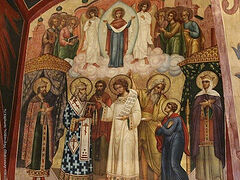
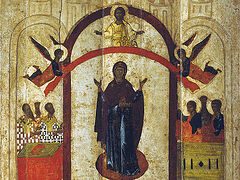
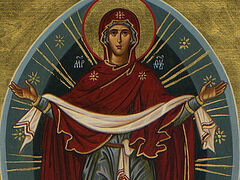
This feast day commemorates the miraculous appearance of the Mother of God at the Blachernae Church near Constantinople. Blessed Andrew saw the Most Holy Theotokos walking through the air, illumined by Heavenly light and surrounded by Angels and a host of saints. St. John the Baptist and the Apostle John the Theologian accompanied the Queen of Heaven. Kneeling, the Most Holy Virgin began to pray tearfully and at length for Christians. Then, approaching the altar, She continued Her prayer. On finishing it, She took the veil—the omophorion2—from Her head and spread it over the people praying at the church, protecting them from visible and invisible enemies. Once again, Constantinople was saved from the foes besieging it. This vision of Blessed Andrew became the foundation for a special veneration of the Most Holy Theotokos, specifically Her prayerful patronage over the Christ-loving people of God.
Brothers and sisters, the Mother of God prays for us, for Holy Russia, and for the whole world. Such is Her maternal heart, which cared for everyone (for example, those who arranged the wedding in Cana of Galilee) and suffered at the Cross of Her Son. Even until now, She stands in prayer for us, sinful servants of God. But how do we, brothers and sisters, ourselves respond to Her prayers for us? Do we thank Her as we should? Do we read akathists and other hymns, or glorify Her with our good deeds? I am not saying this to reproach you, but to remind myself, first and foremost, of how easily we accept God’s blessings, and how little we thank Him in return, if only with words, let alone deeds! How easily we grow accustomed to God’s mercy, and how easily, in response to His mercy, we sin grievously! Then we fall into despondency and useless self-pity, compounding our sin and sometimes bringing ourselves to despair, pleasing the enemy of our salvation. But, brothers and sisters, let us remember that there is no depth of fall from which the prayer of the Mother of God cannot deliver us. We, great sinners, have no other Intercessor more powerful than the Most Holy Theotokos. That is why we boldly cry out to Her alone: “Most Holy Theotokos, save us!”, while to others, even the greatest saints of God, we say: “Pray to God for us.”
Let us recall the ancient Christian practice of reciting the prayer “Rejoice, O Virgin Theotokos…” 150 times a day. Fulfilling the precept of St. Seraphim of Sarov, the sisters of the Diveyevo Convent recite this hymn 150 times daily as they walk along the Holy Canal, which follows the footsteps of the Theotokos when She appeared to St. Seraphim. The holy elder used to say: “Whoever walks along the Canal with prayer, reciting ‘Rejoice, O Virgin Theotokos…’ 150 times, has everything here: Mount Athos, Jerusalem, and Kiev! Visitors will come to us and take a little clay from it for healing, and it will be to us in place of gold!” Our ancestors knew many edifying stories about the power of the Theotokos prayer rule, and generally about the power of the intercession of the Most Holy Theotokos for the most desperate sinners. The intercession and help of the Most Holy Virgin in the life of the Church is great, and it is reflected in the appearance of numerous wonderworking icons. Their very names speak of the Most Pure One’s virtues and effective aid: “Surety of Sinners”, “Joy of All Who Sorrow”, “The Merciful”, “Seeker of the Lost”, and many others.
Interestingly, the name “Seeker of the Lost” comes from the seventh-century tale “On the Repentance of Theophilus in the City of Adana.” According to tradition, this was the prayerful cry of Theophilus the Archdeacon, a church administrator in Adana (now in southern Turkey) who had sold his soul to the devil. He had initially declined a high church rank, but later, when the new leadership stripped him of his position, he sold his soul to the evil one through a sorcerer in order to regain his status. Years later, fearing for his soul, he began to repent and entreat the Mother of God for salvation, calling Her the “Seeker of the Lost”. After forty days of fasting and prayer, Theophilus’ supplication was heard. The Queen of Heaven announced that his sins were forgiven and returned the charter he had signed. The following day, on Sunday, Theophilus publicly confessed everything that had happened at the cathedral and received the Holy Mysteries of Christ. This occurred in 538. Dedicating the rest of his life to repentance, Theophilus passed away (as recorded by his disciple Eutychianus). He is venerated as a saint in the Catholic Church.
This is the utter depth of hellish wickedness from which the Most Holy Virgin snatches the souls of lost sinners! Why does the Mother of God possess such great boldness before God, and possess the incomparably high standing of “More honorable than the cherubim, and beyond compare more glorious than the seraphim”? The Holy Fathers point out that the Theotokos, having conceived and given birth to the God-man, became the receptacle and vessel in which God dwelled; from Her flesh He created His human nature and was born of Her, making Her the Mother of God. In the words of St. Ignatius: “Although other holy people become partakers of the Divine Nature (cf. 2 Pet. 1:4) and abodes of the Triune God (cf. Jn. 14:23) through the work of the Holy Spirit in them, they do so in a completely different manner than the Mother of God, Who alone received into Herself God the Word for His incarnation…”
Just as the God-man is the King of Heaven, the King of all mankind and angels, so the Mother of God is the Queen of Heaven: the Queen of both mankind and angels… She has been given special authority and a special boldness to intercede before God for humanity. The Holy Church addresses its petitions to all the greatest saints of God, to all angels and archangels, with the words, “Pray to God for us!” But to the Mother of God alone it uses the words, “Save us!”
So, fathers, brothers, and sisters, let us more frequently call upon our fervent Intercessor, to Whom the Lord adopted us alongside His beloved disciple; let us strive to be worthy of such adoption as sons and daughters. O Most Holy Theotokos, save us and protect us with your honorable omophorion! Amen!