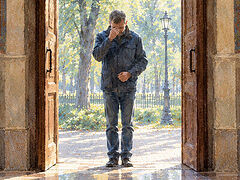
I would like to share a story. It is completely true, though I have changed the names and a few details to avoid causing anyone embarrassment. This is a story about a man who lived with a carpet on his wall for years, never suspecting there was a door hidden behind it. And one day he finally decided to pull that carpet aside.
But let me start from the beginning. One of the parishioners of my church is a man, let us call him Sergei Petrovich. He is in his early fifties, has a bit of a belly, wears an expensive watch, and has a confident look in his eyes. A typical member of today’s middle class—he has his own business, a house in the suburbs, two cars, a wife, and children. In short, he has everything one is supposed to have. And, of course, a neat gold cross around his neck, because he is Orthodox. Well, “Orthodox” in a manner of speaking… As he used to say himself, “I believe in God, but I rarely go to church—just on the major feasts.” At Pascha—to have kulichi blessed; at Theophany—to get some holy water; and occasionally at Christmas—to stand for a bit with a candle. And he has often ordered forty Liturgies for the health of his mother-in-law when she was sick, and for the repose of his uncle when he passed away. In general, he did just what everyone else does.
He was sure that it was enough. That faith was just a set of rules: you are born and baptized in the church, you marry in the church, and finally you have your funeral in the church. And between these events, you can live however you please, as long as you do not kill, do not steal, and do not work on Sundays. Or at least pretend you are not working.
I knew him for several years. He would come to confession about once a year, right before Lent, and his confession went something like this: “Father, I repent, I am a sinner, but I don’t have any major sins—I live like everyone else.” I tried to talk to him, asking if he read the Gospel or prayed at home. He would shrug and reply, “No time, father—work, family, this and that. But I try to be a good person.” And I could see he wasn’t being hypocritical. He truly tried to be good. But his “being good” was somehow… horizontal. He was nice to other people, but he lacked a vertical dimension—he had no heaven.
One day, Sergei Petrovich came to my church off his usual “schedule”. It was a weekday, the church was empty, and it only smelled of incense and wax. He walked in and looked around, as if he were here for the very first time. I was just coming out of the altar after the service. I saw him and was surprised,
“Sergei Petrovich, what brings you here? It’s not a great feast today.”
He sighed and waved his hand,
“Well, father, I just dropped by… to light a candle and to talk, if you have a moment.”
We sat down on a bench in the narthex. He remained silent for a long time, twirling his car keys in his hands. Then he said,
“I’m in trouble, father. My business is collapsing. My partner burned me, and the loans are suffocating me. My wife says I’ve become irritable and take it out on the children. My health is failing too—high blood pressure and heart issues. I suddenly realized that everything I have been building is falling apart, and there is absolutely nothing I can do about it. I’ve been working like a horse my whole life, but now I’m left with nothing, right back where I started. And I don’t understand what I’ve been living for.”
He fell silent, looking at the floor. I didn’t rush him—such moments require silence. Then he raised his eyes,
“I went to church… Well, not often, but still. I wear a cross, I prayed sometimes. Why didn’t God help me? I’m not some kind of sinner—I didn’t kill and didn’t steal...”
As I looked at him, I suddenly remembered an old parable I had heard from my spiritual father, and decided to share it with him.
“You know, Sergei Petrovich, there is a story. Once upon a time, there lived a man who had a beautiful wall carpet. He hung it on the wall in his largest room.1 The carpet was expensive, antique, and with an intricate pattern. The man was very proud of it: he made sure it did not fade in the sun, that moths did not eat it, and that dust did not settle on it. He often admired it and showed it off to his guests. And everything was fine. But one day, a friend came to visit and asked, ‘What’s behind your carpet?’ The man was surprised. ‘What do you mean, what? The wall,’ he replied. ‘Why don’t you pull it aside?’ the friend suggested. The man moved the carpet and discovered… a door. It turned out that all those years, the carpet had not just been hanging on the wall, but had been covering the entrance to an adjacent room! And the man had completely forgotten that this room even existed. Inside it, as it appeared, there was a window, light, and plenty of living space. Yet for so many years, he had lived in the dark part of the house, settling for no more than a carpet.”
I paused. Sergei Petrovich was listening intently, but it was clear he did not see where I was going with this.
“You say you believe in God,” I continued. “But your faith is like a carpet: beautiful, proper, and sanctified by tradition. You cherish it and take pride in it. Yet behind it lies a door. And behind that door is the Living God. Instead, you stand in front of the carpet and think that is the ultimate goal.”
He frowned,
“So, are you saying I believed incorrectly?”
“I am saying you may not have believed at all. You followed customs: You lit candles, had kulichi blessed, and ordered services of need. But that is tradition, not faith. Faith is when you pull the carpet aside and enter the room; when you meet God face-to-face, rather than through rites.”
Sergei Petrovich gave a nervous chuckle,
“Well, father, you’re going too far… How is that—meeting God? Is He going to come over for tea?”
“Why not?” I smiled. “He is knocking, by the way. The Book of Revelation says, Behold, I stand at the door, and knock: if any man hear My voice, and open the door, I will come in to him, and will sup with him, and he with Me (Rev. 3:20). He is knocking on the door of your heart. And instead of opening it, you hang a wall carpet over the door so that the knocking won’t bother you.”
 He fell silent, deep in thought. I could see that my words had struck a chord. But he was not ready to give up.
“All right,” he said after a pause. “Suppose I want to push this carpet aside. What should I do? Learn all the prayers? Start fasting by all the rules? Quit my business?”
“To begin with, just push it aside. There is no need to break down the wall right away. Just tell God, ‘Lord, I am here. I do not know how to find You, but I want to. Help me.’ And start reading the Gospel like a letter from the Father. Try praying in your own words—not from a prayer-book, but the way you talk to a friend. Tell Him about your problems, fears, and fatigue. He is listening.”
Sergei Petrovich let out a skeptical grunt,
“Will this help my business?”
“I don’t know,” I answered honestly. “Maybe it will. Maybe it won’t. But it will definitely help you; you will stop being alone in your trouble. You will realize that behind your back is not an empty void, but a Father Who loves you. And then even the collapse of your business will not be the end of the world for you, because your true treasure is not in the bank, but in the heart.”
He left, thoughtful. I was not sure he would follow my advice. People like Sergei Petrovich are often too busy to stop and think about their souls. They don’t lock the stable door until the horse is stolen, and need a disaster to take action.
Several months passed. I had almost forgotten about that conversation. But one Sunday, after the Liturgy, I saw a familiar figure at the church. It was Sergei Petrovich. He was standing off to the side, stripped of his usual self-confidence, and dressed more modestly than before. I walked over to him.
“Hello, Sergei Petrovich. Good to see you. How are things?”
He looked at me, and I saw that something had changed in his eyes. The emptiness that used to be there was gone. A quiet kind of depth had appeared.
“Things are still tough, father,” he replied. “The business never recovered. I had to sell the house—we moved into an apartment. At first my wife was nagging me, but eventually she calmed down. And You know, for the first time in many years, I am finally sleeping peacefully.”
He paused, searching for the right words.
“I started reading the Gospel, as you advised. Initially, I understood nothing; then things started to click. Next, I tried praying in my own words. And… it was weird; it felt like I was talking to Someone Who was really listening. I began to notice that the world around me had changed somehow. Or maybe not the world, but myself.”
He chuckled.
“I used to think that faith was like insurance—you pay your premium, and you sleep easy. But it turns out faith is like… like breathing. You just can’t live without it.”
As I listened to him, I rejoiced, feeling that he had truly pushed the carpet aside and stepped into the room. Then he told me a funny story. One day, he was riding the bus (he’d had to sell his car) and reading the Gospel on his cellphone. People were giving him sidelong glances, and one guy wondered,
“What’s up, pops? Found faith?”
Sergei Petrovich smiled and replied,
“No, I found God.”
The guy looked surprised, while Sergei Petrovich suddenly realized that for the first time in his life, he had spoken the absolute truth about his faith.
“Do you know, father, what the funniest part is?” he said to me back then. “I thought that if I started praying, I would instantly become some kind of saint and all my problems would be solved. But it turned out that praying doesn’t mean getting answers. It means being with God. And there is more peace in that than in all my past victories.”

As I looked at him, I saw a man who had gone through fire and water and not been burned—a man who had lost much, but found what mattered most. And in that moment I thought: “Why, I myself—a priest—sometimes cover the door with a wall carpet. I forget that behind the rules, statutes, and canons stands the Living God, Who is not waiting for formal bows, but for my heart.” And I am grateful to Sergei Petrovich for reminding me of this.
More time passed. Sergei Petrovich found a new job—modest, but honest. He has not become a millionaire, but peace has finally returned to his family. He goes to confession and communion regularly, reads the Scriptures, and tries to live by them. He has not become a fanatic, has not grown a waist-length beard, and he does not lecture everyone around him; he simply lives with God. And there’s a light in his eyes now that wasn’t there before.
Recently, he came up to me after the service and said,
“Father, do you remember the parable about the carpet? I want to show you something.”
He pulled out his cellphone and showed me a photo. It was the house where he used to live before his business went under. An old carpet hung on the wall in one of the rooms.
“I took this when we were leaving,” he explained. “I wanted to keep the memory alive. And then, when you told me about the door, it suddenly clicked: I had a carpet hanging on the wall my entire life, and there was a pantry door right behind it. And I never once looked back there. When we were moving out, I took the carpet down and saw the door. I opened it, and there was... nothing. Just dust and mouse droppings.”
He laughed. “That was what my faith was like, too. A carpet on the wall, and behind it—an empty closet where the mice of doubt and the spiders of fear live. And I thought there was a treasure there. Funny, isn’t it?”
I smiled. “Funny, yet sad. So many people live like that. They believe there is holiness behind the carpet, yet there is only emptiness, because they never opened the door.”
“But I have opened it now,” said Sergei Petrovich. “And do you know what I found in there? Not a closet, but a whole world—light, air, and open sky. It is as if I crawled out of a dark cubbyhole into the sunlight. And I am still terrified that I could have lived my whole life like that.”
He was silent for a moment, then added:
“I used to wear a cross, but I didn’t understand what it meant. Now I know: the cross is not an ornament, but a sign that I died to my old life and rose to a new one. And that my life is not my own, but His.”
Looking at him, I thought: “Here he is, a real human being. Not a saint, yet alive. Not sinless, yet repentant. Not rich, yet happy, because he found something more precious than all the gold in the world—he found God.”
And I remembered that very carpet again. Only now I knew that behind it was not a pantry, but a door. And this door is open to everyone who is ready to push the carpet aside and enter.
My dear readers, I have shared this story so that each one of us might ask ourselves: “What is behind my carpet? Perhaps all my life I have been preserving a beautiful pattern, yet I have never entered the room where the Lord is waiting for me?”
Wearing a cross around your neck is very good. But the most important thing is to have the cross in your soul. And the cross is not a burden, but freedom. Freedom from fear, vanity, and meaninglessness. Freedom to be with the One Who is Love.
Pull the carpet aside. There is a door behind it. And He is standing behind it, knocking. Just open it!