Priest Aleksandar Sekulic is a cleric of St. Alexander Nevsky Cathedral in Belgrade. He answers some questions and talks about the great Serbian archpastors he has seen in his life.
 Priest Aleksandar Sekulic —Father Aleksandar, your blessing. Please tell us about yourself. Where were you born and raised? Why did you decide to become a priest?
—I was born in 1984 in the city of Visegrad in former Yugoslavia. In my childhood, we lived in what is now Slovenia. In 1991, a military conflict broke out there—the so-called Ten-Day War. Slovenia wanted independence. Up to that point, everything had been fine for me as for a child. I grew up quietly and communicated with other children. But after the outbreak of the conflict, my friends started teasing and calling me names, saying that I must leave their country. This was how children were influenced by adults and what was happening there. My father did not want problems and a difficult situation for his family, so we left Slovenia in June 1991. We moved to the western part of Serbia, to the city of Užice. We lived there until 1999, when the NATO bombing of the Federal Republic of Yugoslavia began.
Then I was fifteen. I looked at what was going on, thinking with sadness how it was possible that this was the second military conflict in my life. I wanted to leave Yugoslavia and go to Holy Mount Athos to become a saint there. I wanted to become like our great Serbian saints who lived there many centuries ago, like Stefan and Rastko Nemanjic. The Orthodox world knows them as Sts. Simeon the Myrrh-Gusher and Sava of Serbia respectively. Of course, in my case, these were naive youthful thoughts. I told myself that I didn’t need to change my life so drastically right away, but what I could really do at the moment was to go to seminary. So I decided to become a priest, and my parents approved of my choice.
I entered the theological seminary in the city of Kragujevac and later graduated from it. After that, I wanted to continue my theological education and travelled to Libertyville (Illinois, the USA) where there is an old Serbian community and a theological school. I was ordained deacon on Holy Saturday, 2009. My first Liturgy was on Paschal night with Metropolitan Amfilohije (Radovic). It was at St. Sava’s Cathedral, the largest cathedral in Serbia. At that time, I was a soloist of the Belgrade Singing Society. And the next morning we flew to Moscow for the Paschal Festival conducted by Valery Gergiev.1 The following day, I was allowed to serve as a deacon at the Liturgy at the Cathedral of Christ the Savior. I was very glad, so I served my first Liturgy in Belgrade and my second Liturgy in Moscow.
 At the service with Metropolitan Amfilohije (Radovic). Photo from Fr. Aleksandar’s personal archive
—When did you start serving at St. Alexander Nevsky Cathedral in Belgrade? Please tell us what is remarkable about your parish and what is special about it.
—The special thing about this parish is that it is the only church in Serbia dedicated to the holy Right-Believing Prince Alexander Nevsky. It has quite an interesting and long history going back to the nineteenth century. During the Russo-Turkish War (1877–1878), Russian volunteers helped Serbian soldiers liberate Serbia from the Turkish invaders. This church became a token of gratitude to the Russians from the Serbian State. It was decided to build this church and dedicate it to a Russian saint.
This is a wonderful church, painted in the Serbian-Byzantine style. We have memorial plaques dedicated to Russian volunteers and the holy Tsar-Martyr Nicholas II, whom we venerated as a saint already 100 years ago. We have a particle of the relics of St. Alexander Nevsky. We also have a missionary school and a publishing house at our church. I believe Russians will like this church if they visit it. I was a deacon there for thirteen years, and in July 2022 I was ordained priest.
—Father Aleksandar, please tell us about His Holiness Patriarch Irinej (Gavrilovic). You worked at his office. What can you remember about him? What kind of person was he?
—His Holiness Patriarch Irinej belonged to the old school of Serbian hierarchs. He studied at the seminary in the city of Prizren in what is now Kosovo and Metohija. He belonged to a spiritual generation skilled in prayer. In his young years, he struggled at the Ostrog Monastery in Montenegro and was the head of a monastic school there. He had enormous experience in spiritual life and prayer. For thirty years he was bishop of the diocese in the city of Nis. It is one of the most important and largest cities in Serbia.
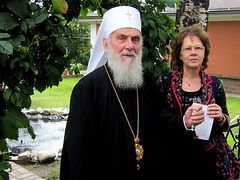
I can say from my experience that Patriarch Irinej was never in a hurry. He would deliberate on various questions for a long time. He didn’t make any rash decisions. I believe he first prayed and then made a decision. I was the secretary of his office, and there, you know, there are often a lot of questions and problems. Someone is constantly asking something, and you need to respond quickly. But he took his time and spoke slowly: “We’ll see, we’ll see.” I felt that he was praying to the Lord that the decision he would make would be right and fair.
 His Holiness Patriarch Irinej (Gavrilovic). Photo from Fr. Aleksandar’s personal archive —Please tell us about Metropolitan Amfilohije (Radovic). You said you served with him. Could you recall how he served and prayed? What was he like?
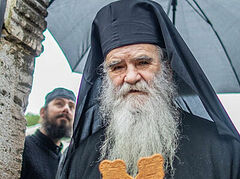
—You know, Metropolitan Amfilohije was a very interesting man. He remembered everyone he met on his path in life. He remembered every situation and everything you said to him. He was such a quiet man who always prayed to God. He had a cell in the Patriarchal office. The bishops of our Church have small cells where they stay when Church Councils and Synod meetings are held. Every time I went to him on administrative matters, he would say, “Father Deacon, please sit down,” and treat me to whatever he had at that moment, even if it was just an apple. He wanted to be a good host. It’s rare for a metropolitan to make you coffee or tea...
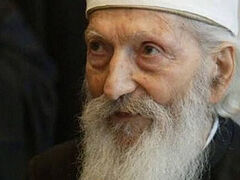
I concelebrated with him at the Liturgy on several occasions. There is a chapel in our Patriarchal office dedicated to St. Simeon the Myrrh-Gusher. Actually, it’s very hard to describe how Vladyka Amfilohije prayed… He was deep in prayer. He also never hurried anywhere; he read and prayed slowly. I remember the time when he was the locum tenens of our Patriarchal throne. After each Liturgy, he went to visit our Patriarch Pavle (Stojcevic), who was then in the Hospital of the Military Medical Academy. And I accompanied Vladyka there several times. The Metropolitan gave him Communion. It was amazing to see how much Metropolitan Amfilohije loved and revered Patriarch Pavle. It was active Christian love on his part. It’s hard for me to describe it…
—You were probably a witness of the communication between two holy men at that moment.
—Definitely.
—Is Metropolitan Amfilohije regarded as a saint in Serbia and Montenegro? He is depicted in a fresco of one of your monasteries.
—I am certain that this is an expression of esteem for the metropolitan by the people who met him. It seems to me that every believer who loves the Lord, wants to serve Him with his life and who has met Metropolitan Amfilohije at least once was instantly drawn to him with all his heart. He was a very intelligent, deep, prayerful, and just a very good man. He loved each of us. When we love someone, we usually want that person to be ours alone. But that’s a kind of self-love. Whenever I looked at Metropolitan Amfilohije, I saw that he loved everyone. But I never worried about it. There was no pride in his love for people: he loved everyone for God’s sake and did not think about himself. The Gospel speaks of such love for our neighbor: A new commandment I give unto you, That ye love one another; as I have loved you, that ye also love one another (Jn. 13:34).
—Father Aleksandar, thank you for your memories of these people. Recently, the choir of the Moscow Sretensky Monastery sang the Liturgy in your cathedral. Please share your impressions. How do the Serbs view this choir?
—They sang here both a long time ago and recently. On their last visit, we did not advertise it, otherwise it would have been impossible to enter the church. The Serbs love them very much. I remember they also visited Serbia in 2013. According to the schedule, they were to have sung in two cities: Novi Sad and Nis. The Ambassador of the Russian Federation asked His Holiness Patriarch Irinej which concert he would attend. Of course, he answered: “I’ll be in Nis.” Then I went up to the Patriarch and said:
“Your Holiness, may I ask you something?”
“Of course.”
“The choir of the Sretensky Monastery is visiting Serbia. How can there be no concert in Belgrade? It is the capital of Serbia. Your Holiness, is there any way they could give just a small concert in Belgrade?”
The ambassador was near and he called the choir director at once. And a few hours later on the same day they sang an additional concert at our Church of St. Alexander Nevsky. That concert wasn’t on their schedule, but it was great. There were more people in the church during their performance than at Pascha or Christmas. That’s how they are loved in Serbia.
 Metropolitan Tikhon (at that time the abbot of the Moscow Sretensky Monastery) and Patriarch Irinej. Photo from Fr. Aleksandar’s personal archive
In early May this year, they sang the Liturgy here on the feast of Greatmartyr George the Victorious. There were very many people then, too. You probably know that in Serbia there is a tradition when each family celebrates a Krsna Slava—that is, the day of remembrance of the family’s patron-saint. In my family, it is St. George the Victorious. I celebrated the Liturgy that day, and your Choir sang. I can say that it was the best feast of St. George in my life.
—Please tell us, how do the Serbs view Russia now?
—It is a difficult question, because in any given family there may be people with opposite views. I can only speak on my own behalf and I cannot speak on behalf of all Serbs. I see Russia as an Orthodox country. When I look at Russia, I look at its saints, the Russian Orthodox Church, and the holy relics of the Kiev Caves Lavra, some of which were reportedly taken out and we don’t know their whereabouts. I have visited Russia, Ukraine, and Belarus. For me, they are one nation. I hope and pray that in the future we will have the opportunity to serve together again, to be together, so that the joy of our ministry can be conciliar. I worry about everything that is happening in this world, and I pray that the Lord will show His mercy on all of us.
—What does it feel like to be Orthodox in modern Serbia? Is there any pressure on you as Orthodox Christians from the State?
—It seems to me that those times are long gone. Before the outbreak of the civil war in the former Yugoslavia, there was pressure on the Church, the clergy and every priest. After that, the awakening of our people began. Today, every person in Serbia is free in his faith, free to visit churches, and free to commemorate his family’s patron-saint. As Orthodox Christians, we can live a normal life—there is no pressure on us here now. Everyone is free to believe as they wish.
—Is there anything you would wish the faithful?
—Don’t forget about other Orthodox Christians in this world. We must pray for each other. There are no “Serbian” or “Russian” saints in the Heavenly Kingdom: each of them is just a saint. As the Apostle Paul said, For as many of you as have been baptized into Christ have put on Christ. There is neither Jew nor Greek, there is neither bond nor free, there is neither male nor female: for ye are all one in Christ Jesus (Gal. 3:27, 28). Towards the end of every Liturgy, the priest pronounces the exclamation: “Holy things for the holy.” To become a saint is the most important thing for everybody who sincerely believes in the Lord Jesus Christ.
—Thank you!