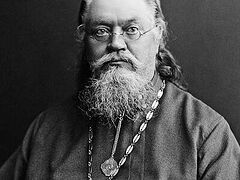
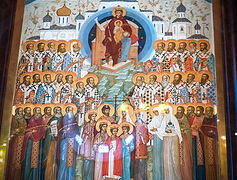
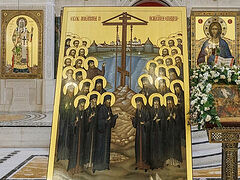
November 2. Hieromartyr Nikolai Lyubomudrov, Priest (1862–1918)
‘Lord, Receive My Spirit! Forgive Them, for They Know not What They Do!’
 Hieromartyr Nikolai Lyubomudrov Fr. Nikolai carried out his pastoral ministry in the village of Latskoye of the Yaroslavl governorate. For thirty-two years, he selflessly served his parish: he founded a library, fought alcoholism among the people, and held public literary readings on Sundays to raise culture and literacy. To illustrate these readings, he used magic lantern slides—the latest technological invention of the time. After the readings, the priest would converse with the peasants.
In the autumn of 1918, after Fr. Nikolai, at the request of female parishioners, had celebrated a prayer service for the salvation of fellow villagers who had been conscripted into the militia during a peasant uprising, he was accused of counter-revolutionary activity. Peasants close to Fr. Nikolai advised him to go into hiding for a while, but the priest did not consider it possible to abandon his flock. Foreseeing his imminent death, Fr. Nikolai wrote a farewell letter to his wife and children; and on the night before his arrest, he prayed in his room, kneeling in front of the icons with a candle in his hand.
October 20 marked the St. Demetrius Memorial (Ancestors’) Saturday. In the morning, Fr. Nikolai was celebrating the Divine Liturgy and a memorial service at the church. A military commissar and two soldiers armed with rifles arrived at the church and arrested him right then and there. Having changed his vestments, Fr. Nikolai said goodbye to his family and parishioners, and was escorted under guard out of the church toward the vegetable gardens at the edge of the village. As the soldiers began loading their rifles and ordered the priest to turn away, Fr. Nikolai faced his executioners, made the sign of the cross, and raised his hand to bless them, saying: ‘Lord, receive my spirit! Forgive them, for they know not what they do!’ Two shots rang out, and the priest fell. The soldiers walked up to him, fired once more, and tore off his silver cross. Arguing over who should keep it, they hurried to the priest’s house, where other members of the detachment were already looting.
November 4. Uncovering of the Relics of Hieromartyr Nicodemus (Kononov), Bishop of Belgorod (1871–1919)
Vladyka Nicodemus’ Martyrdom
In 1913, Vladyka Nicodemus became the Bishop of Belgorod and Vicar of the Diocese of Kursk. He labored greatly on the uncovering of the holy relics of St. Joasaph of Belgorod. During his service in the Diocese of Kursk, he composed two prayers to St. Joasaph, as well as a major work: The Life, Glorification, and Miracles of St. Joasaph.
 Hieromartyr Nicodemus (Kononov)
In 1919, on the second day of the feast of the Nativity of Christ, Vladyka Nicodemus was arrested right in the altar of the Holy Trinity Cathedral1 by the Red Commissar Sayenko for sermons in which he spoke out against pillaging and violence. At the request of the faithful, who demanded the bishop’s release, local Chekists2 freed him for one day, arresting those who had interceded for him. Mother Maria, who had led one of the groups of believers protesting the bishop’s arrest, was shot immediately. The following day, Vladyka was arrested a second time, and two days later, by order of Commissar Sayenko, he was secretly shot and buried in a common grave outside the city.
Six months after the execution of Vladyka Nicodemus, the White Army took Belgorod, and the hieromartyr’s grave was opened. Signs of severe torture were discovered on his body. Due honors were rendered to the holy remains of Vladyka Nicodemus, and they were buried in the Holy Trinity Monastery near the shrine of St. Joasaph of Belgorod. On November 2, 2012, his incorrupt relics were uncovered at the burial site. Today, the reliquary with Hieromartyr Nicodemus’ relics rests at the Holy Transfiguration Cathedral of the city of Belgorod.
November 6. Martyr Alexei Neidhardt (1863–1918)
A Builder of God’s Churches
 Martyr Alexei Neidhardt While holding positions of power and public office, Alexei Borisovich engaged extensively in philanthropy. Throughout his life, Neidhardt donated generously to the needs and construction of Orthodox churches, for which he was repeatedly blessed by the ruling hierarchs and the Holy Governing Synod as a ‘zealous builder of God’s churches.’ In addition, Alexei Borisovich served as a trustee for numerous orphanages and educational institutions.
In 1917, he was dismissed from service and moved to Nizhny Novgorod. In 1918, he signed an appeal to the flock on behalf of the Congress of Clergy of the Nizhny Novgorod Diocese, calling for protests against the closure of churches and monasteries and the confiscation of church property. The saint was arrested, sentenced by the Nizhny Novgorod Cheka, and executed by firing squad alongside Bishop Laurence/Lavrenty (Knyazev) and Archpriest Alexei Porfiriev.
November 7. Venerable Confessor Matrona (Vlasova), Ryassaphore Nun (1889–1963)
The Diveyevo Nun’s Three Arrests
At the age of six, Matrona was left without a father or mother and was sent to be raised at the Diveyevo Convent of St. Seraphim, where her aunt, Nun Kaleria, had been struggling for many years. The girl showed an aptitude for drawing, and painting became her obedience. Thus, in obedience and prayer, Ryassaphore Nun Matrona lived at the convent until it was shut down in 1927, after which, together with three other Diveyevo sisters, she took up her residence in the village of Kuzyatovo of the Ardatov district (the Nizhny Novgorod region). The sisters helped at the church, earned a living by needlework, and led a quiet and peaceful life, yet even this displeased the local authorities. The sisters were arrested in April 1933 on charges of anti-Soviet agitation. Ryassaphore Nun Matrona was sentenced to three years of imprisonment.
 Venerable Confessor Matrona (Vlasova) After serving her prison sentence, she found work at a church in the village of Verigino (the Nizhny Novgorod region), where she served as a choir singer, caretaker, and cleaner. On November 10, 1937, the saint was arrested a second time and sentenced to ten years of imprisonment in Karlag,3 where she worked as a hospital cleaner. The camp authorities noted her conscientious work and modest conduct. Following her release, Ryassaphore Nun Matrona resumed her church service. In 1949, Mother Matrona was arrested a third time and sent into exile in Kazakhstan. In 1954, her brother submitted a petition for his sister’s pardon.
Ryassaphore Nun Matrona spent the final years of her life with her brother in her native village. Fellow villagers recalled that the saint was deeply humble and of a quiet disposition, spending most of her day in prayer. Because the village church had been closed, the Diveyevo sisters held services secretly in private homes, despite numerous bans and persecutions. Ryassaphore Nun Matrona peacefully reposed in the Lord on November 7, 1963. She was buried in the village cemetery to the left of the graves of the New Martyrs Evdokia (Eudoxia), Daria, Daria and Maria of Puzo.
November 11. Hieromartyr Nikolai Probatov of Aglomazovo, Priest (1874–1918), and with him Martyrs Cosmas, Victor Krasnov, Naum, Philip, John, Pavel, Andrei, Pavel, Basil, Alexei, John and Agatha
A Priest and His Parishioners Who Received Crowns of Martyrdom
 Hieromartyr Nikolai Probatov During the First World War, there was a shortage of priests in the army, and the ruling hierarch appealed to the clergy of his diocese with a request to serve as chaplains in the active forces. However, there were few volunteers: most declined due to illness, family circumstances, or having young children. Hearing this from his fellow priests, Fr. Nikolai felt ashamed, ‘What are we doing? We are priests, but we refuse! One has a wife, another has children—while out there our own soldiers are shedding their blood defending the Motherland; we must agree.’ Although Fr. Nikolai and his wife had three children of their own—a fourteen-year-old eldest son, and a son and daughter aged one—he went to serve as a regimental chaplain in the 1st Bakhmut Regiment, which was fighting against the Austrians. While serving at the front, Fr. Nikolai saw how little faith remained among the soldiers: out of the entire regiment, no more than thirty attended church services. Returning home in 1917, he said to his loved ones with undisguised sorrow, ‘Priests are no longer needed here; they are now citizens of Heaven rather than of earth.’
In 1918, a punitive detachment arrived in the village of Aglomazovo (now in the Ryazan region), where Fr. Nikolai served. Eighteen local peasants were arrested alongside the priest. After torturing the condemned, the executioners took them out of the village to the river that evening and shot them. Of the eighteen people, thirteen died; the rest crawled to the nearest huts during the night and were hidden by the villagers. Those who were martyred alongside Fr. Nikolai were the churchwarden Cosmas Egorovich, and the peasants Victor Krasnov, Naum and Philip (father and son), John, Pavel, Andrei, Pavel, Basil, Alexei, John, and Agatha.
November 13. Hieromartyr John Kochurov, Priest of Tsarskoye Selo (1871–1917)
The Execution of a Father before His Son’s Eyes
Fr. John graduated from the St. Petersburg Theological Academy. The beginning of his parish ministry was tied to the Orthodox parish in Chicago, which opened in 1892. The priest served as a missionary in the USA for twelve years. In 1907, he returned to the Russian Empire, serving first in Narva (now in Estonia), and, from 1916, at St. Catherine’s Cathedral in Tsarskoye Selo.
 Hieromartyr John Kochurov
Five days after the October coup, Bolshevik detachments entered Tsarskoye Selo, and the priests of St. Catherine’s Cathedral were arrested. Fr. John protested and tried to explain the situation, only to be struck several times in the face. Then, amidst whoops and jeers, an enraged mob of soldiers took him to the Tsarskoye Selo airfield and shot him dead right before the eyes of his son, high school student Alexander, who had been running helplessly behind him. Fr. John became the first priest-martyr of the Soviet era.
November 14. Hieromartyr Alexander Shalai, (1879–1937)
A Priest’s Accusation and Summary Execution
 Hieromartyr Alexander Shalai Fr. Alexander held firm religious convictions and was both a zealous man of prayer and a caring pastor. According to eyewitness accounts, in August 1935, when the church in the village where he served was closed and workers began removing its bells, Fr. Alexander approached the crowd of villagers who had gathered to assist. Addressing the perpetrators, he said angrily, ‘Why are you meddling in what is not your business? Clearly, you have nothing better to do than ruin church property!’ Someone in the crowd remembered these words and later informed on Fr. Alexander.
After the church had been shut down, Fr. Alexander could no longer celebrate the Divine Liturgy for lack of a building, yet he continued to perform occasional services of need whenever parishioners asked him to. During the All-Union Population Census, he organized a petition among the villagers to reopen the local church.
All of this was brought up against the priest when he was arrested on August 6, 1937. Fr. Alexander was charged with ‘counter-revolutionary agitation aimed at undermining collective farms.’ However, the true reason for his arrest lay elsewhere—in his refusal to renounce his faith in God and his priesthood.
On October 10, 1937, without trial or investigation, Archpriest Alexander Shalai was sentenced to death by firing squad. All his property was confiscated, and his family was exiled (Fr. Alexander had four children: Volya, Alexander, Irina, and Natalia). The priest was executed on November 14, 1937, in Bobruisk (the Mogilev region of Belarus), suffering martyrdom for his confession of the Orthodox faith.
November 14. Hieromartyr Dimitry Ovechkin (1877–1937)
Debates on Religious Themes
Hieromartyr Dimitry graduated from the Kazan Teachers’ Seminary. After several years of teaching, he was ordained priest and served in the cathedrals of the town of Osa (the Perm territory). He was repeatedly persecuted by the Soviet regime.
In the 1920s, the authorities organized public debates on religious themes, and Fr. Dimitry decided to take part in them. His wife tried to dissuade him, ‘Dimitry, why are you participating in these debates? They will imprison you again! What on earth will we do?’ However, Fr. Dimitry made a firm decision to defend the Christian faith before the atheist lecturers and participated in all three debates held in the city of Perm. Immediately afterward, he was arrested and sentenced to three years of imprisonment, which he served in the salt mines of Solikamsk.
 Hieromartyr Dimitry Ovechkin
Fr. Dimitry returned from imprisonment disabled, with ailing legs and an injured spine. The authorities then sent him into internal exile in the town of Kudymkar, where his wife and son joined him. In 1936, they all moved together to live with their eldest daughter, who was residing in Maikop4 at the time. The priest’s wife, Olga Grigorievna, missed her native region and often said to her husband, ‘Dimitry, let us go to Osa to die.’ Fr. Dimitry hesitated for some time, but in the autumn of 1937, he finally gave in to his wife’s persuasion. That was a time of the most ruthless persecution. On arriving in the town, the priest was immediately arrested, sentenced to death, and executed by firing squad on November 14, 1937.
November 14. Martyr Peter Ignatov (1904–1941)
Pious Spouses
 Martyr Peter Ignatov When Peter Ivanovich turned twenty-two, he was conscripted for mandatory military service and assigned to the OGPU5 troops, where he served as a private for three years. While he was in the army, his wife, Anastasia Alexeyevna, took a job as a weaver at a factory in the village of Kuntsevo near Moscow (now part of Moscow). After demobilization, Peter moved in with his wife in Kuntsevo and began working at a warehouse.
During Peter’s military service, Anastasia had devoted her heart entirely to God and the Church, so much so that her way of life had come to resemble that of a nun. On returning from the army, Peter was deeply struck by his wife’s piety. While before he had not taken matters of faith so seriously, now, looking at his spouse’s way of life, he reflected deeply on them and followed her example—going to church for services and reading spiritual books together with her. The couple frequently attended churches in Kuntsevo and Moscow and found a spiritual mentor—an elder—in one of the monks from Sergiev Posad who had settled near the monastery after the Lavra was closed. Their married life resembled that of monastics: their sole concern was how to please God.
NKVD officers took notice of this pious Orthodox couple and, on October 20, 1937, decided to arrest them. That same day, Peter Ivanovich and Anastasia Alexeyevna were arrested and placed in separate prisons in Moscow. On November 19, 1937, an NKVD troika6 sentenced both spouses to eight years in a corrective labor camp. Peter Ivanovich Ignatov died on November 14, 1941, in a corrective labor camp in the city of Norilsk and was buried in an unmarked grave.
November 16. Hieromartyr Sergei Kedrov, Priest (1880–1937)
Partaking of the Holy Mysteries of Christ before Arrest
Fr. Sergei graduated from the Moscow Theological Seminary, and from 1908 served as a priest at the Holy Trinity Church in the village of Faustovo near Moscow, where he also ran the parish school. At the school, Fr. Sergei organized a special class to teach singing and choir conducting to talented children; subsequently, they formed a wonderful church choir. They proved so faithful to their church that even during the period of persecutions and threats under Soviet rule, they did not abandon the kliros.
In the 1920s, Fr. Sergei contracted typhus. While he was in the hospital, his wife, Lyudmila Alexandrovna, asked the doctor about her husband’s condition, and he replied that it was hopeless. She then made a vow to God that for a certain time she would walk on Sundays a distance of fifteen miles to a village where a wonderworking Jerusalem Icon of the Mother of God was kept at the church. She prayed fervently to the Queen of Heaven, and Fr. Sergei recovered. The Theotokos saved him from death at that time, preserving him for a martyr’s crown.
NKVD officers arrested the priest on October 25, 1937. Around two in the morning, the chairman of the Faustovo Village Council and the local policeman came for Fr. Sergei. The saint asked them to wait and give him time to pray. Such was the people’s respect and love for the priest that even the representatives of the local authorities did not enter the house or conduct a search, but waited patiently for the pastor to come out to execute the arrest order. He prayed long and fervently, and finally, having partaken of the Holy Mysteries of Christ, he came out to them.
Fr. Sergei was imprisoned in the town of Kolomna in the Moscow region. During the interrogation, he denied all the charges brought against him. On November 15, the NKVD troika sentenced him to death by firing squad. Archpriest Sergei Kedrov was shot the next day—on November 16, 1937—and buried in an unmarked mass grave at the Butovo firing range near Moscow.
To be continued…
Bibliography:
Damascene (Orlovsky), Hieromonk. Martyrs, Confessors, and Ascetics of Piety of the Russian Orthodox Church of the Twentieth Century: Biographies and Related Materials. Book 1. Tver, 1992.
Damascene (Orlovsky), Igumen. Martyrs, Confessors, and Ascetics of Piety of the Russian Orthodox Church of the Twentieth Century: Biographies and Related Materials. Book 5. Tver, 2001.
The Lives of the New Martyrs and Confessors of the Moscow Diocese of the Twentieth Century. November. Tver, 2003.
The Lives of the New Martyrs and Confessors of the Moscow Diocese of the Twentieth Century. Vol. 3. Tver, 2005.
Orthodox Encyclopedia. Edited by Patriarch Kirill of Moscow and All Russia. Electronic edition. https://www.pravenc.ru/.
St. Petersburg Diocesan Gazette. Nos. 1–2 (1991).
Stupeni. No. 2 (26). https://stupeny.by/vypusk-zhurnala/stupeni-2-26-ikona-svidetelstvo-vechnosti/.
Tikhon (Zatekin), Archimandrite, Igumen Damascene (Orlovsky), and O. V. Degteva. The Lives of the Saints, New Martyrs, and Confessors of the Nizhny Novgorod Land. Nizhny Novgorod, 2015.