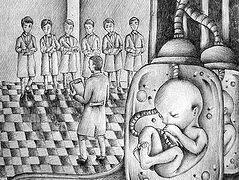
Three Comrades, a novel by E. M. Remarque. First US edition, illustrated by Paul Wenck. Photo: Wikipedia There are books that leave you with a strange, lingering feeling as you read them: the author speaks of godlessness, yet the pages breathe the Gospel. Erich Maria Remarque (1898–1970)—a staunch unbeliever raised in a Catholic seminary, who knew the Scriptures well—wrote a novel that could be called a sermon without a preacher, a prayer without a prayer, and Christianity without Christ. This is the central paradox of Three Comrades: While denying God, Remarque affirms exactly what God has instilled in humanity—the capacity to love, to sacrifice, to maintain friendship to the very end, and to live for others while forgetting yourself.
How the Novel Was Written
Remarque spent nearly four years working on Three Comrades, beginning in 1932. In 1933, he published a short book titled Pat, which served as the first rough draft of his overall vision. By that time, his books were already being burned in public squares across Germany. Living in exile in Switzerland, the author drank heavily, battled illness, and met with fellow German expatriates. As the novel neared completion, the Nazi government invited him to return to his homeland; he refused and instead traveled to Paris for the Congress of Writers in Exile. The novel was first published in 1936 in Denmark, in Danish, followed by a serialized magazine release in the USA, and finally in the original German in Amsterdam in 1938. Shortly thereafter, Remarque and his wife were stripped of their German citizenship. In the USSR, the novel was not published until 1958.
Remarque wrote about post-war Germany, but he did so from exile—from the perspective of a man who had been robbed of his homeland, with an acute sense of impending catastrophe. He knew the meaning of loss, and the meaning of loyalty against all odds.
The Novel’s Plot
The story is set in Germany in the late 1920s—a time of economic crisis, unemployment, political unrest, and the rise of Nazism. Three World War I veterans—Robert Lohkamp (Robby), Otto Köster, and Gottfried Lenz—operate a small auto repair shop; they live in poverty but stick together, bound by wartime camaraderie, mutual support, and absolute loyalty.
One day, Robby meets a young woman named Pat Holmann. Love sparks between them—a beacon of light in a twilight of destitution, drinking, and despair. Pat has tuberculosis, and her health steadily declines. The comrades do everything in their power to save her. To help cover the costs, Otto sells his beloved racing car named “Karl”, which he built with his own hands, and considers a true friend. The scene where he parts with the car as if it were a living being is one of the novel’s most poignant moments.
In parallel, Lenz’s storyline unfolds. He is the “last romantic”, the life of the party, an optimist, and a joker who is suddenly killed by a Nazi. This is the first devastating loss—a symbol of the impending catastrophe facing the German people.
Unfortunately, Pat’s condition grows worse. The treatment at the sanatorium does not help. Ultimately, she dies in Robby’s arms, despite all their efforts and sacrifices. The novel’s ending remains open, but this openness is deeply bleak and hopeless.
An Existential Crisis
Remarque is one of the most poignant voices of the twentieth-century anthropological crisis. He was a staunch unbeliever. His characters cannot accept faith in a benevolent God after the horrors of war and the misery of the postwar years. There is a scene in the novel where Robby speaks with a priest in a church garden, yet remains deaf to his sermon. He puts it bluntly, “Too much blood has been spilled on this earth for anyone to keep faith in a Heavenly Father!”
The writer's consciousness was poisoned and warped by the horrors of war. Yet he remained a child of Christian culture. He could not reject Christian ethics, even while rejecting the Christian faith. Therein lies the central paradox of his work.
 The world of the novel is a world where all pillars of stability have crumbled. Unemployment, inflation, political chaos, the rising tide of Nazism, and a total lack of prospects—all these conditions breed disbelief and a sense of hopelessness. Remarque describes not just a specific historical moment, but a state of mind familiar to people of any era. This is a state of existential crisis, where life feels meaningless and absurd. Why? Because the very source of meaning has been lost. People have run dry of faith in God—not an external, formal, ritualistic faith, which is perfectly intact, but a personal, living, and grace-filled one. Consequently, for those without faith, death becomes an unconquerable horror that poisons absolutely everything and everyone.
Death permeates the novel’s entire narrative: memories of the front, where comrades perished; the murder of Lenz; the slow fading away of Pat; and finally, the inner spiritual emptiness of Robby and the book’s other characters. For Remarque, death is not merely a biological fact—it is the backdrop and context of earthly life, a black hole that consumes all meaning.
The Apostle Paul calls death the last enemy (1 Cor. 15:26). For a Christian, death is an enemy, but a defeated one: O death, where is thy sting? O grave, where is thy victory? (1 Cor. 15:55). Christ has risen—and therefore, death no longer has the final word. But for Remarque, there is no Christ, and thus, no resurrection. To him, death is inevitable and invincible. It renders everything meaningless. Why love, if the beloved will die? Why form friendships, if the friend will perish? Why build, if everything will fall apart? Remarque does not know the answer. His characters live knowing that death will triumph—in spite of this knowledge. They love, though they know they will lose those they love; they maintain friendships, though they know they will part; they make sacrifices, though they know the sacrifice will not save them. In this lies a tragic courage without hope.
Without Christ, Yet According to Christ
Speaking of the meaninglessness of life, the author raises no questions: why has it become meaningless? Who is to blame? Is it not humans themselves who, through their own misdeeds, have brought themselves and the world to such a state? Remarque does not accept faith in God, yet his characters, at their best, act just as Christ taught. They do not arrive at Ivan Karamazov’s conclusion: “If there is no God, everything is permitted.”1 Rejecting faith, they do not reject faithfulness. Denying a Divine plan, they do not deny love. Having no belief in an afterlife, the friends are still ready to die for one another.
The friendship of the three comrades is an image of Christian love: They are truly willing to lay down their lives for one another (cf. Jn. 15:13). In a worldly context, their sacrifice looks like madness, but in a Gospel one, it is the norm.
To a Christian reader, the three friends involuntarily evoke an association with the Trinity. Otto Köster—reserved, strong-willed, powerful, and decisive—points to the Father. Robby Lohkamp—loving and suffering—embodies the Son. Gottfried Lenz—joyful, active, and gifted—reflects the Spirit.
Of course, the analogy here is highly tentative. It is unlikely that Remarque had the Trinity in mind; he simply did not think in theological categories. Yet the very structure of the image—three people bound by love, living for one another—cannot help but evoke this association in a believer. This is an earthly trinity of friends who live by Christian laws without knowing their Source.
People who do not believe in Christ nevertheless live by His commandments. People who do not believe in the resurrection love as though love were eternal. This is precisely what Christianity without Christ looks like. Why, then, do they act this way? Why, having rejected the faith, do they not reject Christian ethics? Why do they not arrive at the ethical nihilism of Friedrich Nietzsche?
Remarque does not ask or answer this. He is merely a witness who describes what he knows and has lived through. His characters, too, cannot explain why they act one way and not another. They simply know that it is right, that there is no other way, and that they must act this way. They still listen to their conscience—the voice of God in man. They do not know Christ, but Christ knows them. They cannot explain why they love—yet their love is real, and it bears witness to the reality of the One Who is Love. Herein lies the main paradox of the novel: even in a world without God, man cannot entirely cease to be the image of God.
The characters also reject the cult of material wealth, which dehumanizes people just as much as war. Reading Three Comrades, one is inevitably drawn to a thought that echoes the Gospel truth: A rich man shall hardly enter into the Kingdom of Heaven (Mt. 19:23). According to Remarque: it is difficult for a rich person to be decent. The truth lies with the insulted and injured,2 not with the rich and proud. In Remarque’s work, sympathy is reserved for those at the bottom of the social ladder: prostitutes, destitute students, and laborers—all who survive as best they can. The adversity they live in forces them to stick together and help one another. Wealth blunts the capacity for empathy, fuels selfishness and greed, and leads to moral degradation. Of course, poverty in itself does not make a person holy, just as wealth does not make one sinful. They simply create certain conditions that foster one lifestyle or another.
The Worldview Era
Remarque's novel can be viewed as a portrait of a specific cultural era—a portrait of a civilization transforming into its own antithesis. Before transitioning to radical anti-Christianity, the Western world passed through an intermediate stage: Christianity without Christ.
Friedrich Nietzsche had already written about this when discussing the death of God in European culture. His famous phrase “God is dead” was a statement of fact: Western man had killed faith in himself but had not yet realized all the consequences, nor followed this to its logical conclusions. Nietzsche understood that an indifferent Christianity without Christ would inevitably be followed by anti-Christianity—by overt, radical defiance of God and a departure from all traditional Christian values.
Remarque is one of the most vivid witnesses to this transitional state of Western culture. His characters are not yet rebels against God. They are simply non-believers who have renounced God and gone their own way. They no longer think about Him, though by inertia they still follow Christian morality. Their virtues are Christian virtues, but severed from their roots. They rest on human nobility, wartime brotherhood, and personal integrity—but not on faith and grace.
The author speaks of a world where people are still capable of loving, making friends, and making sacrifices, even as he senses that they have lost the ground beneath their feet. Three Comrades is a warning that Christianity without Christ leads to an impasse. And beyond that lies either a return to God or a final plunge into the darkness of rebellion against God. Nietzsche called for the latter. Remarque called for nothing. But his very witness, his very luminous melancholy, shows that Nietzsche's path is not the only one. Even having lost faith, a person can preserve a conscience that will call him back—to the One Who instilled it in him.
Russia’s Radiant Image
The portrayal of Russia in the novel deserves special attention. It appears as a distant, mysterious world with its own path, depth, and enigma.
One of Robert’s neighbors is “the Rittmeister Count Orlov—a Russian emigre, waiter, film extra, hired dance partner, and a dandy with graying temples. He played the guitar beautifully. Every evening he prayed to the Kazan Icon of the Mother of God, begging for a job as a head waiter in a second-rate hotel. And when he got drunk, he became tearful.” He possessed something the other characters in the novel lacked—a sincere, living faith that remained in his heart despite all the misfortunes he had endured. Orlov had gone through no less than the three friends, but this had not shaken his faith. In every situation where he appears, the Count displays true nobility and humanity.
Russia also literally sounds in the novel, right during Pat’s farewell to her friends before leaving for the sanatorium from which she will never return:
“We heard a Don Cossack choir. It was a very gentle song. Above the choir, which sounded muffled, like a distant organ, hovered a single clear voice. It seemed to me as if a door had opened noiselessly, an old, tired man had entered, sat down silently at a table, and begun to listen to the song of his youth.”
This likely refers to the famous Don Cossack Chorus conducted by Serge Jaroff—an ensemble formed in 1920 at a Russian refugee camp in Turkey that went on to achieve immense popularity in interwar Europe. Their tours in Germany were invariably a resounding success, and their record sales exceeded twelve million copies. The choir performed both Cossack folk songs and sacred chants, including Alexander Gretchaninov's “I Believe”, which left an indelible impression on listeners.
The Russian choir in the novel is the voice of faith, resounding so powerfully that it cannot go unheard.
Luminous Melancholy
The novel’s finale is bleak. If we remain strictly at the level of events and the characters’ reflections, the book should leave us with a sense of utter hopelessness. Yet, the actual experience of reading it proves to be quite different. The love manifested in the characters triumphs, defying the author's own intent. Remarque wanted to say that life is meaningless. But his characters, entirely unaware, refute him. Their friendship, their love, their self-sacrifice form a flame that no darkness can extinguish.
Despite the author’s assertions about the inevitability of death, we close the book with a desire to live on. Why? Because even in a world without God, Remarque could not destroy in his characters that which speaks of Him. Pat’s death, Lenz’s death, Robby's grief—it is all tragic, but not hopeless. Life is worth living because the love they carried through their suffering is real and wondrous. And this miracle of love—against all odds, in defiance of Remarque himself—bears witness to the One Who is Love.
Remarque does not preach Christ—he does not believe in Him. Yet, whether wittingly or not, he speaks of what God has put into man. He denies God, yet points to His image in man. He says the world is absurd—yet his characters live as though the world has meaning: they love, without believing in the eternity of love; they stand against death, without hoping for resurrection.
If non–believers are capable of such love and such sacrifice, then what of us, the believers? If even worldly people can live in a Christian way, then why can’t we, the church people? If death cannot kill love even in atheists, then why do we, who hold the promise of resurrection, fear death? In these questions lies perhaps the most important thing an unbelieving writer can do for a believing reader.
Closing the book, we feel not despair, but a radiant melancholy—a sign that even in a world that renounces Christ, He never stops knocking at the human heart. Behold, I stand at the door, and knock: if any man hear My voice, and open the door, I will come in to him, and will sup with him, and he with Me (Rev. 3:20).