On November 6/19, the Russian Orthodox Church honors the memory of St. Varlaam of Khutyn, Wonderworker of Novgorod, who lived in the twelfth century. During his lifetime, the saint was the founder and first abbot of the Khutyn Monastery of the Transfiguration of the Lord.
 St. Varlaam of Khutyn The future saint was born into a virtuous and pious family in Veliky Novgorod. At Holy Baptism, he was named Alexei. From his earliest years, the boy sought solitude, avoided playing with his peers, and loved to read spiritual books, attend the services at the house of God, and pray fervently. He held a special love for the Psalms. His parents taught him to read and write, raising him in the fear of God, yet they worried that he was exhausting himself through fasting. To this, he would reply, “My dear parents, I have read many sacred books, but nowhere have I found parents themselves advising their children to do anything wrong, as you are advising me. Is not the Heavenly Kingdom more precious to us than anything else? But it is not food and drink that will lead us there; rather, it is fasting and prayer. Remember how many people have lived since Adam, and all of them died and returned to the dust of the earth. Yet those who pleased God through their virtuous lives, who shed their blood for Christ, and who renounced the world out of love for Christ, have inherited the Heavenly Kingdom and are glorified by all. Therefore, with God’s help, I also wish to imitate them according to my strength.”
At a young age, the future saint wished to follow the words of the Gospel: Seek ye first the Kingdom of God, and His righteousness (Mt. 6:33). He reasoned thus: “Truly, our life is brief and fleeting. In it, everything changes, everything turns like a wheel. It is like a dream vision.”
After his parents’ death, he distributed his possessions to the poor (coming, as he did, from a wealthy family) and withdrew to a certain hieromonk, who tonsured him with the name Varlaam. Seeking solitude, the newly tonsured ascetic found a desolate place in the Novgorod forests and settled there. The local people considered this to be a place of ill repute, and was therefore called Khutyn (more correctly, “Khudyn”, meaning an “evil”, “bad”, or “cursed place”). People were afraid to go there. But the future saint saw a ray of light over the forest, and resolved to settle there as the will of God. In the thick of the forest, he built himself a cell, where he prayed day and night, warding off demonic attacks. During the day, he engaged in heavy physical labor, while clothed in chains and a hairshirt (now both are kept at the Khutyn Convent).
In the Gospel, we read the Savior’s words to His disciples: Ye are the light of the world. A city that is set on an hill cannot be hid (Mt. 5:14). The ascetic life of this disciple of Christ could not be hidden from people, and they began coming to him from everywhere. For everyone, he found the right word of consolation and guidance. Some asked to settle near him, and, following the commandment of love for one’s neighbor, he did not refuse them. As St. Dimitry of Rostov writes in the Life of the saint compiled by him, “St. Varlaam tirelessly instructed all who came to him:
Children, guard yourselves against all unrighteousness; do not envy, and do not slander. Refrain from anger, do not lend money at interest, and beware of judging unjustly. Do not swear falsely, but having taken an oath, fulfill it. Do not give yourselves over to carnal passions. Be always meek and treat everyone with love. This virtue is the beginning and the root of all good.
“Thus every day Blessed Varlaam instructed all who came to him, while he himself intensified his prayers and mortified his flesh ever more.”
For the monks who had gathered around him, the saint built a wooden church in honor of the Transfiguration of the Lord and several cells. Thus was founded the Monastery of the Transfiguration of the Lord by St. Varlaam, whose brethren lived in strict fasting and unceasing prayer.
Abbot Varlaam shared a spiritual friendship with the Archbishop of Novgorod. Once, while traveling to see him and crossing a bridge, he saw a crowd of people, a criminal, and an executioner who was about to push the condemned man into the river. The saint requested that the man be given to him, saying, “He will make amends for his sins in Khutyn.” The crowd shouted, “Give the condemned man to our Venerable Father Varlaam!” The former criminal took monastic vows, spent the rest of his life in piety, and died in the monastery. Another time, passing over the same bridge, the man of God again saw a crowd and a condemned man. The people begged him to save this one too, but the abbot did not heed their pleas, and the execution took place.
Many were perplexed by what had happened, including his disciples. He, however, explained to them: “The judgments of the Lord are a great deep. The Lord desires salvation for all and does not wish the death of a sinner. The first man was condemned justly, but after his condemnation he recognized his sins. The Lord delivered him from death through my unworthiness to give him time to repent and make amends, which he truly did while living in the monastery. The second man, however, was wrongly condemned, but the Lord allowed him to die so that he would not become a wicked man in the future; and now, having died in his innocence, he has received a martyr’s crown from the Lord.”
Reflecting on this episode from the Life of St. Varlaam, Metropolitan Anthony of Sourozh once mused in a sermon: “Each one of us can reflect and put the question to himself: Do we understand St. Varlaam’s action? Do we understand the depth of life and our immense responsibility for the way we live? Do we understand the depth of death and the encounter with the Living God—whether in jubilant joy, or in terror that our life on earth has borne no fruit and we pass into eternity rendered meaningless, vain, and empty? We know that His coming means the end of all earthly life and the beginning of eternity, and between them lies the meeting with the Living God and the revelation that there is no meaning in life whatsoever, save love… Let us remember St. Varlaam of Khutyn and enter into life so that it may become a victory over death and a triumph.”
The life of St. Varlaam was truly a victory over death in every sense. Thus, it is known that he raised a boy from the dead, strictly forbidding his father to reveal it to anyone. God bestowed upon the ascetic the gifts of clairvoyance and working miracles. By the example of his holy life, he showed others the path to Christ and His kingdom. “Everything is built by love, everything is bound by love, and everything stands by love,” the saint often said. He taught laypeople to overcome evil with good, not to offend their neighbors, to shun all impurity and falsehood, and never to forget their own sinfulness.
He guided the monks to spiritual perfection through watchfulness, cutting off evil thoughts, practicing strict abstinence, and engaging in prayer. Thus the saint instructed the brethren: “My children, beware of various vices: envy, slander, anger, falsehood, extortion, and biased judgment; abandon false oaths, abstain from fornication, and above all, possess meekness and love—the mother of all goodness. Fulfil this, so that you may not be deprived of the eternal blessings promised by the Lord to all the righteous. Avoid eternal torment through fasting, prayer, and good deeds, by nightly vigils and daily labors.”
Before his repose, St. Varlaam set up a stone church in place of the wooden one, gathered the brethren, and said, “The time has come, my children, for my departure to the Lord. However, I shall not leave you orphans and shall always be with you in spirit; and if you live in love, this monastery will want for nothing even after my death. Live as though you are preparing to die every day. Above all, I commend you into the hands of God. I leave Abbot Anthony, who is currently in Jerusalem, as the guardian of your souls and bodies.”
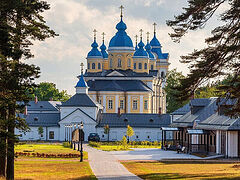
 The Convent of the Transfiguration of the Lord and St. Varlaam of Khutyn
Indeed, after some time, the new abbot arrived at the monastery. St. Varlaam greeted him with these words, “My beloved brother, God’s blessing rests upon this monastery. Today, I entrust this monastery to your hands. Guard it and care for it. I am already departing to the Heavenly King. But do not be troubled by this: though I am leaving you in body, I will always be with you in spirit.”
He peacefully fell asleep in the Lord on November 6/19, 1192. Throughout the following centuries, down to the present day, miracles have been wrought through prayers to St. Varlaam.
Let us say a few words about the Khutyn Monastery. According to tradition, in the late fifteenth century, Prince Ivan III (1440–1505) visited the monastery and fervently questioned the abbot as to why the shrine with the relics of the saint, which lay buried beneath the church floor, had not been opened. By his command, they began to dig to reach the shrine, and at that moment, a pillar of fire erupted from beneath the earth, scorching the altar door. Terrified, the prince fled, striking his staff against the ground, and flames burst forth from there as well. The charred staff and the door were later kept in the monastery’s vestry.
The stone church built by St. Varlaam has not survived. In its place, in 1515, the magnificent Cathedral of the Transfiguration was erected, which is now an architectural monument. Under the Soviet regime, the monastery was closed, but services continued at the cathedral until 1932. At that time, the future elder, Archimandrite Pavel (Gruzdev; 1911–1996), served as a reader and sang in the choir there. In the 1940s, the monastery was destroyed and reopened only in 1994. Today, it is a convent with a large number of sisters.
O our Venerable Father Varlaam, pray to God for us!