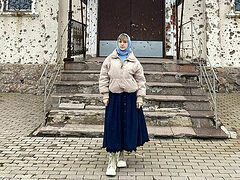
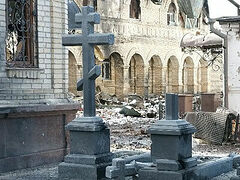
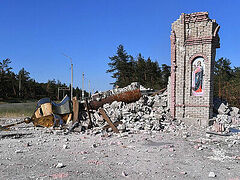
The Church of St. Andrew the First-Called in the village of Golmovsky. Photo: Prichod.ru
In December 2025, I visited the Donbass—Gorlovka, Makeyevka and Yenakiyevo—with a humanitarian mission. This mission was organized by the Caravan of Hope Foundation, specifically by Igor Anatolyevich Lavreshin, the Foundation’s Deputy President and a veteran of the War in Afghanistan. There were three of us: me, Igor Anatolyevich, and my son Roman—a second-year student at Leningrad State University. Archpriest Alexei Isayev, head of the Frunzensky Deanery of St. Petersburg and rector of St. George’s Church, along with Archimandrite Alexander (Fedorov), dean of Sts. Peter and Paul Cathedral in St. Petersburg, provided great assistance in collecting humanitarian aid. From the Council of Veterans of St. Petersburg, thanks to the support of the Hero of Russia and Third Rank Captain A.G. Zaitsev, we received a consignment of medicine and food for the SMO soldiers.
 Igor Anatolyevich Lavreshin, Roman Vladimirovich Vasilik, and Archimandrite Alexander (Fedorov) In the village of Golmovsky not far from the city of Gorlovka our humanitarian mission visited the church of St. Andrew the First–Called right on its patronal feast, December 13. The rector, Archpriest Vadim Morozov, told us about the life of the church in recent years. In 2024, he visited St. Petersburg as part of the project called “Orthodox Donbass. Seven Days without War.”
Shelling began as early as 2014. There were several direct hits to the church. Fr. Vadim recalls how one day a Ukrainian missile hit the cell of his assistant, the acolyte Alexei. Fortunately, he had left the cell five minutes before. Truly, great and wonderful are Thy works, O Lord! Because there was virtually nothing left of the cell. If Alexey had stayed there for five more minutes, he would have been killed…
 Archpriest Vadim Morozov. Photo: Prichod.ru
Another time, the Armed Forces of Ukraine struck the church during the Liturgy of the Faithful. Fr. Vadim was just coming out onto the ambo during the Great Entrance. At the very moment he was praying for the Patriarch: “Our great Lord and Father, His Holiness Kirill...”, drones exploded nearby. He told the parishioners, “Bend down! Crouch!” Meanwhile, the priest thought as he was standing there: “How am I going to crouch with the Chalice and paten in my hands?” And God saved his life; the shrapnel did not touch him or the parishioners. And there have been many such events since 2014. One day, Fr. Vadim came to the church where he had left the sacred vessels on the table of oblation the day before; and he found that the saucer for particles from the proskomidia had been damaged by shrapnel. But all the other vessels were intact.
 Rector of the Church of St. Andrew the First-Called Archpriest Vadim Morozov with parishioners beside St. Andrew’s Church. Photo: Prichod.ru
The road from Gorlovka to Golmovsky resembles a lunar landscape—it’s covered not with just potholes, but real craters. We saw at least three burnt-out rusted-through cars on the side of the road. Fr. Vadim said that drones regularly hovered over the road in 2023 and 2024 and the first half of 2025, hunting both cars and individuals. In the end both buses and even ambulances stopped running to Golmovsky altogether. Fr. Vadim sometimes had to take out sick parishioners and deliver food to those in need himself. It became easier when the front line moved. But even now, there are occasional drones. On the other side, they don’t let you relax. Nevertheless, Fr. Vadim and his parishioners are filled with deep faith in God’s mercy and ultimate victory. “God will not forsake us,” says the priest.
 Service at the Theophany Cathedral in Gorlovka with Metropolitan Mitrofan (far left—Protodeacon Vladimir Vasilik) On Sunday, December 14, the Lord vouchsafed us to pray at the Liturgy at the Theophany Cathedral in Gorlovka, and I, a sinner, was privileged to concelebrate with Metropolitan Mitrofan of Gorlovka. The tragedy of Gorlovka became obvious from Vladyka Mitrofan’s story. Just before Pascha 2025, there were as many as 256 enemy drone attacks. On the central street of Gorlovka, six drivers were killed and six buses were seriously damaged. The situation improved after the advance of Russian troops in the summer and autumn of 2025, and the front line had moved. Looking at the magnificent Theophany Cathedral, you can hardly believe that it was struck by a dozen missiles and drones. However, Metropolitan Mitrofan explained the situation: “We do not want our cathedral to be a war memorial. We want it to be a monument of peace and constructive endeavor.”
Our next stop was at the Church of St. Nicholas the Wonderworker in the city of Makeyevka. We arrived when the preparations for the patronal feast (December 19) were in full swing. The rector, Fr. Alexander, was pleased with our gifts: candlestands, icons, candles, incense, etc. He talked about the troubles that Makeyevka had experienced since 2014, when there were battles there between the volunteer units of the Donetsk People’s Republic and the Armed Forces of Ukraine. Surprisingly, Fr. Alexander had no anger, or even slight annoyance, towards those who had shot at his church and threatened the lives of his parishioners. On the contrary, there was some pity in his words about the misguided and intimidated Ukrainian fellows, abandoned by their own superiors, who had found themselves against their will in a war they did not need at all. And there were several direct hits to his church. The priest showed us the places where holes had been made in the walls and the roof. We heard a number of amazing stories from him about miracles during the war. For instance, he told us about the soldier Igor, who had been saved from death thanks to his cross hit by an enemy bullet. He also told us about a father and son who went to war together. What he shared with us is, without exaggeration, a testimony of the grace of God and human courage.
 Church of St. Nicholas the Wonderworker in Makeyevka A similar story was told to us by the soldier Roman, to whom we handed over medicine and camouflage nets in the Yenakiyevo administration. He told us how he had escaped from a drone by clinging to a tree and “merging” with it with one thought: “Lord, save me! Lord, have mercy!” And God heard him: the drone swerved to the side…
What are the Donbass residents afraid of? Only that they might be abandoned and betrayed. Vladyka Mitrofan’s account of the fate of six priests in the city of Krasny Liman (now Liman) is an illustrative example: After our troops had first entered it and then left, two of these priests managed to flee, while the others were imprisoned by the Security Service of Ukraine, and so far only one has been released in a prisoner swap. We want to hope that the Donbas residents will not become victims of another bargain and exchange, that they will live to see a peaceful and decent life, and sooner or later a just peace will come to the land of the Donbas.
And finally, one more miracle. In Makeyevka, we were horrified to discover that our old Fiat Ducato’s brake pads had worn off during our arduous journey. Riding over the Donbas potholes, its rear and side doors were now jammed. In a word, we rode back on a wing and a prayer. And if it hadn’t been for St. Nicholas the Wonderworker’s intercessions and Roman’s skill, we probably wouldn’t have made it back. And our return to St. Petersburg was a genuine miracle before Christmas.