Hieromonk Platon (Kudlasevich) from the Moscow Sretensky Monastery talks about the celebration of the most important feast of the Church year, Holy Pascha, and answers some questions on this subject.
 Hieromonk Platon (Kudlasevich)
—Father Platon, your blessing. Why is Pascha the most important feast for Orthodox Christians? What is its meaning?
—This is the most important feast, because Christ was raised from the dead. The Apostle Paul says, And if Christ be not raised, your faith is vain (1 Cor. 15:17). He rose from the dead, so everything has huge, important meaning. It was not in vain that the Lord became incarnate, lived on earth, suffered, rose again and gave us all the opportunity to spend an eternity with Him. But we have the opportunity to live with God already here on earth. We can receive the grace of the Holy Spirit. The Lord says, If I go not away, the Comforter will not come unto you (Jn. 16:7). We receive grace in the sacraments of the Church. In the prayers of the Church, we can receive comfort, mercy, and help from God every day. If we have an open heart and seek God, He will give us His grace.
—What is the right way to prepare spiritually for Pascha and celebrate it?
—We were preparing for Pascha during Lent. The Church instituted almost fifty days of Lent. We pray, make prostrations, watch over our spiritual life, and try to reform. We make efforts to be if only a little like the saints of God, whose memory we commemorate on Lenten Sundays: Sts. Mary of Egypt, John Climacus, Gregory Palamas, and a whole host of other saints of our Church. They were close to God, and we, through our attachments, through our sins, move away from God. And by fighting our sins and becoming more and more independent of our various earthly needs, we can draw closer to God. This is possible through prayer, through repentance, and through the sacraments. That’s how we prepare for this feast of feasts.
But even if some of you have not prepared for Pascha, we hear the following in the beautiful Paschal Homily of St. John Chrysostom: “You sober and you heedless, honor the day! Rejoice today, both you who have fasted and you who have disregarded the fast. The table is full-laden; feast ye all sumptuously.” Holy Pascha is for everyone. However, those who have not fasted certainly deprive themselves of the gifts that they could have received during Lent. But the Lord gives joy to everyone one way or another. As long as we live here on earth, we can change our state and our eternal destiny. Therefore, of course, we must make the most of this opportunity.
It is important to come to church for the Paschal service, to partake of the Body and Blood of Christ and Paschal joy. Then we spread this joy, greeting each other, exchanging gifts and exclaiming: “Christ is Risen!” We have plenty of joy during this period. It is advisable to come to church every day during Bright Week. We spent the whole of Lent fasting, repenting, and improving. Pascha is a festival when we should rejoice and accept the Risen Savior into ourselves. Our Church Hierarchy calls on those who attend church regularly, who have fasted and have not committed serious sins, to receive Communion without confession during Bright Week. It would be wrong for us to stand in long queues for confession even in Bright Week. We need to spread this joy in church, at home and wherever we are.
—Father Platon, how can we explain the meaning of Pascha to non-believers or people who don’t know very much about the Church?
—If people you are talking to are non-believers or far from the Church, perhaps you should share your understanding of this feast with them, what our Savior did through His boundless love for the human race, and maybe tell them a little bit about the life of Christ. And if you do it honestly and openly, then the person will respect your choice, and may lend an ear to your words. Maybe something will change in his life and worldview too, and he will convert to Christ. We must share our faith with others—that which brings us joy and gives us strength. And people respond to it.

If we just take something from Catechism, the person may not even understand what it’s all about. But if we talk about what really touches our hearts, there might be something useful for him in this. However, if a person is aggressive towards the Church, then of course you shouldn’t cast your pearls before swine. In that case you don’t use high-sounding words or wave your fists. If he has a negative disposition or he doesn’t care, then just say a few kind words, give him a Paschal egg or a kulich, give him your attention and smile. And that will be enough for him—this is more than any words.
—Why do some people not feel Paschal joy, and what should they do in that case?
—How can we rejoice when we have anger and irritation inside us? What Paschal joy can we talk about then? Pascha is Pascha. Has the feast come? Yes, it has. Is there joy in the world, in the Church, and everywhere? Yes, there is. Don’t we feel it? Well, never mind. Is there a reason for this lack of joy that we can eliminate? Let’s eliminate it. No reason? Leave it as it is. If we seek emotions, sooner or later they’ll lead us to a dead end, and most likely into spiritual delusion. Then we wouldn’t be turning to God in prayer, but for some “prayerful feeling” or “tender emotion”. This is wrong—we don’t seek emotions. Do we have joy? Thank God. No joy? Never mind, it will come later. Thank God for everything! St. Paisios the Hagiorite gave this advice: “In order for the true joy of the Resurrection to come to us, we must cultivate ‘joy-making mourning’ in us. If we spend Holy Week piously and with spiritual compunction, we will celebrate the Holy Resurrection in spiritual jubilation and divine joy.”
—Should we try to keep the Paschal mood when we come home and have a festal meal?
—Everything comes to an end. We come to church, and the night Liturgy is being celebrated. It’s physically hard for us to stand through the service, sometimes it’s stuffy in church, and so on. But these are moments that happen once a year. They should be cherished and enjoyed. How can we keep this joy? It’s possible only by the grace of God. If the Lord gives us such joy the next day, it will be fine. If not, then it’s not a tragedy. Let’s use our time in church for our benefit. We have fasted, prayed, and made prostrations for many days. And now we have joy. Don’t think: “I’m going to get back home and have a meal now.” We should enjoy every minute of prayer while in church. Even if we go home tired, we’ve experienced Paschal joy. Let’s keep it in mind. Let’s thank God for this period, for the strength He gave us, for prayer, for the celebration—and for everything.

—Why is the Paschal night service so dynamic? Some priests literally run around the solea.
—At Pascha, we have such exultant and fast-paced hymns, while our Lenten services were long and melodious. Some priests run fast for joy, while others sprint through it to keep up with the fast-paced singing. Actually, the Paschal service is not short. The midnight service usually commences at eleven in the evening, the cross procession starts at midnight, and the main service ends at about three in the morning.
—What is Pascha for you? Where there any Paschal celebrations that stand out in your life?
—For the past few years I have always celebrated Pascha at Sretensky Monastery. Of course, it’s a very solemn and well-attended event, and we all prepare for it with great excitement. Although we get tired, it is a special joy. I don’t remember much from my childhood. Our parents would prepare kulichi, pascha cheese, and colored eggs in advance. I remember helping at the altar in church and walking in cross processions. I recall some moments connected with the service and church. My brothers, parents and I participated in cross processions every day throughout Bright Week we gave gifts to our close ones, and there were delicious treats.
—Why was the new cathedral of the Sretensky Monastery consecrated in honor of the Resurrection of Christ and the New Martyrs and Confessors of the Russian Church? How are they interrelated here?
—Beyond all doubt, they are interrelated, because all suffering matters only in Christ’s Resurrection. When we enter the cathedral we see Christ the Savior, Who gives His Body and Blood to His disciples.1 And our New Martyrs are depicted among them. That is, the Lord is not bound by time, and the Resurrection of Christ always takes place in eternity. It happened as a historical fact and happens always.
Every time we celebrate the Liturgy and perform the Eucharist, we remember both the Passion of Christ and His Resurrection. It seems that it was just a unique historical event, but it happens simultaneously and continuously in eternity. The Resurrection of Christ justifies all the torments of our great predecessors—the New Martyrs of the Russian Church, which is why Vladyka Tikhon (Shevkunov) named the cathedral in honor of the Resurrection of Christ and the New Martyrs of the Russian Church. The church is bright and airy, and it has a cheerful and Paschal atmosphere. We celebrate the patronal feast on Pascha.
—Father Platon, is it known how our New Martyrs celebrated Pascha?
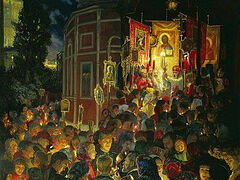
—They mostly observed Pascha in labor camps and exile. It was vividly described by the writer Boris Shiryaev (1887–1959), who shared the hardships of imprisonment in the Solovki labor camp with our monastery’s patron saint, Hieromartyr Hilarion (Troitsky). I will quote an excerpt from his book, The Undying Lamp: “I couldn’t help but recall the only Matins allowed at the Solovki camp in a dilapidated cemetery church… Vladyka Hilarion obtained permission for all prisoners (and not only for the clergy) to celebrate. He persuaded the head of the camp to give us the ancient banners, crosses and chalices from the museum for that night, but he forgot about the vestments. It was too late to go and ask for a second time. But we didn’t lose heart. The famous burglar… was urgently sent to the museum. He worked with master keys, extracting ancient, precious vestments from chests and showcases… That Matins was unique. Dozens of bishops headed the procession. Ancient lamps burned with the ineffable colors of the Holy Night, and banners with the faces of the Savior and His Most Pure Mother shone radiantly.
“No bells rang… But long before midnight, endless rows of gray shadows had moved towards the dilapidated cemetery church… Few managed to get into the church. It couldn’t even accommodate the clergy. Over 500 of them were then languishing in prisons. The whole cemetery was full of people, and some of the worshipers stood next to the trees of a local pine forest.
“Silence reigned. Exhausted souls yearned for the blessed peace of prayer. Ears pricked up and caught the sounds of singing coming from the open gate of the church, and, gaily playing in all colors, the Northern Lights roamed across the dark sky, its pillars flashing. With a formidable command of a hierarch endowed with unearthly power, Vladyka Hilarion’s mighty exclamation thundered out:
“‘Let God arise, and let His enemies be scattered!’
“Snowflakes fell from the branches of nearby pines, and on the top of the belfry the symbol of the Passion and Resurrection—the Holy Life-Giving Cross that we had erected on that day—flashed, glowing brightly.
“A unique procession of the cross appeared from the wide-open gate of the dilapidated church, twinkling with multicolored lights. There were seventeen bishops in vestments, surrounded by lamps and torches, along with more than 200 priests and the same number of monks, and the countless number of those whose hearts and thoughts were longing for Christ the Savior that wonderful, unforgettable night. Shining banners created by craftsmen from ancient Veliky Novgorod solemnly floated out of the church doors; lamps… lit up with a magnificent multitude of colors; the sacred vestments and mantles, embroidered by the slender fingers of grand duchesses of Moscow, were freed from captivity and blossomed.
“‘Christ is Risen!..’
“Those who were doomed to death in the deaf darkness of isolation wards made the sign of the Cross. The swollen, whitened lips of those with scurvy whispered the words of the promised eternal life as they bled...
“‘Christ is Risen!’
“That was the only Matins celebrated in the Solovki labor camp.”2
—You have provided a stunning excerpt. Father Platon, His Holiness Patriarch Kirill said: “Every minute of a true Christian’s life should be filled with Paschal joy.” How can this be achieved in the world?
—Where there is no place for sin, there is a place for God and joy. If we have only worries, chores, vanity, sins and passions inside us, then we have no place for Christ.
During Lent, we have purified our hearts, and now let us fill our cleansed hearts with Christ and Paschal joy. The Patriarch calls on us to above all else have the Lord and the joy that He has given us all in our hearts.
—What would you say to our readers on these days of Holy Pascha?
—I wish our parishioners Paschal joy and the grace of the Holy Spirit. I congratulate everyone for making it to Pascha. The Lord, in His mercy and love for mankind, has once again given us the opportunity to celebrate the Radiant Resurrection of Christ. And I wish for all brothers and sisters to maintain this Paschal joy and life with God. I hope our life will truly be with God, and not with something that separates us from Him. And I also hope that all our labors and attempts at fasting will benefit us. And Pascha makes up for what is missing in all this through the Resurrection of Christ—it grants us joy and what we strive for—the spirit of peace and the grace of the Holy Spirit.