How beloved are Thy tabernacles, O Lord of hosts (Ps. 83:2).
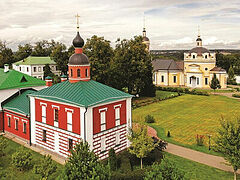
 The Cathedral of the Shamordino Convent
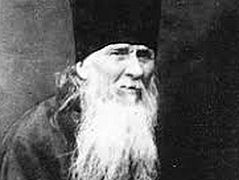
The Stavropegic Convent of St. Ambrose and the Kazan Icon of the Theotokos is a convent of the Russian Orthodox Church, situated just over twelve miles north of the famous Optina Monastery between the ancient city of Kaluga and the ancient town of Kozelsk. The Optina Monastery and the Shamordino Convent are known and loved by Orthodox people not only in Russia, but also abroad. Both are closely interconnected spiritually: Shamordino is the child of the great holy Elder Ambrose (Grenkov; 1812–1891) of Optina.
In 1875, St. Ambrose of Optina blessed his spiritual daughter, Nun Ambrosia, to purchase the small estate of V. P. Kalygin near the village of Shamordino. Nun Ambrosia (secular name: Alexandra Nikolaevna Klyuchareva; 1819–1881), a former landowner from Tula, lived in the world in a pious marriage with Fyodor Zakharovich Klyucharev until she was forty. In 1860, by mutual consent, the spouses withdrew from the world: Fyodor Zakharovich entered the Optina Monastery, and Alexandra Nikolaevna, the Convent of the Elevation of the Holy Cross in the town of Belev (now in the Tula region). Alexandra Nikolaevna’s only son had two twin daughters, Vera and Lyubov. His wife died shortly after giving birth, and their grandmother took the babies’ upbringing on herself, moving with them to the Optina Monastery. Thanks to their grandmother’s care, the girls grew up to be extraordinary children: meek, gentle, loving each other dearly, and very attached to St. Ambrose, their godfather.
In the Shamordino estate, Nun Ambrosia, with the blessing and according to the plan of Elder Ambrose, built a large wooden house on a stone foundation for her granddaughters. Widows and orphans lived in this house with the girls—virgins from among former serfs who had faithfully served the Klyucharevs for a long time. Over time, their relatives began to join them, seeking solitude and prayer, since Mother Ambrosia’s pious mood influenced the way of life on the estate. Many of those who lived with her later became the first nuns of the convent, established on that site.
In 1881, Mother Ambrosia peacefully reposed in the Lord, and two years later, her granddaughters died of diphtheria at the age of twelve. According to Nun Ambrosia’s spiritual testament, in the event of her granddaughters’ deaths, a community for nuns with a church and an almshouse was to be set up in the Shamordino estate. Her will was fulfilled in 1884: by a decree of the Holy Synod, a community of nuns was established in the village of Shamordino of the Peremyshl district of the Kaluga province (now the Kaluga region).
 St. Ambrose of Optina St. Ambrose became the organizer of the new convent, and his devoted spiritual daughter Sophia Mikhailovna Bolotova (1845–1888) became his indispensable helper. Sophia Mikhailovna came from an ancient, pious noble family. In 1875, she married Andrei Nikolaevich Yankov. Their marriage lasted a little more than a year; in 1877, Andrei Nikolaevich died suddenly. In 1880, the thirty-five-year-old Sophia Mikhailovna visited the Optina Monastery for the first time, where she met Elder Ambrose. That meeting drastically changed her life: Sophia Mikhailovna resolved to devote herself entirely to the service of God. However, St. Ambrose decided to test her, blessing her to marry someone she did not know—whom he would point to. Sophia Mikhailovna accepted the elder’s words as the will of God and soon married the elderly landowner Nikolai Ivanovich Astafyev from Kozelsk. Her husband was seriously ill and had a difficult character. Sophia Mikhailovna looked after him as a nurse and carer with Christian love for about two years until his repose in 1884. At that time, Elder Ambrose began to entrust many affairs related to the organization of the community to Sophia Mikhailovna, who carried out all the elder’s instructions with great responsibility and love. St. Ambrose used to say that he had never had and would never have another such obedient disciple like her.
When the question of the appointment of an abbess of the community under construction arose, the choice fell on Sophia Mikhailovna. Abbot Isaac (Antimonov) of the Optina Monastery and Elder Ambrose sent Bishop Vladimir (Nikolsky) of Kaluga and Borovsk a recommendation to appoint Sophia Mikhailovna as the abbess of the community under construction, attaching a letter of reference stating that she “quite understands both monastic life and household matters, and the sisters of the new community are very kindly disposed towards her, so they obey her orders implicitly.” On September 17, 1884, Fr. Ambrose vested Sophia Mikhailovna in monastic robes and later tonsured her a nun while retaining the name Sophia.
Soon, through the efforts of Elder Ambrose and Mother Sophia, the first church of the convent was built in the former house of the Klyucharevs. On October 7, 1884, Abbot Isaac and Mother Sophia sent a report to Bishop Vladimir of Kaluga and Borovsk on the completion of the interior of the wooden church in honor of the Kazan Icon of the Mother of God and its readiness for consecration. The church was consecrated on October 14, 1884, on the feast of the Protecting Veil of the Most Holy Theotokos. This day is considered the day of the foundation of the convent, which was initially called the Gorskaya Convent of the Kazan Icon.1 On the same day, Nun Sophia was appointed its abbess.
Bishop (the future metropolitan) Tryphon (Turkestanov; 1861–1934), who knew Mother Sophia personally, wrote:
“The first abbess, Mother Sophia, became the head of a poor convent: a wooden house with a house church, and several wooden huts for the sisters to live in. That’s all! There was no money, no property, no supplies of any kind, and yet the community was growing every day. The elder sent many healthy and strong young virgins, capable of work, to the convent, but no fewer (if not more) sick and disabled ones, incapable of any work… The community was becoming ever larger, and the means of subsistence kept decreasing. But Mother Sophia was not one to be confused or discouraged by difficulties. Of imposing appearance, with a firm character, fervent faith in God and deep obedience to the elder, she was able to endure everything for the glory of God and for the benefit of the convent entrusted to her.”
With the blessing of Elder Ambrose, women of any rank, age, state of health and without financial contributions were admitted to the convent, while most Russian convents could not afford to do that at the time.
The life of the Shamordino Convent was guided by St. Ambrose—the liturgical rules, monastic order, construction work, and the assignment of obediences were arranged with his blessing. Whenever he came to Shamordino, he inspected everything, marking out places for the construction of future churches, cells and other buildings. He tonsured many of the sisters himself. One of the brightest moments in the lives of the convent nuns were his visits to Shamordino.
Elder Ambrose and Mother Sophia gave much attention to the spiritual life of the sisters. Although Nun Sophia ruled the convent for only three and a half years, she managed to do a lot over that period, and most importantly, to earn the boundless love of the sisters. Under Mother Sophia’s active direction, the living quarters for the nuns and household facilities were built, sketes and monastic workshops were organized, an almshouse, a day nursery and an orphanage were opened. There was an elementary school at the orphanage, where the sisters taught children reading, writing, and the Law of God. Elder Ambrose would exclaim regarding the orphanage and the day nursery: “Oh, you came up with such a great idea! How I love it!” One of the difficult tasks was the construction of a large stone Cathedral of the Kazan Icon. Under Mother Sophia, this stone church was designed and staked out at the future construction site. For the construction of the cathedral, special furnaces were put up near the convent and the production of their own bricks was launched, with Elder Ambrose himself supervising their quality.
Mother Sophia’s austere ascetic life and incessant labors to organize the convent undermined her health, and on February 6, 1888, at the age of forty-two, she fell asleep in the Lord, having received the great schema shortly before her death. According to St. Ambrose of Optina, Mother Sophia “had found favor with God” for her godly life, and the elder referred to her as a saint. From the time of her repose to the present, many have turned to her in prayer with faith and love, receiving grace-filled help and consolation.2
Another grace-filled ascetic, Schema-Abbess Euphrosyne (Rozova; 1836–1904) became Mother Sophia’s worthy successor. Elder Ambrose’s devoted spiritual daughter, she had struggled at the Belev Convent before moving to Shamordino. The elder chose for his convent not so much a practical administrator as a nun who was experienced in spiritual life and had many years of monastic obedience behind her. Mother Euphrosyne guided the sisters (entrusted to her by the elder) strictly and wisely, teaching them patience and humility.
On October 23, 1891, St. Ambrose departed to the Lord at the Shamordino Convent he had founded. After his repose, other Optina elders were its father-confessors: Sts. Anatoly the Elder, Joseph, Barsanuphius, Anatoly the Younger, Nectarius and Nikon, as well as Schema-Hieromonk Meletius (Barmin), Schema-Hieromonk Pior (Shestakov), Schema-Hieromonk Innocent (Florov) and others, who, like St. Ambrose, treated the sisters with paternal love.
After Elder Ambrose’s repose, miraculous Divine Providence began to manifest itself in the life of the convent, which was left without any means of subsistence. Knowing Mother Euphrosyne’s desperate situation, the sisters were often despondent, but she never lost heart, and no matter what trouble befell them or what difficulty they had, only these words were heard from her: “Thank God,” or “Through the elder’s prayers.”
And this deep faith did not put her hope to shame. The Lord sent the convent benefactors—spiritual children of St. Ambrose—the spouses Anna Yakovlevna (1842–1920) and Sergei Vasilyevich Perlov (1835–1910), who began to tend to its needs with the most ardent concern. Thanks to their generous patronage, all the convent’s main stone buildings were constructed—the magnificent Cathedral of the Kazan Icon, an almshouse with a house church of the Icon of the Mother of God, “Assuage My Sorrow”, a refectory for the nuns, a hospital, a building for workshops, a stone canopy above the cell where St. Ambrose reposed, a water tower and a burial vault. The magnificent architectural ensemble of the convent’s buildings was made of red bricks that it produced itself. With the support of S. V. Perlov, Various workshops were opened for the convent’s self-sufficiency: chasing, metal and wood gilding, weaving, sewing, carpet, bookbinding, shoemaking and others. Sergei Vasilyevich set up a printing house at the convent, where spiritual literature was published, along with a photographic workshop. The convent sisters who worked in the workshops were taught by experienced teachers hired by Sergei Vasilyevich.
By the early twentieth century, the convent had become a major spiritual center of the Russian Empire, where over 800 sisters of various ranks and backgrounds labored in monasticism. The Shamordino Convent, just like the Diveyevo and Leushino Convents,3 became known as a “woman’s Lavra of Russia.” Pilgrims from all over Russia flocked there for spiritual help.
On July 21, 1901, on the feast of the Kazan Icon of the Most Holy Theotokos, the community officially received the status of a convent, and Mother Euphrosyne was elevated to the rank of abbess. On November 6, 1902, Bishop Benjamin (Muratovsky) of Kaluga consecrated the grand fifteen-domed Cathedral of the Kazan Icon, built in the Russian style with decorative kokoshniki,4 semi-columns, valances, and ornate architraves. The marvelous and glorious cathedral could accommodate up to 5000 worshippers.
In 1889, Maria Nikolaevna Tolstaya (1830–1912), Leo Tolstoy’s beloved sister, entered the Shamordino Convent. Mother Maria had her own house there, built at her expense, with a small garden and a vegetable patch. According to contemporaries, she was very worried about the soul of her unfortunate brother. She died at the convent, having received the schema the day before her repose.
When Fr. Ambrose was still alive, Abbess Euphrosyne lost her eyesight, but continued to bear the cross of abbacy as an obedience to the elder. Under her, all the main monastic buildings were constructed, and the convent was strengthened spiritually and financially. Mother Euphrosyne died in 1904 at the age of sixty-eight.
 Shamordino in the early twentieth century. Photo: Pastvu.com
Following Abbess Euphrosyne’s repose, with the blessing of Elder Joseph of Optina, the Shamordino Convent was headed by Nun Ekaterina (Sambikina; 1842–1911), one of the first nuns of the convent and Elder Ambrose’s disciple. A well-known spiritual writer and Nun Ekaterina’s relative, Konstantin Nikolaevich Leontiev (monastic name: Clement; 1831–1891), a spiritual child of St. Ambrose of Optina, referred to her as “the elder’s confidante”, since during the elder’s lifetime she helped him as a confidante and in communications with his numerous spiritual children and pilgrims. Mother Ekaterina often passed on questions from other people to the elder, and then gave them answers verbally or in writing. When a year before his death Elder Ambrose had to live in Shamordino due to illness, she was appointed his cell-attendant. This spiritual school, which Nun Ekaterina went through under the elder’s guidance, became a good foundation for her service as abbess a few years later.
Elder Joseph, the father-confessor of Shamordino, was at peace about the convent, fully entrusting the management of all affairs and the spiritual education of the sisters to Mother Ekaterina. Seven years later on February 24, 1911, Mother Ekaterina reposed, receiving the great schema before her death.
The last abbess of Shamordino before the October Revolution was Mother Valentina (Rozantseva; 1864–1919). Elder Joseph appointed her two months before his death: after retiring to his cell for prayer, he handed the sisters a sealed envelope with the name of the new abbess. When it was announced that the choice had fallen on Nun Valentina, she fainted from shock, deeming herself unworthy of this rank, and agreed only out of obedience.
Through Divine Providence, Mother Valentina became the abbess at a tragic time. She put all her strength into saving the convent from being looted and destroyed by the new Government. In April 1918, the evaluation commission arrived in Shamordino to transfer the convent to the Bolshevik Council. In connection with this, Mother Valentina appealed to Bishop Theophan (Tulyakov; 1864–1937, a future hieromartyr) of Kaluga and Borovsk with a request to allow the convent to be renamed a “labor commune”. Permission was granted. For several years, the nuns lived at the convent while working in an “agricultural cooperative” (artel). Nun Alexandra (Nikitina) was chosen as the chairperson of the commune and tactfully negotiated with representatives of the new Government, but they interfered in all the convent’s affairs, imposing their own rules. The convent’s well-established administration gradually declined. It was deplorable for Abbess Valentina and the sisters to see their dear convent, set up by the many labors and prayers of Fr. Ambrose and his spiritual children, dying before their eyes. Mother Valentina meekly bore the cross of her office placed on her shoulders by the Lord. In 1919, doctors diagnosed her with cancer. Elder Anatoly (Potapov) of Optina secretly tonsured her into the schema, and on September 25, 1919, she reposed in the Lord.
In those years, many nuns had to leave the convent; they went to live with their families. The sisters who remained huddled in the hospital building. They eked out a miserable existence, and there was not enough firewood to heating the building. One of the Shamordino nuns recalled that time as follows: “Many of us grew weak from overwork and, mainly, from grief…”
The convent was shut down and dissolved on March 12, 1923, “as a hotbed of counterrevolution.” All the convent’s lands and estates became collective farm property. The nuns were ordered to leave the convent, and many of them moved to Kozelsk and the surrounding villages to be closer to the father-confessors of Optina, who had had to leave their monastery as well. In 1929, many of the sisters were exiled and imprisoned, and some of them died as martyrs. Currently, fourteen Shamordino sisters are known to have been shot.
During the Second World War, a military hospital was located on the territory of the convent. According to the recollections of the head of the hospital, Viktor Lvovich Lapidus, a career army physician, “Along my front-line roads, Shamordino left the most unforgettable impression. This place evoked a mood of something pure, something filled with grace. Indeed, I noticed that everything was much easier to do in Shamordino than in other places. Remarkably, entering the area of Shamordino, everyone would fall silent. There was a sense of peacefulness, not just constraint, in the behavior of the soldiers and officers. There were no violations of discipline. At the same time, neither the medical command staff nor the political instructors had to make any efforts in this regard. Everything seemed to happen by itself.”
In the Soviet era, the Shamordino Convent fell into complete disrepair. The Cathedral of the Kazan Icon was desecrated; it stood without domes, and small trees grew on its rusted roof. Later, it became home to an agricultural college and a combine harvester was installed in the altar as a visual aid. The refectory housed a club with a cinema room. The convent’s outbuildings were in decay.
In 1988, Elder Ambrose of Optina was canonized. In March 1990, monastic life at the Shamordino Convent began to revive. The convent is situated in one of the most beautiful corners of Holy Russia. The religious author and philosopher Ivan Kontsevich (1893–1965) wrote about the glorious nature around the convent:
“Shamordino is situated in a delightful area—on a wide meadow above a cliff. A dense deciduous wood clings to an almost vertical slope. And far below, the small Seryona River meanders like a silver ribbon. Beyond the rolling hills, the plain merges with the horizon, shaded here and there by distant pine woods or groves.”
The beautiful natural scenery created by the Lord should be matched by the beauty of buildings created by human hands. The abbot of the resurgent Optina Monastery, Archimandrite Eulogius (Smirnov; 1937–2020, the future Metropolitan of Vladimir and Suzdal), petitioned Patriarch Pimen of Moscow and All Russia to reopen the Shamordino Convent. On May 3, 1990, Patriarch Pimen signed a decree on the resumption of monastic life in Shamordino. A nun from Riga, Mother Nikona (Raisa Egorovna Peretyagina; 1941–2012), was appointed abbess of the convent.
 Abbess Nikona (Peretyagina)
I deem it necessary to write in more detail about Abbess Nikona, who, with God’s help, managed to revive the convent from ruins in a very short span of time. Raisa Peretyagina was born on October 12, 1941 in the town of Lysva (Perm region) into the family of Egor Mikhailovich and Anna Ignatievna Peretyagin. On the very day Raisa was born, her father was killed at the front. From an early age, the girl sang in church choir. After completing the eighth grade of evening school, Raisa worked at a post-office, and from 1976 as a dispatch clerk for the distribution of literature in the editorial office of the Journal of the Moscow Patriarchate. At that time, she sang at the Church of the holy Apostles Peter and Paul in Lefortovo in Moscow. Later she graduated from the choir conducting school at the Moscow Theological Seminary. Metropolitan Pitirim (Nechayev; 1926–2003), who was then the editor-in-chief of the Journal of the Moscow Patriarchate, played a major role in her life during that period.
In October 1983, Raisa Egorovna became a novice at the Holy Trinity-St. Sergius Convent in Riga. In 1988, Metropolitan Leonid (Polyakov; 1913–1990) of Riga and Latvia tonsured her a nun with the name Nikona in honor of St. Nikon of Radonezh. In 1990, at the request of the Abbot of the Optina Monastery, Archimandrite Evlogy (Smirnov), Nun Nikona and Novice Nun Efrema arrived in Shamordino from Riga to revive monastic life there.
From the very first days of the convent’s resurgence, Fr. Polycarp (Nichiporuk; 1946–2024) was appointed its father-confessor. Fr. Polycarp began his monastic life at the Holy Trinity-St. Sergius Lavra, where he was tonsured a monk in 1972. He was ordained hierodeacon in the same year, and hieromonk in 1976. In 1989, he was transferred to the Optina Monastery, and in 1990 he was appointed father-confessor of the reborn Shamordino Convent.
Thanks to his prayers, along with spiritual and worldly experience, the convent began to revive quickly. Fr. Polycarp and Mother Nikona proved to be of one mind: in the regenerated convent they introduced daily night services, the cross procession around the convent, and so on. In just twenty days, under their direction, the church at the historic almshouse in honor of the “Assuage My Sorrows” Icon of the Mother of God was prepared for consecration. It was consecrated on May 27, 1990—a date that went down in the convent’s annals as the day of its rebirth. On the same day, Nun Nikona was elevated to the rank of abbess. The bells began to ring, icon lamps began to burn, and the celebration of services resumed there again.
The first sisters had to live and labor in difficult conditions; there was no water or heating. The nuns prayed fervently and worked unremittingly. Soon, Schema-Nun Seraphima (Bobkova), a spiritual daughter of the last Optina elder, St. Nikon (Belyaev), was brought from Belarus. She had been a novice at the Shamordino Convent even before the Revolution. Schema-Nun Seraphima supported the sisters with prayers, comforted them spiritually and told them about the former Shamordino. Mother Seraphima reposed at the age of 105 on November 3, 1990—the eve of the feast of the Kazan Icon of the Mother of God.
Under the active Abbess Nikona, a care home for sisters and a hospital were reopened, along with a Sunday school for children from the surrounding villages. The area was cleared, flower beds were laid out, and the convent was transformed into a little corner of paradise. On the site of the house-cell where St. Ambrose of Optina departed to the Lord, the first church in Russia was built in honor of this saint. On July 28, 1996, just two months after the restoration work had commenced, the church was consecrated by His Holiness Patriarch Alexei II. In 1999, a skete with a house church was built in the convent area in honor of the Icon of the Mother of God, “The Multiplier of Wheat”. In August 2005, Patriarch Alexei II consecrated the restored magnificent Cathedral of the Kazan Icon. In 2006, work began on the reconstruction of the destroyed Holy Trinity Church, and in 2018, regular services resumed in it.
 The Cathedral of the Kazan Icon
Abbess Nikona passed away on May 28, 2012, following a serious incurable illness. Mother Nikona was buried in the very vault where the relics of the first abbess of the Shamordino Convent, Schema-Nun Sophia (Bolotova), used to rest.
Abbess Sergia (Shcherbakova) is the current abbess of the Convent of St. Ambrose and the Kazan Icon. She was born on July 30, 1968 in Moscow. In 1989 she graduated from the G.V. Plekhanov5 Moscow Institute of National Economy with a degree in economics. On December 4, 1990, on the feast of the Entry of the Most Holy Theotokos into the Temple, at the age of twenty-two, she entered the newly reopened Shamordino Convent. Here she performed various obediences—in the kitchen, in the prosphora bakery, in the convent gardens—and eventually became a reader at the church and began to sing in the choir. On April 12, 1992, with the blessing of His Holiness Patriarch Alexei II, she was tonsured riassaphor with the name Euphalia; on December 6 of the same year, she was tonsured into the mantia with the name Sergia in honor of St. Sergius of Radonezh. Soon, Mother Sergia was appointed deputy abbess, an obedience which she performed for eleven years. In 2006, she was appointed treasurer of the convent. All that time, she was Abbess Nikona’s assistant and spiritual daughter. After Abbess Nikona’s demise, with the blessing of His Holiness Patriarch Kirill, on June 4, 2012, Nun Sergia was appointed acting abbess of the Shamordino Convent, and two years later, by a decree of the Holy Synod, she was appointed abbess of the Convent of St. Ambrose and the Kazan Icon. On July 6, 2014, the feast of the Vladimir Icon of the Mother of God, His Holiness Patriarch Kirill of Moscow and All Russia elevated her to the rank of abbess at the Novodevichy Convent in Moscow.
The particularly venerated relics of the convent are a Kazan Icon of the Mother of God (painted by the sisters of the pre-revolutionary convent), along with icons of the Mother of God, “Quick to Hear” and “It Is Truly Meet” (the Athonite style). There are also reliquaries in the churches with particles of the relics of St. Ambrose of Optina, other Optina Elders and many other saints.
Almost the entire interior decore of the churches was made by the sisters’ hands—icons were painted, the splendid icon mounts were embroidered with beads, stained glass windows and icon cases were made. Master seamstresses embroidered shrouds and banners. Talented seamstresses sewed vestments for the clergy.
 The resting-places of the convent’s abbesses and S. V. Perlov
The spirit of Elder Ambrose still lives in the convent, and his prayers guard it. The graves of its abbesses and the grave of its benefactor, S.V. Perlov, are behind the sanctuary of the Cathedral of the Kazan Icon. Shamordino leaves an indelible mark on the lives of pilgrims and tourists who visit this grace-filled convent at least once. Experiencing monastic life changes the soul for the better. There is always prayerful stillness and tranquility there, allowing you to take a break from the hustle and bustle of the world and reflect on eternity. There is a sense of grace in the crystal-clear air. Some women return here to labor.
Currently, over 100 nuns of different ages labor in monasticism under the spiritual guidance of Abbess Sergia.
Under the grace-filled protection of the Mother of God, the holy Elder Ambrose, and Mother Sophia, the revived Shamordino Convent continues to live in order to shine with true Gospel light on the world and offer up humble prayers for our earthly Fatherland and for Orthodox Christians worldwide.