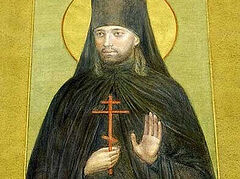
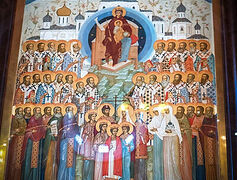
On July 27, 1938, 142 people were shot at the infamous Butovo firing range near Moscow. Among them was Priest Leonid Druzhinin (commemorated July 14/27), an “anti-Soviet element” who had the “wrong” biography of being a clergyman.
Kashira. The Son and Grandson of Priests
 Church of the Ascension of the Lord. Photo: sobory.ru In 1879, a son was born into the family of Priest John Grigoryevich Druzhinin and his wife Glafira Mefodyevna in the town of Kashira.1 The newborn was baptized with the name Leonid at the local Church of the Ascension of the Lord. At that time, the stone church in the classical style was rebuilt in a new location half a mile away from the old one, a bell-tower was set up according to the old design, and the side chapels of St. Nicholas the Wonderworker and the Kazan Icon of the Mother of God were consecrated. The church had a parish school and a parish charity, whose activities included the maintenance of churches and parish clergy, the education of children, orphanages, and medical care for the sick. The parish encompassed a part of Kashira and Pushkarskaya Sloboda (now Pushkarskaya Street in Kashira)—including about 700 people in total.
From 1865, the life of John Druzhinin, who had graduated from the Tula Theological Seminary, was connected with the Ascension Church. At the age of twenty-two, he came to this church. At that time, Methodius Rozhdestvensky, his future father-in-law, was its rector.
Twelve children were born in the Druzhinin family, four of whom died prematurely. Their son Leonid always attended church with great reverence and loved to pray at the venerated icons. He never thought of a life path other than serving God, so he entered the Tula Theological Seminary and in 1902 completed the full course with a second-category certificate, according to which he was eligible to apply for the position of a teacher or a deacon. Leonid Druzhinin chose school.
Prudishchi Village Parochial School
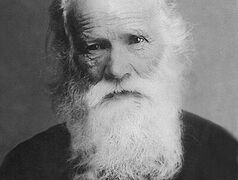
 Leonid Druzhinin In the early twentieth century, the gem of the ancient village of Prudishchi in the Venev district of the Tula province was the Church of the Protection of the Mother of God with side chapels of St. Demetrius of Thessaloniki and the Archangel Michael. The church parish was quite large, because it included residents of the villages of Prudishchi and Shchuchye, as well as seven more villages. In 1893, the rector of the Holy Protection Church, Priest Dimitry Sokolov, founded a one-room parochial school in Prudishchi.
In 1900, the Tula Diocesan School Council sent a request to the Spiritual Consistory2 for the appointment of authorized representatives to purchase a landlord’s estate with all the appurtenant structures for the Holy Protection Church. The goal was to open a two-room school. Because of emerging issues with the estate’s heirs, authorization was obtained to temporarily purchase the property in the name of the district superintendent of the Venev branch of the Diocesan School Council, Priest Dimitry Sokolov.
So on October 1, 1901, a new two-room parochial school was opened in the landowner’s house in Prudishchi with a four-year course of study. The following year, Leonid Ivanovich Druzhinin came there to teach the Law of God and fundamentals of the history of the Russian Orthodox Church and the Fatherland. However, this occupation did not captivate Druzhinin, as he had always dreamed of serving at God’s altar in the church.
The Village of Georgievskoye (Kadnoye) in the Tula Region
In 1903, Leonid Druzhinin was ordained deacon, then priest, and in 1904 he came to the village of Georgievskoye about sixty miles away from Tula. It is a picturesque mountainous area, adorned with high banks of the Krasivaya Mecha River with its tributary of the Sitovaya Mecha, both of which flow into the larger Kamenka River. Priest Leonid Druzhinin spent twenty-five years of his life in the village of Georgievskoye, where he and his wife had children. His Church ministry was repeatedly recognized with various awards.
Today, the desolate ruins of the church and bell-tower in Georgievskoye, closed in the 1950s, show how beautiful, large and rich it was. The stone building was constructed in the classical style at the expense of parishioners and benefactors in 1854. Twenty years later, a bell-tower appeared, built at the expense of merchants from the town of Yefremov, brothers A. and V. Petrov and other benefactors. The construction of the spacious church was justified, because the parish, in addition to the village, comprised ten more settlements.
Thirteen years passed—the 1917 October Revolution broke out in the country. In Tula, a major military and industrial center, the atmosphere became very tense, while virtually nothing had changed in rural areas. In March 1918, Soviet power was established in the city. Severe shortages of bread, salt, kerosene, and other basic goods crippled the city, part of the regional hospital was closed, and there was a surge in crime. The next act of the new government was persecution of the Church—churches were looted, shut down, and destroyed; shrines with holy relics were opened, and the monasteries were repurposed into concentration camps. In 1921, the number of churches in the Tula province dropped from 1089 to 350, and a concentration camp was located in the former Shcheglovsky Monastery of the Theotokos and Greatmartyr Panteleimon. All this really worried the village priest Fr. Leonid Druzhinin, who realized what a future awaited him, his church, and the faithful.
Arrest: “Unemployed and a Priest in Church...”
In 1929, the Moscow Region was established, and on July 12, the Tula District, a former province, became part of it. By the end of the year, communes, partnerships for the joint cultivation of land and agricultural artels emerged. Collectivization was slow; the Soviet Government was looking for “enemies” and found them in the person of priests, who were “leading villagers astray from the right path of collective farming organization”.
In 1929, Fr. Leonid was arrested and sentenced by the Tula District People’s Court to one year of imprisonment and three years of exile. There was an entry in his file: “Unemployed and a priest of the church of the village of Georgievskoye. He is not a member of the Communist Party.” Unfortunately, there is no information on his charges, his place of imprisonment, or his exile destination.

On his early release in 1931, Fr. Leonid Druzhinin came to his daughter in Tula and lived there until 1938. We can only speculate about his activities and the reason for his departure. The fact is that in August 1937, mass searches, detentions, and arrests began in Tula and the whole region. The region received limits for two categories: arrest and the camp. It was the notorious “Kulak Operation”, aimed against “kulaks” (supposedly wealthy and independent farmers), those who had been in opposition to the Bolsheviks (Social Revolutionaries, Mensheviks, anarchists), clergymen, the Whites, and criminals.
Fr. Leonid was aware of what was happening in the city and tried to change his place of residence in order to hide and save his loved ones.
Skhodnya, the Moscow Region
In 1938, the village of Skhodnya3 near Moscow became a “workers’ settlement”. At the beginning of the year, Leonid Druzhinin, a priest and former prisoner, came there with his family. The family took up its residence in one of the four apartments at 7 Zheleznodorozhnaya Street. However, soon this once picturesque and quiet holiday village was no longer a safe haven—in 1937, arrests of priests and active parishioners began there.
The Holy Trinity Church in Skhodnya was closed several months later. In October 1937, Elena (Elizaveta Korobkova), a nun from a convent near Moscow, and a group of parishioners were arrested; in November 1937, arrested were Natalia (Baklanova), a novice nun from the Novodevichy Convent, and in February 1938, Ekaterina (Konstantinova), a novice at the now non-existent Convent of the Icon, “Joy of All Who Sorrow”, in central Moscow. All of them became holy New Martyrs.4 The charge: “the distribution of church literature and counterrevolutionary activities.”
On March 22, 1938, Archpriest Mikhail Belyaev, rector of the Holy Trinity Church in Skhodnya, was arrested. The priest was shot on June 27 for being “hostile to the Soviet Government and conducting counterrevolutionary insurgent propaganda.”
March 1938. Arrest
March turned out to be fatal for Fr. Leonid Druzhinin as well. On March 14, “they came for him”, as Soviets used to say. First, there were interrogations and a cell in the district NKVD5 department of the town of Solnechnogorsk, then an investigation cell in the basement of the main building of the Taganka Prison.
 View of the Taganka Prison shortly before its demolition
On June 2, the NKVD Troika for the Moscow region sentenced Priest Leonid to execution by firing squad (capital punishment) under Article 58:10 of the RSFSR Penal Code. This article was a catch-all used to prosecute the clergy and encompassing such actions as “holding religious services at home, failure to report a crime, helping exiled clergy, spreading slander against the Soviet regime, conducting anti-Soviet propaganda, counterrevolutionary activities, etc.” Priest Druzhinin’s guilt was “counterrevolutionary propaganda”.
The relatives of the prisoners were informed of a more humane sentence: “ten years without right of correspondence”, which in reality meant a completely different thing.
“Ten Years without the Right of Correspondence”—Execution
On July 27, the death penalty sentence against Priest Leonid Druzhinin was carried out at the Butovo firing range. However, such actions were carefully concealed. There was a specific terminology: “Assignment to the first category”, “Ten years without the right of correspondence”, and “Special operation”. The condemned were brought to the firing range in groups of thirty in ordinary vans labeled “Bread.”
Fr. Leonid was laid to rest in one of the prepared burial trenches at Butovo, about 330 feet long, covered with lime, construction debris, and earth.
On July 31, 1989 Priest Leonid Druzhinin was exonerated due to the lack of evidence of a crime.