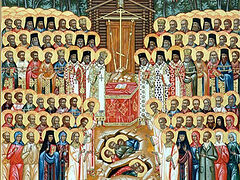
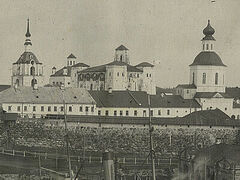
On August 23 this year, the Russian Orthodox Church marks the Synaxis of the Saints of Valaam. With the blessing of Patriarch Alexei II of Moscow and All Russia, the celebration of this feast was fixed on the first Sunday after the Transfiguration of the Lord—the patronal feast of the Valaam Monastery. The Synaxis includes saints who lived in different centuries, such as Sts. Sergius and Herman of Valaam; Abraham of Rostov, the Wonderworker; Arseny of Konevets, Alexander of Svir, Herman of Alaska... But besides these holy men, it also includes several New Martyrs and Confessors of Russia, whose lives were chiefly connected with the Moscow Dependency of the Valaam Monastery. We offer our readers brief accounts of some of them.
 Synaxis of the Holy Fathers Who Shone Forth on Valaam
The Venerable Martyr Tavrion (Tolokontsev)
He was born in August 1871 in the Vologda province into a peasant family. In 1908, he entered the Holy Transfiguration Valaam Monastery. Several years later, he was tonsured a monk at the Moscow Dependency of the Valaam Monastery and named Tavrion.
 The Venerable Martyr Tavrion (Tolokontsev) After the dependency had been closed, Fr. Tavrion settled with other monks at the Church of the Rzhev Icon of the Mother of God in Moscow. In 1930, the apartment where the brethren lived and prayed together was searched, and all monastic funds were confiscated. Monk Tavrion was sent to the Butyrka prison. During the interrogation, he was asked what he intended to do next, to which he replied, “I will serve the Church as long as it exists.” He also added, “We believe that the Lord sent this government to our people for their sins. And the Apostle Paul in the New Testament said that There is no power but of God: the powers that be are ordained of God (Rom. 13:1); so we must pray, and God will grant that the Soviet Government will improve and treat ministers of religion better.” He was charged with staying in an “illegal monastery” and “anti-Soviet agitation.”
For three years Fr. Tavrion was exiled to the Vologda Region, where he remained after his term ended. He lived at one of the churches in the city of Veliky Ustyug. In 1937, he was arrested again “for counter-revolutionary activities.” He told the investigator: “I have not conducted any counter-revolutionary activities, so I cannot give evidence. In the autumn of 1937, I traveled to Moscow and Arkhangelsk to arrange for the opening of the Dymkovo Church1 where I wanted to serve as a priest, but my journey turned out to be fruitless.” The interrogation was finished, and Fr. Tavrion was sentenced to ten years in the Novozero corrective labor camp in the Vologda region.2 He died in the camp two years later and was buried in an unknown grave.
The Venerable Confessor Patriky (Petrov)
He was born in March 1877 in the Kostroma province into a peasant family. Deciding to dedicate his life to God, in 1904 he entered the Valaam Monastery, where he was tonsured a monk with the name Patriky. He performed the obedience of carpenter. From 1917, he lived at the monastery chapel in Petrograd3 and was ordained hieromonk. In 1932, he was arrested for “educating his parishioners in obedience to the Orthodox Church” and for “their spiritual education in accordance with the word of God”. The following words of the Gospel were fulfilled in the life of the New Confessor Patriky: And ye shall be hated of all men for My name’s sake: but he that endureth to the end shall be saved (Mt. 10:22). He was sentenced to three years of exile in Kazakhstan. He died in exile on March 24, 1933, and was buried in an unknown grave.
The Venerable Martyr Galaktion (Urbanovich-Novikov), Hieromonk
He was born in 1877 in the Vilna province into a peasant family. In 1900, he entered the Valaam Monastery, where eight years later he was tonsured a monk with the name Galaktion. In 1915, he was ordained hieromonk and sent to Moscow to serve as the steward at the Moscow Dependency of the Valaam Monastery.
In 1924, Hieromonk Galaktion tonsured Archpriest Arkady Ostalsky, a future new martyr, as a monk. In that same year, the dependency monks were evicted from their cells, though they were still allowed to celebrate services. In 1926, the Dependency Church of Sts. Sergius and Herman of Valaam was closed. The monks and parishioners continued to worship at the Church of the Rzhev Icon of the Mother of God. Hieromonk Galaktion was greatly loved and respected by the parishioners. A year later, he was arrested for “ties with representatives of the Finnish Mission in Moscow engaged in espionage.” He was sentenced to five years in the notorious Solovetsky Special Purpose Camp (SLON).
 The New Martyr Galaktion (Urbanovich-Novikov)
On his return, he served in one of the churches in the Moscow region. In 1936, he was arrested again for “conducting anti-Soviet agitation, explaining the Holy Scriptures in a counter-revolutionary spirit.” He was placed in the Butyrka prison in Moscow. The saint denied the charges. He was sentenced to five years of exile in Kazakhstan. On arrival at the destination, he was arrested again “for anti-Soviet agitation and propaganda”, as he was a supporter of Patriarch Tikhon and an opponent of Renovationism.
He answered during the interrogation: “In the presence of people around me, I said that there used to be many churches, but now, under Soviet rule, churches are being closed. I did indeed say that Soviet rule would not last long and the previous state system would return.” In December 1937, he was sentenced to execution by firing squad. The sentence was carried out immediately. St. Galaktion was buried in an unknown grave.
The Venerable Confessor Arethas (Mitrenin), Hieromonk
 The Venerable Confessor Arethas (Mitrenin) He was born in 1879 in Kronstadt. In 1902, he entered the Valaam Monastery. Eight years later, he was tonsured a monk and ordained hierodeacon. He was sent to the Moscow dependency of the monastery, where his obedience was singing in the choir. In 1921, he was ordained hieromonk. Two years later, the Soviet authorities settled women into the greater part of the dependency. Hieromonk Arethas accepted all the trials steadfastly and without murmuring. Soon he left for Finland to the New Valaam Monastery, but not for long, as he was expelled from there for his faithfulness to the Russian Church and the Julian calendar.1. After that, he took up his residence at the chapel of the Valaam Monastery in Leningrad.
On February 18, 1932, 318 monks and nuns were arrested in the city, including Fr. Arethas.
The investigation brought several charges: “You created illegal monastic communities and turned them into havens for counter-revolutionary elements”; “Holding illegal services, you anathematized (cursed) the Soviet government while aiming to restore the monarchy;You maintained close ties with camp prisoners and with an exiled spiritual father via letters, money and food parcels”, and so forth.
He told the investigators: “I have never opposed the Soviet government, but I cannot be a Soviet person because we monks have been stripped of everything: monasteries and churches are closed, and clergy are being exiled. Religion is being persecuted everywhere.” Hieromonk Arethas was exiled to Kazakhstan, where he died in 1932 at the age of fifty-three.
The Venerable Martyr Athanasius (Egorov), Igumen
He was born in March 1884 in the Tver province into a peasant family and studied at a parish school. At the age of twenty-two, he entered the Valaam Monastery and was tonsured into the mantia with the name Athanasius. From 1917, he served at the Valaam Dependency in Moscow, until Metropolitan Sergei (Stragorodsky) took him as his cell-attendant. Fr. Athanasius remained in this obedience until his arrest. The metropolitan elevated his cell-attendant to the ranks of hierodeacon, hieromonk, and then igumen. Igumen Athanasius served at one of the churches in the Moscow region.
In 1937, he was arrested and sent to the Butyrka prison for “terrorist agitation and providing financial assistance to the clergy imprisoned for anti-Soviet activities.” During the interrogation, he answered honestly: “Metropolitan Sergei treated me well, but still he regarded me to a certain extent as his servant. While serving under the metropolitan, I managed household matters, sometimes helped him at church services and carried out other assignments… Metropolitan Sergei provided financial support to a rather large circle of clergymen, and the money was usually sent by postal transfers. Not wanting this matter to become public, the metropolitan did not send transfers in his own name, but on behalf of various people from among his inner circle, and in particular on my behalf.”
The case was reviewed by the Military Collegium of the Supreme Court of the USSR. He was sentenced to “execution by firing squad with the confiscation of all his property.” The sentence was carried out immediately on August 19, 1937. Igumen Athanasius was shot and buried in an unknown grave.
***
Metropolitan Anthony of Sourozh once said in a sermon about the New Martyrs of Russia: “They … sacrificed their lives for Christ, for the faith; they were tortured in secret torture chambers, prisons, and camps because they believed in Christ and preferred to die rather than deny Him—their God, their Savior, the One Who loved them so much that He gave His Own life so that we would not doubt Divine love and so that the gates of eternal life would be opened to us.” That is why it is so important for us, modern believers, to remember the ascetic labors of our holy New Martyrs.