Historically, the image has been known by various names: the Savior on the Cloth, the Holy Towel, the Savior on the Linen, and the Holy Mandylion. On August 16/29, 944, the relic, brought from the city of Edessa, was placed in the reliquary church of the Great Palace in Constantinople. Its widespread veneration began from that time onward; throughout the Christian East, the Image Not Made by Hands was revered as a great holy relic.

In 1204, the Crusaders sacked Constantinople and carried the Image Not Made by Hands away from the Byzantine Empire. Its subsequent fate remains unknown. According to some accounts, the sacred image sank along with one of the Crusaders’ ships.
The face on the original image is believed to have measured about nineteen centimeters in length—the size of a human face—and this dimension was regarded as sacred. It corresponded to the size of an icon intended for private prayer at home or to be placed on an analogion, and many copies were made to these dimensions. In the fourteenth century, there was also a tradition of depicting the face of Christ on a life-size scale. Even in the early period, the image was painted in a monumental style, dictated by the custom of carrying this icon in large processions through Constantinople; it was painted so that the image could be clearly discerned from any distance.
After 944, the Tale of the Image Not Made by Hands was composed. This work became the principal popular source for the history of the image. The earliest source, however, is the account in the Ecclesiastical History of Evagrius Scholasticus, dating to 594. A separate chapter in the history of the holy image concerns its presence on military campaigns.
In 586, before the battle against the Persians on the plain of Solachon, a Byzantine commander, according to the historian Theophylact Simocatta, carried before the troops the image “not made by hands of the God-Man.” The battle took place on the road to Edessa, some 200 kilometers east of the city. The father of the future Emperor Heraclius distinguished himself in this battle and subsequently made it a rule to carry an icon of the Savior Not Made by Hands on military campaigns. From that time onward, a Byzantine tradition arose of depicting the Savior’s image on military banners during imperial campaigns. An icon of this kind is known to have accompanied Prince Andrei Bogolyubsky on his campaign against the Volga Bulgars. Later, the “great image of the Savior” appeared on the banner of St. Dmitry Donskoy, and, following his example, on that of Ivan the Terrible during the conquest of Kazan. Until the time of Peter the Great, whenever the tsar went on campaign, an image of the Savior was carried with him. The Armory Chamber housed numerous banners bearing the Image of the Savior Not Made by Hands: they were restored before new campaigns and otherwise preserved there. To this day, the collection of the Armory Chamber of the Moscow Kremlin contains several such banners. Under Emperor Nicholas II, the Image of the Savior Not Made by Hands once again appeared on the standards of all infantry regiments. Despite the emergence in modern times of many new military banners bearing various icons of the Savior, the Mother of God, and the saints, the ancient tradition of depicting the Savior Not Made by Hands as the foremost “bringer of miraculous victory” was preserved in the Orthodox armies into the twentieth century.
The ancient tradition of depicting the Savior Not Made by Hands as the foremost “victory-working wonder” was preserved in the Orthodox armies into the twentieth century.
There are two principal traditions concerning the origin of the Image Not Made by Hands: one is associated with Abgar, ruler of Edessa, and the other with the Savior’s prayer in the Garden of Gethsemane. The principal venerated image is small and is associated with the ruler Abgar. According to tradition, the toparch Abgar came to believe in the Savior and sent Him a letter asking Him to come and heal him. He also sent a painter to make a portrait of Christ. The Savior sent Abgar His blessing, and together with it, His own portrait: after washing His face with water and then “wiping the moisture from it… with a towel, He deigned, in a divine and ineffable manner, to imprint His features upon it.” The cloth was sent so that the ruler might be healed of his illness. After being cured of leprosy, Abgar placed the Image Not Made by Hands in a niche above the city gate, fastening the cloth to a board and adorning it with gold. The Mandylion was laid upon a board and covered with a sheet of gold—an ornamental covering that subsequently became a kind of canon for reproductions of the relic in icon form.
 Abgar Receives the Image of Jesus Christ Not Made by Hands. Composition from a wing of a triptych. St. Catherine’s Monastery, Sinai
In the fifteenth century, a legend about St. Veronica appeared in the West in several versions. According to the best-known version, a woman named Veronica wiped the face of the suffering Christ with a cloth, upon which an image of His face remained. This tradition found expression in numerous European literary works of the modern era.
The story continues with the emergence of a new iconographic type of the Savior Not Made by Hands. Abgar’s great-grandson returned to paganism, and the bishop of the city ordered the Savior’s image to be hidden—sealed within the city wall—with a burning lamp left before it. The image was not remembered again until the middle of the sixth century, when the city was besieged by the Persians. It was discovered intact, with the lamp still burning before it. But in addition to the image on the cloth, the Savior’s face had also been imprinted upon the inner surface of the tile. Thus arose the “Savior on the Tile,” or Holy Keramidion. In the cathedral of the Mirozh Monastery, the images of the Savior Not Made by Hands on the cloth and on the tile are depicted facing one another on the eastern and western transverse arches. There is also a tradition concerning another “Savior on the Tile” venerated in Hierapolis. While traveling from Jerusalem to Edessa, the Apostle Ananias hid the Holy Cloth among a pile of tiles. During the night, a radiance like fire shone forth from it, after which the Apostle discovered that Christ’s image had been imprinted upon one of the tiles.
At the Seventh Ecumenical Council, the Image Not Made by Hands was one of the most important arguments advanced by the defenders of the veneration of icons: the healing of Prince Abgar and the subsequent veneration of the image were both recalled. The participants in the Council are depicted raising up the Image. This representation reflects the Constantinopolitan tradition according to which the icon of the Holy Face was solemnly elevated on the Feast of the Triumph of Orthodoxy.
The Image Not Made by Hands was one of the most important arguments advanced by the defenders of the veneration of icons.
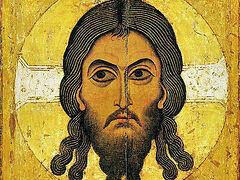
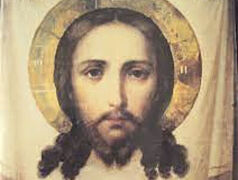
The earliest representations show Christ with an elongated beard, as though wet, and similarly arranged locks of hair, which together with the beard fall almost along the same line. This iconographic type is represented in iconography by numerous variations: in ancient images, the Face together with the hair is most often precisely inscribed within the circle of the halo. Sometimes the Face was depicted with the neck. At certain periods, greater attention was paid to the material aspect of the image. In the thirteenth and fourteenth centuries, for example, iconographers showed particular interest in depicting the cloth itself. Its folds could be painted horizontally, as though the cloth were stretched across the surface of the icon, or vertically, as though hanging down. The cloth was embellished with ornamental borders and patterns and sometimes decorated with fringe. At other times, the Face of Christ was depicted within the circle of the halo without the cloth, against either a monochrome or colored background.
The image became extraordinarily widespread. In addition to icons and banners, it was frequently reproduced on cast-brass icons made by the Old Believers of Pomorye1 and became something of their “hallmark.” There are, for example, brass icons on which the Savior Not Made by Hands appears as the principal image, while the same image of the Savior is repeated in the finial, or “ear,” at the top. On rare occasions, the Savior Not Made by Hands appears at the center of the Deesis—for example, on embroidered aërs.2
 The Savior Not Made by Hands. Russian North (Pomorye?). Last quarter of the sixteenth century.
In the work of Simon Ushakov,3 the Image Not Made by Hands became a central, defining theme. The masters of the Armory Chamber worked on the frescoes of the Upper Savior Cathedral, built in the Kremlin by Tsar Mikhail Feodorovich. Simon Ushakov repeatedly painted icons of the Savior Not Made by Hands to be presented as gifts to Tsar Alexei Mikhailovich. While preserving the traditional iconographic layout, his icons displayed a distinctive style: Ushakov worked in the new tradition of zhivopodobie, or lifelike representation.
Images of the Savior Not Made by Hands were also produced on a small, intimate scale. At the center of some fourteenth- and fifteenth-century pectoral crosses preserved in the Andrei Rublev Museum, the image of the Savior Not Made by Hands appears in place of the Crucifixion. Later Rostov enamel devotional icons, carried away from Rostov by pilgrims and travelers, feature brightly colored images of the Savior Not Made by Hands, sometimes with angels holding the cloth by its two upper knots.
The image of the Savior Not Made by Hands was at once the chief hope of Orthodox sovereigns, an icon carried by pilgrims and used at weddings, a central image in the icon corner of the Orthodox home, and an icon in the church iconostasis, placed above the Royal Doors.