On September 10/23, the Russian Orthodox Church celebrates the Synaxis of the Saints of the Metropolia of Lipetsk, in south central Russia. This feast day was established with the blessing of His Holiness Patriarch Kirill of Moscow and All Russia. It includes holy hierarchs of past centuries (such as Sts. Pitirim, Bishop of Tambov, Mitrophan of Voronezh, and others) as well as the local New Martyrs and Confessors. We offer our readers short accounts of several lesser-known New Martyrs of the land of Lipetsk.
 The Synaxis of the Saints of Lipetsk
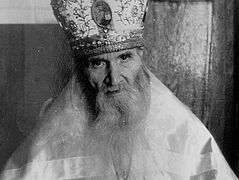
Hieromartyr Uar (Shmarin), Bishop of Lipetsk
The future hieromartyr was born in 1880 in the Tambov governorate into a poor peasant family with many children. The priest of his village helped him graduate from a local four-year school, a gymnasium, and a church teacher’s seminary. He worked as a teacher and got married. In 1904, he was ordained deacon and in 1910 priest. Along with his family, he was assigned to serve in a parish near the Valaam Monastery. In 1918, he moved to Petrograd. Following his wife’s death, he relocated with his five children to the Lipetsk region, where he served in the village of Tyutchevo. The priest was arrested several times but released shortly after each detention. The authorities dropped hints urging him to renounce his priesthood, but he steadfastly refused.
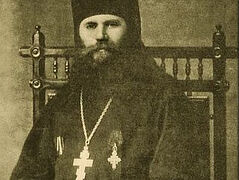
 The Hieromartyr Uar (Shmarin) In 1924, his house was searched, and the priest was jailed. During the interrogation, he was told, “You have a large family, and it will be very difficult for you under new conditions—renounce your priesthood. You are a highly educated man; we need people like you. We are building a new state right now, and we need educated people. We will give you a good, prestigious job, an apartment, and provide you with everything else—you will not have a single worry. The only obstacle to your getting all this is your priesthood. Renounce it, and you will receive everything you’ve ever dreamed of.” He answered, “You will never get what you want from me. I will never betray what I believe in, so all your efforts are in vain.” He was not arrested.
The priest returned to Petrograd, where he took monastic vows with the name Uar and was consecrated Bishop of Lipetsk. During his ministry at the diocese, Bishop Uar actively fought against the Renovationist movement, setting an example of steadfast faith for his flock. Three of his sons died of tuberculosis, and one of them, his eldest son Nikolai, followed in his father’s footsteps and became a priest, and was later exiled to a labor camp in Siberia for refusing to renounce his priesthood. Bishop Uar continued to serve under difficult conditions. On June 8, 1935, he was arrested on false testimony, charged with “anti-Soviet counter-revolutionary agitation.” The archpastor was sentenced to eight years in the Karaganda labor camps (Karlag) in what is now Kazakhstan. During a meeting with his children, he told them, “Do not cry or worry. Live your lives as you have lived them. Live honestly. Do not avenge me. The most important thing is to live a life worthy of your calling.”
From the camp, the hieromartyr wrote to his children that he had nothing to complain about and that they ate as follows: “Cabbage soup and porridge—our very own peasant food.”
Meanwhile, the warden of the church where St. Uar had served was also arrested, and he testified: “Vladyka is having a very hard time right now. He is sick and infirm, yet they force him to do heavy labor. But you all know him: he never loses heart; he himself remains strong, and keeps us all going.”
Initially, Bishop Uar was held in barracks with political prisoners, but in 1938 he was transferred to barracks with criminals, who murdered him. He was buried in the cemetery of the Karaganda labor camp. In 1991, the hieromartyr was exonerated “due to lack of evidence of a crime.”
The troparion to the Hieromartyr Uar reads as follows: “Zealot of the Orthodox faith, uprooter of schisms, and rebuker of godlessness, thou didst serve thy Creator with prayer and labor even unto blood, O Holy Hierarch Uar, first Bishop of Lipetsk; pray to Christ our God for us.”
The beautiful exapostilarion to the saint says: “Beholding Thy bridal chamber adorned, O Savior, the Hieromartyr Uar contended valiantly and, vested as a hierarch, was adorned with the blood of martyrdom. By his prayers, O Christ, enlighten and save us.”
Hieromartyr Priest Mikhail Bogoslovsky
Hieromartyr Mikhail was born in 1883 in the Lipetsk district of the Tambov governorate into the family of a church reader. He graduated from the Tambov Theological Seminary and then from the St. Petersburg Theological Academy with the degree of Candidate of theology (this was broadly equivalent to a modern Western Master of Theology). Even as a student, he was distinguished by his humility, prayerful spirit, sobriety in his judgments, and a keen interest in theological sciences. He was assigned as a teacher at the Taurida Theological Seminary (in the city of Simferopol) and worked there until 1921, when it was closed by the Bolsheviks. In the same year, he was ordained priest and sent to serve in the city of Berdyansk (on the northern coast of the Sea of Azov, the Zaporozhye region).
The parishioners loved Fr. Mikhail; he welcomed everyone with fatherly care and attention, being austere with himself but full of love for others. His sermons were accessible and wise, and he spoke out against schismatics and Renovationists.
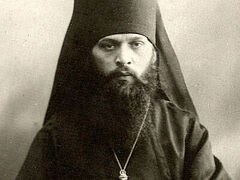
 Hieromartyr Mikhail Bogoslovsky In 1937, all churches in Berdyansk were shut down except for one, where the remaining believers and clergy of the city gathered. That same year, Fr. Mikhail was arrested for “anti-Soviet agitation” and placed in a Zaporozhye prison. The conditions of detention there were as follows: “First, the vilest abuse laced with profanity; next, shoving and beatings resulting in a hernia; and then, being forced to stand without sleep day and night for several days.” A cross was shaved onto Fr. Mikhail’s head. During the interrogations, the priest prayed intensively, making the sign of the cross.
There was no trial. Fr. Mikhail was sentenced to five years in a corrective labor camp in the Krasnoyarsk Territory under the “group case of Archpriest Viktor Kiranov and others, Berdyansk, 1937–1939.” Hieromartyr Viktor Kiranov (†1942; feast: March 30) shared barracks with Fr. Mikhail. In his letters to the outside world, Fr. Mikhail’s fellow prisoner noted his meekness and humility, calling him “Venerable Father Mikhail.” In prison, the priest was subjected to abuse. Later, however, his tormentors, struck by the pastor’s love, begged his forgiveness. Fr. Mikhail reposed in March 1940 in the Kraslag of the NKVD (“People’s Commissariat of Internal Affairs”). The Hieromartyr Viktor Kiranov wrote of his death: “I believe, and am almost certain, that the Lord has received his soul as that of a righteous man and an equal to the other saints who have pleased Him… Like all the saints, he undoubtedly stands before the Throne of the Most High in all the glory of his godly life.”
The Canon to All the Saints of Lipetsk contains the following lines about Hieromartyr Mikhail: “O Thy great long-suffering, Hieromartyr Mikhail! For when a robber who was imprisoned with thee tormented thee and tore out the hair of thy head, leading him to repentance by thy meekness, thou didst forgive him in a Gospel manner and didst deliver him from execution.”
The Hieromartyr Tikhon and Confessor Chionia Arkhangelsky
The future hieromartyr was born in 1875 in the Voronezh governorate into a priest’s family. In 1899, he graduated from the Tambov Theological Seminary, after which he married a pious young woman named Chionia. They had eighteen children, though not all of them survived.
Shortly after their wedding, the head of the family was ordained priest and assigned to serve at St. Demetrios Convent in the village of Troyekurovo in the Voronezh Diocese. Chionia took charge of raising the children in a spirit of piety, teaching them to pray and study the Law of God. The parents taught their children to turn to God in all times of trouble. Chionia also sang in the church choir. Fr. Tikhon served his parish zealously and was deeply responsive to people’s needs. The family sustained themselves through farming, but the Soviet authorities labeled Fr. Tikhon a “harmful element”; as a result, the family’s cow was confiscated in 1925. The priest was arrested several times. As his daughter recalled, “He would be held under arrest while sick and cold for days at a time; then they would release him, and he would come home absolutely exhausted.”
In 1928, the church in Troyekurovo was shut down, and the family was dispossessed. With the blessing of the Hieromartyr Uar (Shirin), Fr. Tikhon began serving in various villages of the Voronezh Region, moving from one church to another until the Soviet authorities closed all of them. In 1932, the head of the family was arrested and charged with “anti-Soviet activity.” However, the priest was temporarily released. The family wandered from place to place. False testimonies were fabricated against Fr. Tikhon.
The year was 1937. In the summer, a car pulled up outside the family’s house, and military officers stepped out.
“Any weapons?” they asked.
“Yes! The cross and prayer!” came the reply.
A search began. Fr. Tikhon was jailed. During his interrogations, he stated, “In my judgment, Communists are faithless, lost, and ruined people who are leading the nation to perdition in the afterlife. They must come to know God. There is no absolute truth on earth; truth exists only in Heaven.” The priest denied all charges of “counter-revolutionary connections.” In October 1937, he was sentenced to death by firing squad. Just before the execution, an NKVD officer asked him,
“Will you recant?”
“No, I will not recant!” he replied.
The sentence was carried out.
 The Hieromartyr Tikhon and Confessor Chionia Arkhangelsky
St. Chionia and the children knew nothing of what had happened. That same year, she too was arrested and thrown into prison. She wrote from there, “My dear children, I have been in this cage for three days now, but it feels like an eternity. There has been no formal interrogation yet, but they asked me if I believed that God saved the Jews by drowning Pharaoh in the sea. I said that I did, and for this, they called me a Trotskyite who must be done away with as an enemy of the Soviet regime. Now I have experienced firsthand how not a single word of the Savior passes away unfulfilled… In my life, I repeatedly committed the sin of judging, condemning others without any right to do so, and now I myself am on trial... Keep the icon lamp burning for the Lord and pray that He strengthens both me and you in His holy faith.”
During her interrogation, they told St. Chionia, “You’ll end up in the camps—I’ll throw you into a labor camp!”
She replied, “As you wish. But I have lived my life, I have sinned, and I must bear the punishment for my sins.”
St. Chionia was sentenced to eight years in the labor camps, where she contracted an incurable disease. She was released in 1944. Until her final days, St. Chionia earned a little money by sewing and prepared everything necessary for her own funeral so as not to burden her children. She passed away in December 1945. In 2001, Chionia was canonized as a confessor. The Russian Church commemorates the holy Arkhangelsky spouses in the Canon to the Saints of Lipetsk with these words: “O beloved pair, who possessed one soul in two bodies, Hieromartyr Tikhon and Chionia the Confessor, who suffered for Christ and revealed to us the model of honorable marriage.”
These are but a few examples of the Christian labors of the New Martyrs and Confessors of Russia, who teach us to love our enemies and fearlessly confess Christ even unto death.