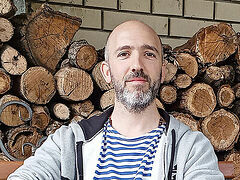
I had heard a lot about Fr. Dmitry since long ago, but I never had the chance to meet him at the diocesan administration—neither as a teacher nor in the position of vice rector of the Tauride Theological Seminary. Apparently, the Lord saw fit for me to meet the priest for the first time as a journalist.
The outskirts of Simferopol. The Church of the Reigning Icon of the Mother of God. The courtyard is cozy, in the style of a Cossack village—spacious and clean. The priest greets me in the courtyard—strong, smiling, with a welcoming face. I receive a blessing and go into the priest’s room—it has an Orthodox‑style appearance, but the icons of the saints and the overall atmosphere suggest that here they are not always ready to turn the other cheek to the enemy.

“Would you like some coffee?”
“With your blessing,” I humbly agree.
While the coffee is brewing, I turn on the voice recorder. I warn him about the recording—that is the nature of the unwavering ethos of the situation. The cardamom on the priest’s table is the final touch, indicating that the conversation will be long, empathetic, and flavorful.
“Fr. Dimitry,” I begin slowly, “please tell me: the Church’s attitude as an institution toward such a phenomenon of human life as war is ambiguous, is it not? But even so, based on the Holy Scriptures, and looking at the nearly two‑thousand‑year history of Christianity, what is it?”
—The Church has always had a negative attitude toward war in the form of an attack, but it has always welcomed, let us say, not warfare, but combat operations as a form of protecting the state’s interests. One very well‑known person articulated well what we are talking about: if a fight is inevitable, start it first.
St. Nikolai of Serbia wrote a great deal about war. There are many examples from the history of Byzantium and our Russian past when the Church approved of defending its borders. Take, for instance, the blessing given by St. Sergius of Radonezh to Sts. Alexander Peresvet and Andrew Oslyabya, the stance of Alexander Suvorov, the Admiral St. Theodore Ushakov, and the commanders of the Great Patriotic War—there is something common in their approach to war. War as a tragedy, as grief, as the killing of people—that is one thing and, of course, it is always bad and unacceptable. But war is multifaceted, and the attitude toward it should be absolutely varied.
—I always remember the scene when one of Christ’s apostles—Peter—draws a sword from its sheath and cuts off the ear of the high priest’s servant, Malchus. Father, can a priest, an ordained man, carry a weapon? Can he carry it, use it?…
—You know, just last week we were sitting in one of the dugouts with our military fathers and we brought this topic up. Our Church leadership does not approve of priests carrying weapons at all. But modern realities show that it is absolutely necessary. Let me give you an example from my own experience: you are driving along the road, drones are flying… and you have nothing to defend yourself with. We are talking about defense, but it is not that important—it all comes down, again, to weapons. Let us begin the story differently—with the thought of an ordinary stick. Can a person be killed with a stick? Can you beat someone to death with an ordinary wooden stick?
— Of course, you can. Even a fork or a sharpened spoon.
—Yes, even with a spoon, as you said. Here, the functions of a spoon and a machine gun are identical. But it can be used to defend against drones, just as a hunting rifle or a pump‑action shotgun can—any of them. So the question is how to treat it and what purpose to use it for. Our situation, where we travel as military priests, does not involve direct combat with the enemy, but no one is immune to drones. Therefore, if it were permissible for me to carry a weapon, I would gladly take one with me to defend myself against them. Electronic warfare systems do not always prove effective; where we go, fiber‑optic cabled drones often get launched, and they are not jammed by electronic warfare equipment. And in this situation, a weapon is the only suitable means. So the question remains open: Is it allowed? is it not allowed? (He laughs.)
—But… the Church forbids it, does it not?
—Yes, of course, and we will not dispute that. Absolutely, 100 percent, so that no one misinterprets my words: The participation of a priest and the use of weapons in combat operations are strictly prohibited.

—Just two years ago, one of my seminary graduates wrote a qualifying paper on the military clergy in the Russian Empire, on the institution of military clergy. And now, in our day and age, what are the duties of a military priest? And in general, who is a military priest? What falls within the scope of his duties? Conducting services, performing rites?
—Of course, and conducting conversations, both general and personal in nature. Another important aspect is boosting the soldiers’ morale, because it is hard for a fighting man. You need to support the wounded in the hospital, the doctor, the medical worker, the commander, the civilian—all of this falls directly within the priest’s responsibilities.
—Am I understanding this correctly: there is practically no difference between what is here, in Simferopol, at the parish, and what is there, in the combat zone?
—No, why would you say that? Parish life is a bit different, you know. Here, we have ordinary civilians: grandparents, young people, children, parents—it is measured and calm, routine in the good sense of the word.
—Father, if we are talking about the model of a military priest. Let us say we are talking about the married clergy. Can any priest bear this cross? Or is there also Providence involved in this?
—Not everyone is meant to do this—that is for sure, 100 percent not everyone. We took a great many priests on our trips, sometimes just so that they could feel for themselves whether this path was right for them or not. That is exactly why we held classes and training sessions—so that the priest could understand whether he would be able to bear this duty. He is eager to go, but practice shows that not everyone is ready, because family‑related issues arise—and, I would say, they are quite justified; the mother, the parents, the children are worried, because there is danger, there are risks, and at this stage of the Special Operation, those risks are much higher than they were for example four years ago. I am not talking about this from hearsay—on August 14, 2014, I made my first trip to Donbas. You could say it is an anniversary. (He smiles.)
—You see, Father, it is no coincidence that we met on this day—everything is divinely ordained. And could you tell me about your impressions from that very first trip?
—Yes, they were terrible, terrible impressions. I still remember how it was. We ended up right in the thick of it. We drove into the epicenter of the fighting: rockets were flying over us, there was gunfire, the forests were on fire, and we were standing on a broken-down car in the middle of the road. (He laughs.) It was not funny at all back then—it was, of course, terrifying. The soldiers who were passing by were just bewildered, shaking their heads: “What are you doing here? Are you crazy or something?”

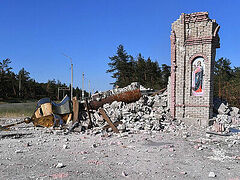
Yes, it was a difficult, very difficult trip. The road to Antratsit (a town in Lugansk Oblast named for its anthracite deposits—ed.); I was traveling with a priest, Fr. Sergius. But, thank God, we somehow managed to get there in an old truck which was dying and overheating. In Antratsit itself, the local residents opened our eyes to what was going on. It is one thing to work with refugees in Crimea (they were received and accommodated at Artek1; the diocese collected aid and distributed it); it is another when you actually go there. The mining settlement near Antratsit, towards Krasny Luch, is on the right side. They drove me in, took me to a building. The miners’ houses are all the same type: small, two‑story buildings. I go into one of them—it is a large room, and I see something large, slightly askew. I think it is a chimney that has gone awry, or maybe it is a carpet that has been gathered in the middle of the room. And then I realize it is an unexploded missile—right in the middle of the room. It had not detonated. These missiles are about three meters long. The direction is clearly identifiable: from the Ukrainian side, you cannot mistake it—they do not fly in zigzags, they follow a clear trajectory. “Smerch,” “Uragan,” “Grad”—all of them were used against the civilian population. We went down to the basement—I even have photos left, showing women sitting in the dim light, in damp basements, in little rooms that look like they were meant for a bicycle, and they had laid out a mattress there and are living with their children. The impressions were, of course, terrible, on the one hand; on the other hand, we saw the real situation and assessed it.
—The anatomy of the conflict itself, right?
—Yes. Regarding the anatomy of the conflict, as you call it, I had a turning point: Odessa, the Trade Union Building—it was real horror, and it was broadcast live. The inhuman Goncharenko,2 other inhuman beings like him—that’s the whole anatomy of the conflict.
—Father, do clergy work more in the rear, or are they more often present on the front lines?
—Here we need to clearly define what we mean by the line of contact. Any line of contact is divided into sectors or zones. Let us take the Kherson region. In fact, the intensity of shelling within its borders and in Sevastopol is practically identical. Perhaps it is even much more unstable here, with us, since there are more strategic facilities in Crimea, and the shelling is more intense. In other words, the concept of the line of contact has become completely blurred. But there are still certain formal boundaries: for example, a five‑kilometer zone, a fifteen‑kilometer zone, or somewhere a thirty‑kilometer zone has been established. All of this is a gray zone, or a red zone, or some kind of yellow zone. Of course, where hand‑to‑hand combat is taking place, a priest has nothing to do…
—Just like a journalist, who even gets in the way. I know that some military personnel get upset.
—Yes, and to the journalist as well. No, if a priest has certain skills—paramedics, nurses (and we have priests who were directly involved in saving lives on the front line, in the biological sense), then he is in the right place. But not every commander will allow a priest without medical skills onto the front line. But even regular military personnel are not always on the front line; they undergo rotations and are moved to rear areas for rest. So, these rear areas can be located 200 or 300 kilometers away from the line of contact. And there, of course, a priest is very much needed. He can serve in this zone with the military personnel quite calmly, without fear for his life from the relatives and loved ones of the clergyman. Although now, even there everything is very conditional—an attack could come flying in there, or anywhere else, and we are all witnesses to that.
It’s very good if a priest has the opportunity to work in a relatively safe area for a certain period of time, say, a week, two weeks, a month, or six months. Or even just to go out for one or two days, administer communion, and talk to the men—it all depends on the situation.

—This question may be impertinent for a clergyman, but still. What interesting cases from your pastoral care of military personnel can you name?
—You know, there are so many of them, and unfortunately, these situations do not stick in my mind. And I don’t have time to write down any specific examples. We have had quite a few such cases, and we can confidently call them miracles of God. To some, they might seem like ordinary coincidences, a combination of circumstances, but that is not the case.
The most vivid moments are the interactions with the wounded in hospitals. And not in the hospitals here in Crimea, but in the primary, almost field hospitals. Working and talking with evacuation teams, with field medics who share their stories of miracles. This is a vast reservoir of truly remarkable events, trials, and acts of gratitude—when people turn to us and ask us to sprinkle them with holy water or to touch the relics of St. Matrona of Moscow; even people of other faiths ask for this. There are many such cases.

—Do trials lead people to God, or are there people whose souls, on the contrary, become harder because of trials? There is a common saying that there are no atheists in a foxhole. Is that true?
—You know, there are still non‑believers at the front. I had an interesting situation like that. It was about three years ago. The political officer formed a new unit. It was just before Lent. We were preparing the soldiers for confession so we could administer communion. One of them came up to the political officer and said: “I am not a believer.” The political officer, with his army‑style simplicity and without mincing words, said: “Come here, you fool, you had better start believing now and not later, when a shell hits the trench and you realize you’ve miraculously survived, when you realize that God saved you!” The guy scratched his head, thought for a moment, and then went along with everyone. (He smiles.) Sometimes both the political officers and the commanders show restraint in the common cause of serving God and the Motherland; everyone sincerely prays to God. There are many believers among the marines, paratroopers, and special forces. And ordinary soldiers also pray. We encounter different reactions: sometimes there’s silence, sometimes there is fullness of joy and support: “Oh! The priest has arrived!”
—Does the congregation help in raising funds and providing the assistance you deliver? I know that you send humanitarian supplies and often accompany them in person.
—With the blessing of Vladyka Tikhon, our church has a Special Humanitarian Center of the Crimean Metropolitanate. Here, we collect, organize, and accumulate all the humanitarian aid that is delivered from various parishes in our diocese, even from other parts of Russia. It comes from the military department and from the Patriarchal Humanitarian Mission of the Russian Orthodox Church. The parishioners of our church are active and are always ready to help (to collect, to load) and to participate directly.

—What do our soldiers need most of all? Obviously, there is support from the Ministry of Defense, but still…?
—You can never have too much, you know.
—That is exactly what I am saying in advance so that readers will respond.
—I am lucky—unlike many volunteers, I have the opportunity to come and see the situation in the front‑line zone firsthand, to assess the situation on the ground where the military is stationed. For example, we cooperate with the “Do Good” volunteer group. It is quite a serious organization (they weave camouflage nets, make warm back bandages and bivouac candles, prepare dry soups and borscht, meat chips, and sweets). Together with them, we have already distributed more than 150 camouflage nets to our Crimean units, and more than 100 nets to one of the brigades on the Kherson front. The line of contact has different needs—they need generators and spare parts. There are some basic tools that, of course, you cannot stock up on in the army; they are needed for repairing vehicles. These are simple things, but they have a completely different value there. Here, in civilian life, we can go into any store, but there, that option is not available. And of course, when I allocate what is necessary, I simultaneously record any new requests or appeals.
—Do you interact with the Spiritual Administration of Muslims of Crimea? Is there any cooperation in this area?
—The Spiritual Administration of Muslims of Crimea provided the men with cars and halal canned food. Fr. Alexander Yakushechkin, as the secretary of the “Peace—A Gift from God” interfaith council is actively working with them in this sphere. The Armenian Apostolic Church is very active in this area; we interact with it the most in this regard.
There are a lot of men at the front—Crimean Tatars—who serve faithfully and loyally. They are doing a great job. Knowing their correct stance, we always treat them with respect, especially since we are well aware of the targeted influence exerted specifically on this ethnic group from abroad, by third countries and organizations that are banned in Russia.
—What do you see as the prospects for the service of military clergy after the victorious conclusion of the special military operation? What measures are being taken to support the clergy who are currently on the front line? As a historian, I know that, for example, the Russian Empire had such support measures.
—I will start with the measures that have already been taken by the Church. At the initiative of our Vladyka Tikhon, a rehabilitation center was established in Pechory. Recently, our military priests have already completed the first course of rehabilitation there. I might be mistaken about the numbers—you can find them yourself in open sources—but it seems that about fifty priests have already completed it.
—A good initiative by His Grace…
—Vladyka Tikhon conceived the project and managed to implement it with the support of various organizations. Just the day before yesterday, I talked about this topic with one hieromonk. He is thrilled: “They have created incredible conditions, almost unreal: there are psychologists, well‑known guests, concert programs, procedures—even a sauna and a salt cave.”
—Do you have the status of a combat participant, father?
—No. Even a full‑time military priest does not get the status of a combatant; I am not even a full‑time employee and do not have it.
—Well, that is exactly what I am talking about.
—Yes. It seems that this needs to be addressed within the legal framework, at least for full‑time priests. A certain legal framework already exists, but there is also a downside to the benefits—some volunteers have started taking advantage of it by going only for a couple of days. They get the status, and that is enough. There are certainly restrictions associated with this.
—Father, is the service at 5 p.m.?
—Yes.
—Then it is time to wrap things up. I want to go to the church. This is my first time here.
—Of course, come in. Happy beginning of the Dormition Fast and Happy Transfiguration!
—God save you!
—God bless you!

In the church, preparations were underway for the service. According to liturgical time, a new day, another day, had already begun. An exclamation from the second priest rang out in the altar. After standing before the icon of the Mother of God, the thought flashed through my mind: “We have none other help, we have none other hope…” After asking for the protection of the Heavenly Patroness for our Fatherland, I went out into the church courtyard with a sense of peace and a warm feeling from my interaction with the priest—everything will be fine for us, we will stand together!