The following is the continuation of an interview with Orthodox blogger Conrad Franz, who visited Russia as a guest of the Media Department of the Moscow Patriarchate in the fall of 2025. In Part 1 we heard about and Conrad’s path to Orthodoxy and Orthodoxy in Texas; in Part 2, he described his trip to Moldova, and the repressions from the current Western-facing government against the Moscow Patriarchate there. In Part 3, Conrad tells us about his trip to the Donbas—what he saw with his own eyes and heard with his own ears.

—Conrad, in our last interview you said you were preparing to travel to the Donbas. Now that you have returned, tell us about your trip, and what you experienced there.
—It was a fantastic opportunity. When I first arrived in Moscow, I discussed it with my hosts, Andre and Charles, and I wasn’t sure it was actually going to happen; but it very fortuitously came to be, as these things tend to do. We drove seventeen straight hours all the way down to Donetsk. Thankfully, the trip was planned to be very religiously focused—Orthodox-focused—which was what I was mostly interested in seeing there. On our first day, for example, we went to Gorlovka after spending the night in Donetsk. Gorlovka was very close to the front line for many years. It is one of the most heavily bombarded cities in Donetsk. They have a museum dedicated to the dozens of children who were killed there by the Ukrainian attacks.
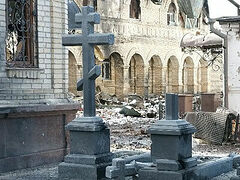
 The Annunciation Church in Gorlovka, before bombing. Photo: pravoslavie.ru
 The Annunciation Church in Gorlovka, after bombing. Photo: pravoslavie.ru
Gorlovka, and the bombing of children
—These children were killed before the Special Military Operation even started, right?
—Yes. This was from 2014 onward. Gorlovka was always one of the main places where even Orthodoxy was targeted; the Theophany cathedral there was struck by the Ukrainians directly four or five times. There has been extensive icon reproduction and building reconstruction work, so it’s still beautiful and looks great now; however, there is still evidence of the damage that was done. I had the privilege of being the first—as I was told—Western journalist to interview Metropolitan Mitrofan of Gorlovka, whom I found to be an absolutely amazing person.
I published the subtitled interview on my blog.
 Bishop Mitrofan (Nikitin) of Gorlovka with Conrad Franz
“You love those imperial people,” they’d say, “you love those Russian saints. We’re not Russians, we’re Ukrainians,” and such like. The former Metropolitan of Donetsk was much more inclined towards the Ukrainian side of things before he was replaced by Metropolitan Vladimir, and so under him, many of the bishops and priests who venerated the Russian saints1 had to do so almost in secret, which is just horrible to hear. But now, Gorlovka is thankfully much safer because the front line has been pushed much farther away, so we weren’t looking over our shoulders quite as much—but we did still have some drone alerts on our drone detection walkie-talkies.
“You love those imperial people,” they’d say, “you love those Russian saints. We’re not Russians, we’re Ukrainians”
The city itself was largely liberated back in 2014 by the Donbas militia, but the front line has slowly been pushed back to the point where Ukrainians aren’t hitting them as much. They’re more likely to hit Donetsk itself, I think, than Gorlovka. Metropolitan Mitrofan is often mentioned; people in his metropolia are fighting, and many have had to leave.
 Metropolitan Mitrofan of Gorlovka. Photo: pravoslavie.ru
He told us about what a very, very long-suffering period it has been for the people of Gorlovka and Donetsk, and I was very grateful that he decided to give me an interview—because, for his own safety and well-being, he has had to maintain a low profile. But I think that now they feel the SMO is in full swing, and advances are being made fairly rapidly every day. At this point, perhaps it’s time to start telling their story—what they have experienced as Christians in this part of the world.
 Iveron Donbas Monastery, procession with the Portaitissa icon
After our day in Gorlovka, we went back to Donetsk and visited the Iveron Donbas Monastery, where the Panagia Portaitissa icon was returned after being removed in 2014. Visiting the monastery and praying at the Liturgy was a very powerful experience. If you were to look at the church without seeing all the people around, you would think it was ruins. It is a destroyed building. But then you go inside; the cupolas and the roof had caved in under Ukrainian shelling, but they put up a plywood roof to keep the rain out. They have cleaned the iconostasis beautifully. There was a massive service there with three bishops, thirty-five priests, and two deacons. Many people were in attendance. There were some National Guardsmen there, apparently for protection. And most notably, I remember Metropolitan Vladimir of Donetsk standing his full six feet ten inches tall. He was standing on the little bishop’s platform, which is already elevated above everyone; he’s so much taller than everyone as it is. I thought, is he on stilts? He’s just a huge, huge guy. He must have some ancient DNA from the olden days.
 At the Iveron Monastery
But something happened there which, strangely, I didn’t see reported—and I looked at every single post I could find, because the Donetsk local media was there, Moscow media was there, along with all sorts of Novorossia media. People were there with cameras rolling almost the entire time. I have not been able to find any clips or audio about what happened. During the service, a Ukrainian missile hit 500 meters from the church. I heard the explosion, and the building shook a little. Of course, I had never experienced anything like that before. I looked around, but all the Donbas people just kept looking straight ahead.
Metropolitan Vladimir was at the altar. He didn’t move a muscle. I thought, man, these people have been through too much. I was told later that they had likely hit it with some recent European addition to the Ukrainian arsenal. And apparently, it crashed in the middle of a graveyard. Why would they be hitting a graveyard? The assumption was either that they were actually aiming for the church to try to kill the Metropolitan or destroy the icon, or that they were just trying to scare us, knowing that we would hear it from that distance. Thankfully, there wasn’t anything else after that. The reason they’re bringing the icon back from where it was taken for safety is that the front line has been pushed farther back.
So the Ukrainians were using something with a little longer range. I have a video of us walking into the monastery. In the video, you can see some of the priests vesting in the parking lot as they prepared to come out for the procession. And there was a Ukrainian drone flying right over us, which I suppose was intended to hit somewhere else in Donetsk. I thought, I hope it doesn’t do a dramatic downward spiral right here, right on top of us. Even just outside the monastery, there is an unexploded monument—a mine, right there.
The nuns warn you as you’re walking in, “Oh, watch out for the unexploded mine. It’s dead, but who knows?”. It was a surreal experience, to be honest. We spoke briefly with the abbess; she gave us some bread and other items, including a copy of the icon that was returned there. We venerated the original and received Communion; it was so wonderful. But it was a truly sobering experience, especially when the explosion rang out and nobody even reacted. I thought, yes, this has been a war zone for well over a decade, and I suppose people just get used to this kind of thing. I’m still hoping that somebody has a recording of the missile strike, because I think that if I could show it, it would be a powerful image to help people understand what the Ukrainians are doing.
 The abbess of the Iveron Monastery We did see a drone get intercepted by air defense as we were driving back into Donetsk one evening, so even though the drones are no longer a daily occurrence, it’s still a real thing that people experience there
Another thing that people experience there on a day-to-day basis is water shortages. In Slavyansk, there is a canal where fresh water flows into Donetsk, and the Ukrainians have completely blocked it off, much like they did to Crimea before the special military operation started. So, on only one of the nights I was there, did we have the water pressure needed to take a shower. The hotel where we stayed had its own rainwater supply, so I had the lowest pressure shower I’ve ever experienced in my entire life. On one of the nights, the sink, toilet, and shower—literally nothing—had any water coming out at all. Thankfully, the kind people at the Atlas Hotel provided us all with a bucket and some water in the corner. So, I was able to sit in the shower and douse myself with water from a bucket, which I guess was the authentic Donbass experience. But this is a four-star hotel. It’s very nice in every other respect, located in the center of the city. When you look out of the window, you see a beautiful skyline. But there I was, taking a shower with a bucket, which I suppose is something people there have just gotten used to, much as they’ve gotten used to the sounds of missiles in the distance. But it makes you realize that this is basically a first-world place that has had to live in this uncomfortable way for so long. And other people who have been to Donbass told me that once you leave, everything sort of feels fake, and in many ways, that’s very true.
Once you leave, everything sort of feels fake; in many ways, that’s very true.
Like, now that I’m here, I’m not worrying about drones, I know the water’s going to work, and half the people on the streets probably haven’t even thought about the special military operation today, it’s as if everyone’s living in a fantasy. Go to Donbas and see what’s really going on; everyone is living in the moment, There are water distribution centers, where everyone can go and receive free water, because you need it to bathe and so on. It’s not like there’s a shortage of drinking water, it’s just that the taps and piping systems aren’t able to access potable water or water suitable for washing.
You walk around and still see the destroyed buildings and remnants from when Donetsk was right on the front line. You see, I would say that a third, if not half, of the vehicles on the streets are military vehicles. Just huge green trucks with who knows what in the back. And you just have to live in the moment. It’s like, okay, we’re going somewhere, and we have to drive on this road, which may or may not be called the Road of Death. There are going to be drone alerts beeping at you every time. And I learned about the driving culture in Donbas, which is completely different from that anywhere else.
You don’t wear your seatbelt because it’s more important to be able to get out of your car quickly if a drone is about to hit you than to be protected by a seatbelt.
You don’t wear your seatbelt because it’s more important to be able to get out of your car quickly if a drone is about to hit you than to be protected by a seatbelt. You don’t want to drive any slower than 110 kilometers per hour because that speed generally allows you to outrun many of the drones. So, everyone is driving fast, and no one is wearing their seatbelt. If you get behind a military vehicle, everyone understands that you can just pass it immediately because it will be going slower. As a result, everyone is passing everyone else at these insanely high speeds. There are actually many traffic accidents there because of this. I remember coming back to Rostov when we left the Donbas; Andrei was saying, Oh my God, I have to get used to not driving like I’m in the Donbas—we can’t just speed past four cars in the other lane because we want to get somewhere faster.
 The Sts. Peter and Paul Church, Donetsk, after a Ukrainian artillery attack.
But I remember, for example, the road to the monastery we went to on Tuesday morning to see the icon. It’s right near the Donetsk airport, where one of the biggest battles was fought by the militia before the special military operation began. This is a very dangerous road. It is still very much under Ukrainian drone fire. Just the number of FPV alerts for nearby drones we were getting was just crazy. You also never want to drive with your windows down because the glass taking some of the impact from a drone would be much better than the drone hitting you directly if it flew into the car. So, I was able to learn all about how the average person, in theory, mitigates the impact.
It mitigates the damage from a drone attack on their car. But the scary thing on that road, as our host told us, is that you’re in very bad company. We found ourselves between two army petrol tankers—one behind us and one in front of us. He said these would be the ideal targets for any drone, so let’s get out of here. We sped past them and tried to get as far away as we could. And we were told that the Ukrainian drone war doctrine is unlike that of the Russians, who are told that if they don’t find a military target or an infrastructure target that’s supposed to be hit, they’re just supposed to run the drone into the ground. It’s not worth flying it all the way back or hitting some random civilian target. Whereas the Ukrainian drones don’t fly back, but neither do they just run into the ground. If they send the drone, it’s going to hit something. And if you can’t find a military target, hit an infrastructure target. If you can’t hit an infrastructure target, hit a civilian construction vehicle. And if you can’t hit a civilian construction vehicle, just kill a random civilian that you see on the road, because they’re probably pro-Russian anyway. So the idea that we were in this truck that looked like it could have been involved in some mission—eventually Andrei was going to leave the truck there for volunteers to use—our truck was probably a few categories above other vehicles. So, we potentially could have been targeted by the Ukrainians, and we were always looking around to make sure we had the drone detection equipment ready and available. Experiencing that for four days, you don’t realize that you enter a kind of zone, and when you leave and no longer have to be in it, you just want to go back. It was such a real experience.
I was able to interview the Deputy Foreign Minister of the Donetsk Republic. She had been in her position since around 2016, very early in the days of the Donetsk People’s Republic. She recounted to me the fascinating story of what it was like to rise up against an oppressive, fake democracy and achieve subsequent independence with very little international support. Finally, she explained how grateful they all were when the special military operation began and they were able to become part of Russia.
 Conrad with the Deputy Foreign Minister of the Donetsk
Because, for a while, I think they just accepted that they were going to be this little country that nobody really supports, with no more than a tiny militia defending us from the Ukrainians as the U.S. builds up their army more and more. And so now, especially these government officials who have been sanctioned by various international communities for being part of the DPR, are eternally grateful to be part of the Russian Federation. They can get help from the Russian Foreign Ministry; they can easily go to Russia and do whatever they need to do. And so, it’s very clear that despite the fact that it is still intense and remains a war zone, there is a bit more confidence and understanding that they really are going to win now that a few years have passed since 2022.
—To be honest, I haven’t seen many of these details even on Russian sites. But let’s talk a bit more about church life there.
—We talked to all sorts of church people. Our host there was a devout Orthodox man. On our last day there, we talked to one of the women whom we had been sort of tailing the whole time. They call her the Angel of Donbas. She goes into the war zone and rescues children who happen to be caught in the crossfire, pulls them out, and gets them to a safe place. Two of these children were already orphans by the time the war began, and I was able to witness their baptism at a church. One woman was one of their godmothers, another of her friends was also a godmother, and a third friend was the godfather of a little boy.
The priest who baptized them was Fr. Alexander at a new parish. I forget the name of the village it was in. It was much closer to the front line than Donetsk, but it was a beautiful new church. The original church had been completely destroyed by shelling, so they built this beautiful new church, dedicated to St. Nicholas, I believe, or perhaps to St. Alexander Nevsky. But the priest was Fr. Alexander, also named after St. Alexander Nevsky, was a very pious—I don’t want to say saintly—man. He has been in that position for a month now. He told us that there have been over 50,000 baptisms among the troops on the front lines since the special military operation began.
 Fr. Alexander
I actually met with members of the St. Alexander Nevsky Volunteer Brigade, who volunteered to fight and considered Orthodoxy the main reason for their involvement. The banner they’re most proud of is the red banner of the icon of Christ, “Not Made With Hands.” You see it everywhere. You see it in many places.
—Were 50,000 soldiers baptized?
—Soldiers, prisoners, volunteers, and others. Everybody—I think there might have been some civilians as well. For example, there is the Tsar Nicholas II Rocket Brigade. You know, many of these people—especially the volunteers and those who have been in Donetsk since the very beginning—are truly Orthodox. They really know what this is about; they keep up with the news about the persecutions in Ukraine, and they’re very grateful that now, in Donetsk, the OCU people can’t get to them. They can’t steal their churches, assault their people, or do all those sorts of things.
—It’s one thing to have your church destroyed by a missile or a drone, with the possibility of rebuilding it. It’s another to have it taken away from you and not even be allowed to set foot on the territory.
—Yes. And if you do, you’ll basically be entering into schism. You’ll be commemorating somebody who’s not even a priest, let alone a bishop—just some layperson that the Ecumenical Patriarch decided to give a piece of paper to.
St. Nicholas Monastery
—I mean, you no longer have any physical access to the church.
—They’ll beat you up. They’ll kick you out of there. One of the most powerful experiences we had was in the St. Nicholas Monastery, established by Elder Zosima of Donbas—as was the Iveron Monastery. His remains are kept at St. Nicholas Monastery. We were able to venerate his grave and see the catholicon, which is a one-ninth scale version of the Dormition Cathedral in the Moscow Kremlin, where the Tsar was crowned. But some of the churches on the grounds have been completely bombed and destroyed. I took a lot of pictures there. I was able to hear the local people’s and fighters’ stories about the tank shells.
I would attribute that to the intercession of Elder Zosima; he prophesied the entire war that is happening right now.
The Catholicon is fairly well preserved. They’ve done a lot of rebuilding on it. I don’t know what it looked like a year ago, but on the outer walls with the stone masonry and frescoes painted there, you can see seven or eight tank shells that went right through. Two of them should have gone right to the iconostasis and just shattered it. Again, the iconostasis is a replication of the one in the Kremlin—a beautiful, huge iconostasis with old Russian style icons. But apparently, through some miraculous means, those tank shells just disappeared into thin air. Basically, the iconostasis is completely preserved. The outside of the church has sustained heavy damage. Some of the domes and cupolas still have holes in them, but the iconostasis remains completely untouched. I would attribute that to the intercession of Elder Zosima; he prophesied the entire war that is happening right now. He told them back in the late ‘90s that Banderites were going to come here and do horrible things, and the people were perplexed—what are you talking about? Banderites? What does that even mean?
He told them, You need to bury me really, really deep in the ground so that when those people come and occupy this place, they can’t dig me up and desecrate my corpse. Thankfully, he is still there, deep underground. Thankfully, he is still there, deep underground. He told everyone these things, and they thought, What are you talking about? The main place where they had to serve the Liturgy—where many of the monks and nuns now have to sleep and do much of their work—is a basement chapel that the elder also instructed them to build, very clairvoyantly. Now, they have underground premises that are much better protected from shelling. Even if the upper church was effectively destroyed, they are still able to worship with an altar, a full iconostasis, and all the necessary elements. It’s a big, big sanctuary underneath. There’s almost no electricity. When we went down, we had to use flashlights. But you know, the nuns were sitting at their desks, transcribing away.
 The St. Nicholas Monastery. Photo: donetsk.kp.ru
It was an extremely powerful experience. You look at it and think, How could anybody live here? The entire town has been destroyed. There’s not a single house with a full roof on it, but 84 people are still living there. We brought them some water, because of course there’s no running water or anything like that there. And the monastery is where all of that gets distributed. We brought them some water because, of course, there’s no running water or anything like that there. The monastery is where all of it gets distributed. These people rallied around the monastery, and the monastics took care of them the whole time.
So, it became very clear to me that the conflict is, frankly, a religious one in many ways. I interviewed a few people who were volunteering—even a man from Irkutsk who had come, and then got baptized. He became Orthodox after seeing everything that had happened.
But the first thing the locals all say is that they don’t want their houses to be rebuilt before the church. “You need to rebuild our church and then you can rebuild our houses.”
I interviewed some refugees from Chasov Yar who had been pulled out of the war zone just three days earlier. They had to watch some of the people they were trying to escape with get killed before their very eyes. There was a mother and her son, who was probably in his early 40s; he could barely talk to us and was looking off into the distance. I asked him a certain question, but he answered, “I’m sorry I physically can’t answer that question right now.” It was a very powerful experience talking to those people.
“You need to rebuild our church and then you can rebuild our houses.”
The mother showed us pictures of their village church, which was attacked even before they were rescued. When Ukraine was occupying Chasov Yar, some men entered the church and fired their machine guns at the iconostasis; they blasted the relics and other shrines, causing other horrible damage. She showed us pictures of the church that was totally devastated. They had set it on fire several times, apparently.
—Did the people from Chasov Yar who witnessed this—when men came in and sprayed machine gun fire on the iconostasis and so forth—offer any opinion as to why these Ukrainian soldiers, who are theoretically Orthodox, did this? What sort of people were those soldiers?
—I didn’t ask them that specifically, but they said that for many years, even while living in Ukraine, they had been experiencing this super anti-Russian attitude. You don’t speak Russian, they said. It’s considered horrible to speak Russian. They were told, “We’re not going to help you if you can speak Russian,” etc. So who knows if the people who did this were Orthodox. I think a lot of people in Ukraine, unfortunately, believe that Orthodoxy in general is a Russian thing and is opposed to their idea of the state. The American mercenaries who go to fight for Ukraine are often open Satanists—that’s a real phenomenon. So maybe these soldiers might not even have been Ukrainian. Who knows? And if they were Ukrainian, maybe they were Uniates, maybe they were hardcore supporters of the schismatic church… or pagans. Or literally just open Satan-worshipping pagans; that could easily have been who did it. And again, this mother and son were among the last people in Chasov Yar; apparently, there are only three civilians there now. So, it was an extremely hard conversation to have with these people.
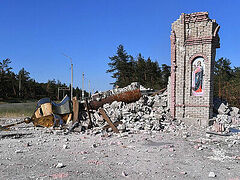
The St. Nicholas Monastery is very near the town of Ugledar, so it is also not too far from the front. The parish church in Ugledar was at one point literally on the dividing line—Russian troops were on one side, Ukrainian troops on the other. I walked through the ruins of the church—you can tell which side was which by the state of the masonry. The arch at the entrance is still standing—I don’t know who constructed it, but it must have been a very gifted builder.
But on the side where the Ukrainians were, there are five massive holes from artillery that struck right through and into the church, while on the Russian side, there are none of those big strikes. On the outside, there are some bullet holes, shrapnel, and other damage because it was back and forth. However, it’s painfully obvious who was trying not to hit the church versus who, as far as I can tell, was intentionally striking it. Behind the iconostasis, you can see where artillery went all the way through from the left side to the right side. There is still a huge icon of the royal martyrs on the right side that has a few bullet holes in it, but it wasn’t destroyed.
And I thought it was a beautiful testament to the fact that the territory has now been liberated, it is safe, and there are already plans to fix up and rebuild these churches. And obviously, they’re not going to send a large construction crew there right now because there’s still drone fire and similar threats. However, as the front advances further, the people there know that it will be rebuilt, giving them hope and confidence. And the monastery, as I said, was basically what saved them spiritually. And it was where they would go to get their water and food. The monks and nuns would cook for them. And I think a lot of the people there were obviously familiar with Elder Zosima of Donbas and knew that eventually, this would pass. Elder Zosima even prophesied the schism. He talked about the UOC versus the OCU and how, if the government forces a break with the Moscow Patriarchate, that’s how they will know that things are going to start to get really bad. So, as someone who talks about prophecies a lot on my show, it was a real, living example of the clairvoyance of our modern-day saints. They make these prophecies for our repentance, as Metropolitan Neophytos (formerly of Morphou) says; but they can also be for your assurance, to understand that if this was revealed to a man of God, then, of course, God is in control and we are not left to our own devices.
They make these prophecies for our repentance
—Or that it is even something we control as human beings.
—Yes, it might be horrible, it might be the worst thing you’ve ever experienced, but God is obviously allowing all of this to happen for a reason. And it’s easy for me to say that because I’m alive and returned from the Donbas. But I think many of the people there, through their connection with the Church, their piety, and these recent saints also have the same assurance.
— So, how do these people feel? Did anybody talk about their feelings, considering that the only people who have any inkling of what they’re going through are Russians—and not all Russians at that? In the West, people talk only about how bad the Russians are; they don’t see the SMO as Russians saving anyone, but rather as the Russians being the aggressors, causing so much damage to Ukrainians. Meanwhile, there is little or no discussion of what the people in the Donbas have been experiencing. Are those people aware of this fact, and if so, how do they feel about it?
They could never go back there. It would be too traumatic.
—They’re generally aware. Many of the people in these war zones were pulled back into Donetsk; they’ve been given Russian passports and have since redistributed themselves across the interior. The people I talked with—the mother and her son, their daughter, her daughter, and the son’s sister—now live in Simferopol. At the time, they were just waiting at this refugee center for their Russian passports to come in so they could move. I asked them if they would ever want to go back to Chasov Yar. But they replied that they could never go back there in their entire lives. It would be too traumatic. And that is not just about the horrible evacuation experience. That includes the persecution, the unwelcomeness, and the simply terrible climate that existed in pre-war Ukraine. They said, Look, we have lived here our entire lives, but the people who are in power now, and the people who have the monopoly on violence, clearly don’t want us here. They want us dead, they want us to leave, or they want us to become exactly what they are. And sure, I’m certain there were people in all of these places who were sympathetic to the Ukrainian side and have since fled in the opposite direction; but those people were not the victims of the Maidan or the blatant cultural erasure—the idea that people speaking the Russian language, the language they grew up speaking, are immediately considered Kremlin agents. The people I spoke with were grateful that I was there as a Western journalist; they said, Hey, somebody might actually tell the West what we’re going through and what’s really going on. They don’t talk to many Americans, so many were surprised that I was even able to get there.
The Church is viewed as obviously “Russian,”, but more than that, it’s seen as an obstacle to the new Ukrainian state they have been trying to build since the early 2010s, and even earlier
I believe that even the Russians, specifically from the religious perspective, could do a better job of spreading these people’s story and explaining exactly what was going on. Like I said, I don’t understand why the Ukrainians tried to strike the Donetsk icon service, except to simply intimidate people on a religious level. It was as if they were demonstrating that they don’t accept any church associated with Patriarch Kirill, because he supposedly supports the war. That’s their sort of steel man argument. Well, if that was the only issue, then they wouldn’t also be persecuting clergy for their basically traditional stances—because the government is obviously pressuring even the OCU people. Epiphany Dumenko said himself that he will be taking a softer stance on LGBT values as Ukraine integrates with the West. So the Church is viewed as obviously “Russian,”, but more than that, it’s seen as an obstacle to the new Ukrainian state they have been trying to build since the early 2010s, and even earlier.
—As I said, you don’t even read about this much in the Russian press, never mind the U.S. press. Although some brave journalists have gone to the Donbas and reported that war crimes were being committed, and that anybody from the West who participates in these strikes is also participating in war crimes. But these journalists were immediately put on that Ukrainian hit list with the Orwellian name, “Mirotvorets,” (meaning “Peace-maker).” They have been debanked in their home countries and even threatened with arrest if they return.
—I have seen some of those on-site video reports, and now I know that this is real stuff here. I was told in Donetsk that you should only walk on asphalt, and in fact, you shouldn’t go anywhere without a group. If you don’t take a road that’s been cleared for cars, there could easily be a petal bomb, a dropped mine, a grenade, or something you might step on that could blow your leg off. So, the people always have to deal with that. It’s a lot better than it used to be; they’ve done a lot of work to clear these areas of mines, but it’s a huge city. Even with the war, there are still over a million people living there, and it’s going to take decades to clear all the mines. This is a tragedy in itself, but even more concerning is that they didn’t want me wandering around because there are still Ukrainian terrorists and saboteurs infiltrating these areas. Truck bombs go off all the time. You know, I was there with Andrei Afanasyev, a well-known host on Spas TV. I’m sure the Ukrainians would love to kill him. They would think that’s the greatest thing ever, just like I’m sure they would think it’s the greatest thing ever to kill Metropolitan Vladimir of Donetsk or Metropolitan Mitrofan of Gorlovka. They have effectively already tried to do that with their drone and missile strikes. So it is very much understood that churchmen are considered armed combatants by the Ukrainians, even if their only “weapon” is their cross.
 Andrei Afanasiev. “The enemy targeted all the crosses”
—Yes, they consider them fair targets. And so, did any of the priests you talked with discuss the rehabilitation of these people who have gone through such stress?
—I did hear about that. For example, many of these people, like the Donetsk Red Cross, distribute aid in churches, hoping in theory that they won’t be targeted because it’s a church. However, the Ukrainians don’t play by those rules. One of the main things they often bring into the area is psychological aid—people for them to talk to, such as priests or psychologists. I did hear about that. Meeting the people that I did was definitely necessary because they witnessed dozens of their neighbors killed in certain situations or know someone who was taken and then disappeared, leading them to assume those people are dead. They don’t know where these individuals are and will never learn what happened to them, for example. We still hear stories about mass graves or bodies being found that were clearly victims of some atrocity that occurred in the fog of war on the front line or in the gray zone. No one really knows what happened. Maybe some guilty person who did them knows, but we probably won’t get answers about thousands of people’s deaths in these areas, which is just such a tragedy.
We probably won’t get answers about thousands of people’s deaths in these areas
I went to the museum in Gorlovka that honors the twenty-seven children aged sixteen and under who were killed in the bombings since 2014, some of them under one year old. They have a large memorial dedicated to them. There is a video that plays in front of their portraits and everything. It’s an extremely tragic thing to witness and to understand that, in theory, it could still happen at any time. I mean, we have heard the Americans talking about giving Tomahawk missiles to Ukraine, which have a range of 1,000 miles.2 That’s all of Donbass, obviously, and then deeper into Russia. People need to understand that, just because it’s easier to do in the Donbass, if these people have the means, they will do the exact same thing in Rostov, in Krasnodar, in St. Petersburg, and in Moscow—which is what Zelensky has openly been talking about doing.3
—These cities are already experiencing continual drone strikes.
—And of course, we know about plans to blow up Metropolitans of the Russian Orthodox Church. If they get long-range missiles—and I’m not trying to fearmonger here—why wouldn’t they strike this place where we are right now?
Greeks in the Donbas
 At the entrance to Mariupol, before the SMO. Photo: ostro.org
—Tell me a little more about the Greek population there.
—So, obviously, everyone speaks Russian, so it’s not like I heard Greek on the streets or anything, but we went to Greek restaurants several times for our food, and it was delicious. For example, we also went to Mariupol, and one of the churches we saw there was actually an OCU church. It had never been finished and sustained a lot of damage during the battles. People are there as a group of rebuilding volunteers, building houses, and eventually, the church is going to be rebuilt as a canonical Ukrainian Orthodox Church.
Even the name Mariupol is Greek. I loved it because most of the entrances had very Orthodox themes. For example, there is a Russian language sign with a huge icon of the Theotokos right above it. And then, on the other side of the road, there is a sign with Mariupol in the Russian tricolor, but written in Greek. So, you have this Russo-Greek city in Donetsk, very much like the Eastern Roman Empire.
Mariupol was fascinating to see because the rebuilding is almost miraculous. You can still see a lot of damage, but there are massive new hospitals, apartment buildings, parks, and other infrastructure. I gave a talk to some students at Mariupol State University, which has a lovely campus. They have very nice, state-of-the-art sports facilities and similar amenities. I talked to a group of about twenty young people, ages eighteen to twenty-two. Many of them understood the Orthodox and civilizational nature of this conflict. They asked some very interesting questions. And it was great to talk with them. One of the guides showing us around was one of the original 300 Donetsk People’s Republic militiamen who stormed Slavyansk in 2014. This action essentially allowed Donetsk and Lugansk to exist as they do today and hold out for eight years before the special military operation began. He himself is half Greek, half Russian, from this region. And you’ll meet many people who are maybe a quarter Greek, one of whose parents was half Greek, or one of whose grandparents was Greek, or maybe they themselves are more Greek than Russian. You can tell by looking at people’s faces. It’s well understood that Greeks are an old, old ethnic group in the Donbas region. Unfortunately, those Greek people—those Russian-speaking Greeks—were some of the earliest victims of Ukrainian discrimination and basically did the math in their heads that it wasn’t worth sticking around, so they went to Greece or somewhere else in Russia, Moldova, or wherever they could go. I was very encouraged to see the Greek sign, and I took a video. Not only is there an icon of the Theotokos next to the Greek sign, but in the middle of it, there’s a huge statue of St. Ignatius of Mariupol. I don’t know much about his story, but there’s a beautiful statue right next to the Greek sign, and I think he might have been part Greek himself. So, despite the fact that the Greek Church technically supports the schism, the Russian people are still proud of their connection to Greece and how they received their faith from them. It was truly beautiful to see the Greek character of these places.
—Conrad, from your experience in Donbas, did you get a sense of how people there view the rest of the world? Does the fact that nobody in the West cares about what they have been enduring for these twelve years hurt them or make them resentful?
—As far as I could tell, most of the real animosity was toward Western Europe and the EU powers rather than toward America. I did notice that. For example, the main person I talked to in the St. Alexander Nevsky Brigade was wearing a New York Yankees hat. That’s what he would wear into battle. Many of these guys really like certain things about America. They are not against the U.S. president or vice president, and they like conservative American people, but they recognize that America has a deep state and many problems. But they didn’t have the same affinity for the UK, France, and Germany. They really had nothing nice to say about them. Many of them seem confident that Trump will fix this. I don’t think so myself, but I admire their confidence. Also, there was no hostility when I said I was American. They were deeply inspired by the fact that I told them there are thousands of Orthodox Christians in America who see what they are doing, support them, and recognize—even if they don’t fully understand it—that it is all tied to the deep politics of Ukraine, Russia, and others. Largely thanks to this site and the Union of Orthodox Journalists, we have all seen what happened to the Cathedral in Cherkassy, what happened to Bishop Longin, and to the abbot of Sviatogorsk Monastery (Metropolitan Arseny), who has been imprisoned in a cold, dank cell for two years, leading to his rapidly declining health. Anyone has the ability to learn about all of this. When you learn about those things, it becomes much harder to oppose the Russian advances on the front line—because there is one thing that’s certain: once you are behind the Russian line and in Russia, you are no longer subject to that persecution.
And it’s hard for people who may have been initially sympathetic to Ukraine to justify their unconditional support because we’ve seen the horrible persecution in Ukraine, which also claims to be a liberal, tolerant state. I did not find any great animosity toward America; although, of course, I had to turn off my U.S. SIM card for obvious reasons.
But people are living in the moment, as I said earlier. I don’t think they even have time to consider what the rest of the world is doing, because every day is a struggle to survive. The question for them is, what are you doing to help? How are you helping? We met lady volunteers from all over Russia who go there to set up small village kitchens and cook food for the volunteers fighting there.
It’s an all hands on deck situation. Everyone’s doing their part. The teachers still have to teach. Little children walk to school, and people get on the bus on Monday morning to go to work. Everything still has to operate. People there can’t just sit back, relax, and let life happen—or even read the news.
Everyone there is actively responsible for ensuring that civilization continues in their home cities. The whole thing was rather surreal, to be honest.
This interview was conducted in the autumn of 2025, and much more has happened since then on the SMO front. But the reality of life in the Donbas remains as Conrad described. Let us all pray to the merciful Lord and His Most Pure Mother that this tragedy may come to an end soon, and that peace may reign among these nations, which were once brothers, and closer to each other in spirit than to any other nations.