Photo: Panorama.pub
Back in the 1990s, a sweet Orthodox girl decided to go to a convent. She wanted to find the most ancient Orthodox convent in Russia and labor for her salvation there. We will not give the name of the elder she turned to for the final decision. But barely had she asked him the question when she heard his answer:
“My child, why should you become a nun when in your native Irkutsk you will be saved faster with your father-confessor K., with the great Sts. Innocent and Sophronius of Irkutsk? And not every city can boast of holy springs like yours.”
That’s why she returned home. And to this day we all keep the answer of that famous elder in our hearts, venerating our great and beloved saints of God. Over the years, we have unceasingly testified to their help in every spiritual and everyday matter, thanking them for their intercessions before the Almighty.
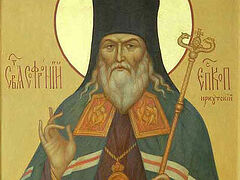
Here is a short life of one of them. The future St. Sophronius was born Stefan Kristalevsky in 1704. After graduating from the Kiev Theological Academy he chose the monastic path, going to the Krasnogorsk Holy Transfiguration Monastery, which was later rededicated to the Protection of the Mother of God.1 There, in 1730, the saint was tonsured a monk with the name Sophronius in honor of St. Sophronius, Patriarch of Jerusalem. Immediately after his tonsure St. Sophronius heard a voice in the church, saying, “When you become a bishop, build a church in honor of All Saints.”
Two years later, the saint was ordained a hierodeacon, and then hieromonk. After some time, he joined the brotherhood of St. Alexander Nevsky Lavra in St. Petersburg, and in 1746 he was elected the Lavra’s father-superior. He labored there for seven more years until Empress Elizabeth Petrovna (1741–1761) herself recommended him as bishop of the Diocese of Irkutsk, which had been without spiritual care for about six years. Hieromonk Sophronius was consecrated Bishop of Irkutsk and Nerchinsk on April 18, 1753. On March 20, 1754, the saint arrived in Irkutsk. The first thing he did was to stop at the Holy Ascension Monastery of Irkutsk, the see of his predecessors, and pray at the grave of Bishop Innocent (Kulchitsky), asking for his blessing for the ascetic labors ahead of him.
For many years, the saint performed his ministry in distant Siberia. St. Sophronius took special care of the clergy children and their education. He cared for the life of the common people and clergy alike. At that time, there were many pagans in the Siberian land, so the bishop often celebrated hierarchical services with awe and reverence, demanding from each priest the same attitude to the sacraments.
 Photo: Iemp.ru
The saint led a humble life. There was a record that he “ate very simple food and frugally, served very often, spent most of the night in prayer, slept on the floor, whether on sheep’s fur, deerskin or bearskin and a small simple pillow—that was all he had for a bed, for a short rest.” Over the seventeen years of Bishop Sophronius (Kristalevsky)’s ministry, the number of churches in Siberia more than tripled, parishes received trained priests, a network of parish schools was set up, and missionary activities noticeably revived.
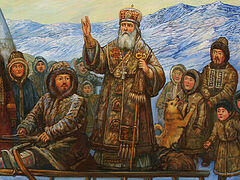
Vladyka Sophronius undertook long missionary journeys even to the remotest corners of his diocese. The bishop traveled to Nerchinsk, Kirensk, and twice to Yakutsk. Vladyka Sophronius spent whole months journeying, not sparing himself. Everywhere he saw shortcomings that he tried to combat: lack of faith, apostasy, or paganism. Enlightening the pagans with the light of the Orthodox faith, Bishop Sophronius (Kristalevsky) also took on the organization of the life of the small numerically indigenous peoples of Siberia, offering them monastic lands for settlement and in every possible way trying to isolate them from the influence of their former superstitions. His labors were colossal, taking into account the distances in the huge Siberian diocese. He devoted all his energies to educational activities, served in parishes, preached sermons, calling on the flock to struggle with vices and to fulfill the Christian commandments. His contemporaries noted the Vladyka’s extraordinary generosity; his home and the entire Ascension Monastery were overflowing with the sick, homeless, and orphans. Numerous visitors flocked to Vladyka for his blessing and help. But regardless of such numerous activities, he led a strict monastic life.
St. Sophronius reposed in the Lord on March 30, 1771, but he was buried only six months later. All this time, the bishop’s coffin stood in the chapel of the Kazan Icon of the Irkutsk Cathedral. His body turned out to be incorrupt, and miracles and healings occurred at the tomb.
On March 8, 1909, a special commission carried out an official examination of the saint’s remains, and the following was discovered: After 138 years, despite the proximity to water (the Angara River flows nearby) and the permanent damp in the cave and under the floor of the cathedral, especially in the summer, the coffin, vestments and body of St. Sophronius remained intact. During the examination, which lasted about two hours, some of those present sensed a fragrance coming from the saint’s relics.
On June 19, 1909, the second official examination of the relics took place. Once again, everything was found in the same condition as in March. The results inevitably became public and further inflamed faith in the holiness of Vladyka Sophronius and hope for his speedy canonization on earth.
And in 1918, the following event happened. May 1 (International Workers’ Day) coincided with Holy Week of Lent and with the anniversary of the episcopal consecration of the saint—April 18 according to the Old calendar. On Holy Wednesday, the day of Judas’ betrayal, the celebration with carousing, revelry, fights and disorderly behavior led to numerous fires throughout Irkutsk. The saint’s relics also caught fire along with his coffin, despite the stone walls and floor of the Theophany Cathedral. But understanding what had happened as a manifestation of wrath for the people’s apostasy, the residents began to venerate the saint even more.
 Photo: Irk-panteleimon.ru
St. Sophronius (Kristalevsky) of Irkutsk and All Siberia was canonized at the Local Council of the Russian Orthodox Church in 1918.
To the end of his life, St. Sophronius kept his love for the Krasnogorsk Monastery, which had nurtured him in his youth. He constantly contributed to the maintenance of its beauty, sending the necessary funds for this. But even in our time, he continues to support the nuns of his beloved convent. One day, our iconographer from Irkutsk ended up at that same convent in Ukraine, and its sisters told her an amazing story:
“When the monasteries were being opened in the 1990s, our convent required major reconstruction. But where could we get timber? Not knowing what we should do, we prayed to our intercessor, St. Sophronius. And, just imagine, less than three days later we recieved a notification to pick up a dispatch at the railway station. What? Where was it from? Who sent it? Questions poured into our mind all the way, until we reached the station. They handed us the documents that read that the timber was from Irkutsk in Siberia, but no sender’s name was indicated. We had it unloaded, delivered, and went to celebrate a thanksgiving service to the Lord.”
When you ask Irkutsk residents, they immediately start giving you one piece of evidence of the saint’s help after another. Once they had prayed, they got an apartment, built a house, and after praying to the saint, on his feast-day, the construction of a house for a large family resumed. Protracted apartment sales, acquisitions—everything seems to be in the “competence” of our saints. Issues are resolved on site if you start asking St. Sophronius for help. The large family of a future priest did not have its own corner for a long time, while raising eight children. They began to turn to the saint for help, and with the donated money they bought an apartment, which was eventually exchanged for a huge house where their younger children were given so much space that they could almost ride bikes there.
Miracles associated with the name of St. Sophronius still occur today. Schema-Archimandrite Zosima (Sokur) related one of them. Arguing in absentia with some who wanted the UOC-MP to become autocephalous, he preached: “Today we honor the memory of St. Sophronius… A native of present-day Ukraine, then a Maloros,2 he graduated from the Kiev Theological Seminary and was a benefactor of the famous Krasnogorsk Monastery… The place is so swampy, the local river is small, and there is an abundance of frogs swimming in it! I saw it for myself—you can even pick them up with your hands. And they greatly annoyed the monks with their croaking! The brethren asked St. Sophronius to pray that they would stop. The abbot prayed, and the frogs stopped croaking around the monastery, and they don’t croak to this day.”
 Zolotonosha Krasnogorsk Monastery. Sobory.ru
“I thought it was just a fairy-tale. When I was in Zolotonosha, they specially took me to the river to see for myself whether the frogs croaked there or not. There are lots of them swimming there, all sitting on stumps, basking in the sun, opening their mouths—but there’s no sound. I, of little faith, have seen it. Outside the convent they croak terribly, God forbid! If you drive a little further away, there is no peace from their ‘songs’. But around the convent, there is silence—you will not hear a single sound.”
That’s how the Lord works miracles in His saints. And He united us all, who are now divided. St. Sophronius was sent from Kiev to St. Petersburg, and from there to Siberia, to Irkutsk. It’s the same path that St. Innocent of Irkutsk walked from the Chernigov province. That’s what our Russia was like—united and mighty. This is what it should be in future generations—inseparable! And the Heavenly bond is always inseparable.