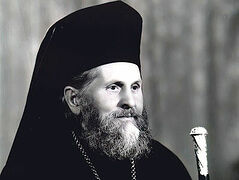
Before his repose, Abba Iulian (Lazăr) was the most visited confessor of the Romanian Prodromou Skete on Mt. Athos. His spiritual children, monks, and laymen would come from all over, crossing land and sea to receive his advice and help. He chose the monastic path at the age of twenty and entered Sihăstria Monastery. He spent thirty years there in the school of Romanian eldership under the care of the great Elders Cleopa (Ilie) and Paisie (Olaru) and others. In 1977, when the Sihăstria brothers went on pilgrimage to Mt. Athos, Hieromonk Iulian remained on the Holy Mountain. The blessed Elder was ninety-seven when he reposed on March 10, 2023. He had spent forty-two years as a spiritual father in Prodromou Skete. The following interview was published in the “Familia Ortodoxa” magazine in 2011.

—Father, what does a Christian of our day need most?
—To confess and sin no more—and if he does sin again, to go to the priest and confess as soon as it happens. For, I tell you, we can fly through the sky, sail upon the waters, travel across the earth—and all you hear is that someone left by car in the morning, and they brought him back dead: The car was smashed to smithereens and they brought him back dead. However death found him, that’s how he’ll be judged! No matter what grievous sins he may have committed, if he confessed them before death overtook him, the Church will rescue him. This is what the Sacrament of Confession is!
Everyone should think about the fact that he’ll depart to the other world. When? We don’t know, but everyone will. In a year, or ten… I used to have this saying: “The years go by, I’m old, but I’ll part with the old man yet.” But I think it’ll be soon—here I am, already eighty-five years old. And so we must be conscious that we’re headed there. We don’t know when, but we have to prepare for eternal life.
The life of man goes through three cycles. The first is in the womb of his mother, where we lived for nine months. The second is on earth, however long he lives: ten, fifty, a hundred years. The third is the life there, which has no end. Therefore, we have to prepare for it.
We have to think about the fact that we’ll die and be held accountable for everything that we did here, since it’s said that “even Abraham will repent that he didn’t do more here”—I found this in the Patericon. There was an elder who was sick. He had been zealous for God from his youth, and in his old age he would fulfill his rule sitting on a stool, saying: “Lord Jesus Christ…” Then one of the young brothers came and said to him: “Don’t torture yourself. Rest a little, because you’re old and sick.” He immediately got up and said: “What are you saying, brother? Don’t you know that even Abraham will repent for not doing more?” Therefore, we’ll be held accountable there, in eternal life, for everything we did here. Whether we did good or evil—everything…
That’s why I say that this flesh will depart while the soul will remain, for it is the master. Only the soul will go there. That’s why I’ve repeated many times: “The body is a good servant but a bad master.” May the body not become the master, for if it becomes the master, it will desire the corporeal. There’s a saying: “All evil comes from self-love.” And from this comes all bodily desires, all laxity, as I told you... A man no longer thinks about the fact that he’ll die, that he’ll go there. “Don’t give the body what it asks for, for it will turn to pain,” “don’t indulge your body, for the soul will die”—these are some very beautiful words, from Mt. Athos.
—Father, we wanted to ask you something about prayer…
—It’s said about prayer: “If you want to sanctify your mind, remember Christ. The more you try, the more you feel His presence.” Or: “Whatever the mind loves, that’s what it thinks about. If you love God, you think about Him all the time.”
We need prayer—we need to pray a lot. The Apostle Paul says quite beautifully: The Cross is to them that perish foolishness; but unto us which are saved it is the power of God. For it is written, I will destroy the wisdom of the wise, and will bring to nothing the understanding of the prudent. Where is the wise? where is the scribe? where is the disputer of this world? hath not God made foolish the wisdom of this world?... it pleased God by the foolishness of preaching to save them that believe (1 Cor. 1:18–21).
—Father, how can we reach such a spiritual measure like what you told us about?
—By thinking about Whom you’re speaking with and that you’re standing before the face of God. That’s the only way you can enter into prayer and concentrate the power of God within you so you can pray longer. We stand before God and we begin prayer. Our prayers are very beautiful; we have morning prayers, we have evening prayers, we read akathists and molebens—but only so that everything reaches the heart. We must feel every word. If you don’t, then you pray in vain! If you look at your clock or just say: “Give, give, give,” then it’s routine, it’s in vain! It’s very beautifully said: Yet in the church I had rather speak five words with my understanding, that by my voice I might teach others also, than ten thousand words in an unknown tongue (1 Cor. 14:19).
—A battle of thoughts comes, Father; terrible thoughts come, a storm of thoughts...
—They don’t come from man. St. Macarius and St. Anthony saw evil spirits and spoke with them. When a man reaches the point of living more and more with God, the spirits don’t approach him. But for someone who’s just starting out, there will be attacks. If you reject them, then they aren’t sins. But if they begin and you open the door to them even slightly and consent to them—that’s sin. For after one attack, others follow; the evil spirit pauses for a while and then wakes up again after a while. But a man must press forward, move ahead. Now it’s all about not moving backwards!
How much you must compel yourself in order to have the Holy Spirit always—and then, as the Ecclesiast says: I sleep, but my heart waketh (Song 5:2)! How much joy there is near the Bridegroom Christ, the soul as bride! Or when the mind unites with the heart, then a marriage is accomplished between mind and heart; this is the greatest joy, that the mind has united with Christ!
Eh, it’s easy to say but hard to do! As it says in Matthew (5:19): Whosoever shall do and teach them, the same shall be called great in the Kingdom of Heaven. Or in the Second Epistle to Timothy (2:6): The husbandman that laboureth must be first partaker of the fruits—of the fruits of the Holy Spirit, the Instructor—and then give them to another. Such beautiful words! I must acquire zeal in myself; I must fulfill this in deed myself.
—That is, we Christians must always do as we say, as we preach.
—Teach yourself first. Man, tell me how you live, that I may believe what you’re trying to prove to me;” “instructing with your life is the best proof;” “if you’re talkative—live first, and only then teach;” “above all, live according to the Gospel that you preach.” Zeal for God takes up residence in you and then grows within you! There are certain people who, it seems, speak only in order to glorify God, for only God can accomplish anything. Without God you can do nothing! And this is true.
Now, returning to the body, the Gospel of John says: It is the spirit that quickeneth; the flesh profiteth nothing: the words that I speak unto you, they are spirit, and they are life (6:63). Scripture also says: I do nothing of myself; but as My Father hath taught Me, I speak these things (Jn. 8:28). These words are from Heaven, this is the action of the Holy Spirit: “What the Father has told Me, that I speak to you.” And He says, meaning: “The Spirit gives life; the flesh profits nothing.” It doesn’t say that it profits, but that in comparison with the soul, the body is nothing. “We are the temple of the Holy Spirit” (cf. 1 Cor. 6:19). We must sanctify the body with our deeds, prayers, and good works. Let us sanctify the body! We have the relics of the saints who sanctified their bodies all their lives. They sanctified this flesh with the soul! We must sanctify it. That’s why I say that the body is a good servant but a bad master. May it not become the master! For in order to sanctify the body, we must treat it as a servant. If it becomes the master, then the servant is the soul!
We don’t need overly convoluted philosophies. The greatest philosophy, as St. Basil the Great says, is the remembrance of death.
—Father, please, give us a parting word.
—I’ve already told you: Let every man think about how not to commit more sins, but if he does, let him confess. This is the greatest work—confession. And let him be careful that death not overtake him in his sins. Let him commit no more sins! If he sins, then as soon as he does, let him go to the priest and confess, that death might not find him like that. As I’ve said, I repeat: A man drives off in a car, and the car is smashed to pieces: Some crazy guy crashed into him, a drunk guy—who knows what. In whatever state death snatched him away, that’s how he’ll be judged. If death snatched him away after he had committed some great sin but had confessed it, then he’s blessed. Let us think about this, about the life to come.