Commemorated on the Synaxis of the New Martyrs and Confessors of Russia, October 3/16, October 30/November 12 (Uncovering of the Relics)
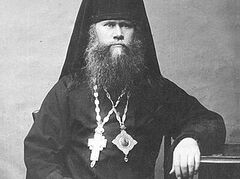
 Photo: rybeparhia.ru The Holy Hierarch and Confessor Agathangel, Metropolitan of Yaroslavl (in the world Alexander Lavrentievich Preobrazhensky), was born on September 27, 1854, in the village of Mogily, Kormovskaya Volost, Venev District, Tula Province, into the family of the priest Lavrenty.
The parents of the future hierarch embodied in their lives the traditional virtues of thousands of obscure families of the Russian rural clergy, through whose self-sacrificing labors the preaching of the Gospel of Christ continued throughout the boundless expanses of the Russian land. An ascetic upbringing of six children by accustoming them to simple peasant labor, conscientious pastoral service in a modest village church, humble acceptance of poverty, and profound liturgical piety—these were the distinguishing features of Fr. Lavrenty’s family’s daily life.
The holy hierarch recalled his religious experiences in adolescence with these words:
“I… often liked to tarry for a long time in the cemetery, and there, among the graves and crosses—those silent yet eloquent witnesses that all is dust, all is ashes, all is but a shadow—with tears in my eyes I would beseech the Lord in His mercy to vouchsafe me, at the appointed time, to become a servant of the altar and to offer the bloodless, redeeming Sacrifice for those who had completed their earthly pilgrimage.”
In 1871, the young man entered the Tula Theological Seminary, where he experienced his first serious spiritual temptations. The methods of instruction and upbringing there did not correspond to the traditions of ecclesiastical piety he had learned in his family. Alexander began considering a career in medicine, but talking often with his father helped him overcome these temptations, and in 1877 he entered the Moscow Theological Academy. There he was able to become acquainted with the tradition of pastoral ascetic labor, which was always the hallmark of the Holy Trinity-St. Sergius Lavra.
In 1881, Alexander Preobrazhensky successfully graduated from the Moscow Theological Academy. For his dissertation, The Hexaemeron of the Bulgarian Exarch: A Study of the Language and Text Based on the Manuscript of 1263, he was awarded the degree of Candidate of Theology.
That same year, Alexander Lavrentievich was appointed to teach Latin at the Ranenburg Theological School of the Ryazan Diocese, and on December 7, 1882, he became assistant superintendent of the Skopin Theological School in the same diocese.
Also in 1882, he married Anna, the daughter of Archpriest Voznesensky. But before they had enjoyed a full year of happy married life, Alexander Lavrentievich lost his wife and newborn child almost simultaneously.
“The path in life that I had chosen was not my appointed lot… I hastened to leave the world, take up my cross, and join the ranks of the monastics.”
Thus did he recall the lesson he had drawn from these terrible trials.
On March 7, 1885, Alexander Lavrentievich received the monastic tonsure with the name Agathangel, in honor of the fourth-century martyr who was a disciple of the Hieromartyr Clement of Ancyra. He was subsequently ordained a hieromonk.
In 1886, Fr. Agathangel was appointed inspector of the Tomsk Theological Seminary and elevated to the rank of abbot. It would be twenty years before he returned to central Russia, by then a respected archpastor.
In 1888, Fr. Agathangel was appointed rector of the Irkutsk Theological Seminary and elevated to the rank of archimandrite. On September 10, 1889, he was consecrated Bishop of Kirensk, vicar of the Irkutsk Diocese, at the Ascension Monastery in Irkutsk.
From 1893 to 1897, he governed the Diocese of Tobolsk and Siberia. In 1897, he became Bishop of Riga and Mitau, and in 1910 he assumed the see of Vilna and Lithuania. In 1904, he was elevated to the rank of archbishop.
Improving throughout his dioceses the work of theological educational institutions, the holy hierarch sought to direct every reform toward a single goal: that young people should, above all, come to love prayer.
Indeed, religious education and Eucharistic life were among the most important aspects of his archpastoral ministry. He did much to improve the lives of ordinary rural priests, whose hardships he understood from personal experience. He organized mutual aid funds, opened shelters for young orphans from clerical families, and expanded the operations of the diocesan candle factory.
In preparation for the anticipated Local Council of 1905, at the request of the Holy Synod the future St. Agathangel prepared a report addressing pressing problems in the liturgical life of the Russian Orthodox Church. In it he spoke of the need to correct grammatical and stylistic errors that had crept into the liturgical books since the seventeenth century, as well as to bring parish worship into greater conformity with the ancient liturgical rubrics.
The hierarch also labored to reform parish life, fostering within it the principle of conciliarity.
He devoted considerable attention to charitable work as well. He maintained a dining hall for poor children his own expense, and he provided regular financial support to many people in need.
His contemporaries testified concerning him:
“A happy equilibrium of spirit, gentleness and attentiveness in his dealings with others, an even and self-controlled disposition, and total respect for others’ opinions—these were the personal qualities of the hierarch that naturally well-disposed everyone who came into contact with him.”
In 1912, the hierarch was awarded a diamond-studded cross to wear on his klobuk. The decree conferring the award emphasized his unfailing benevolence toward clergy and laity alike, combined with firmness of character.
In 1913, he was appointed to the See of Yaroslavl and Rostov. Soon afterward, he was elevated to the rank of metropolitan.
The war that began in the summer of 1914 prevented the hierarch from devoting himself fully to peaceful archpastoral activity. He organized hospitals and sent priests to minister to the troops at the front.
In 1917–1918, he was a member of the Preconciliar Commission and subsequently of the Local Council. Beginning in 1918, he served as a member of the Supreme Church Administration and the Holy Synod under Patriarch Tikhon.
On May 12, 1922, Patriarch Tikhon, while under detention, categorically rejected the demands of a group of Renovationists that he transfer to them the authority of supreme ecclesiastical administration. Instead, he issued Metropolitan Agathangel a decree authorizing him to assume responsibility for Church administration:
“In view of the extreme difficulties that have arisen in Church administration as a result of my being brought before a civil court, I consider it beneficial for the welfare of the Church to place Your Eminence at the head of Church administration until the convocation of a Council.”
On June 3, 1922, the so-called “Memorandum of the Three” appeared, signed by Metropolitan Sergius (Stragorodsky) and Archbishops Evdokim (Meshchersky) and Seraphim (Meshcheryakov). In this document, they treacherously declared that the Renovationist Supreme Church Administration was “the sole canonically legitimate ecclesiastical authority.”
All pastors were urged to regard the directives of the Renovationist Supreme Church Administration as “lawful and binding.”
At this most difficult and dangerous moment, on June 5, 1922, Metropolitan Agathangel issued an epistle announcing his assumption of the temporary administration of the Russian Orthodox Church. In it, he called upon the faithful to preserve the foundations of the Church in all purity and to beware of those who were attempting to unlawfully usurp ecclesiastical authority.
 Photo: pstgu.ru
For his resistance to the Renovationists in their attempt to seize control of the Church, the holy hierarch was immediately arrested. At the end of 1922, the ailing elder, after being held in several prisons, was transported together with common criminals to the settlement of Kolpashevo in the Narym region of Tomsk Province, where he was to spend three years in exile.
In his testament of December 25, 1925, Patriarch Tikhon named Metropolitan Agathangel as the second candidate for the position of Locum Tenens of the Patriarchal Throne.
By the time the hierarch’s exile came to an end, the other two candidates for the position of Patriarchal Locum Tenens had been arrested: Hieromartyrs Metropolitan Peter (Polyansky, commemorated September 27) and Metropolitan Kirill (Smirnov, commemorated November 7).
The GPU sought to place a compliant group of bishops, headed by Archbishop Gregory (Yatskovsky), at the helm of the Church. However, Metropolitan Sergius (Stragorodsky), whom Metropolitan Peter had appointed as his deputy during the exile of all three candidates for the position of Patriarchal Locum Tenens, placed this group under canonical prohibition.
Tuchkov, head of the secret special department of the OGPU, attempted to exert pressure on Metropolitan Agathangel, whose term of exile had expired at the end of 1925. In April 1926, he met with the hierarch in the Perm prison and proposed that he assume supreme ecclesiastical authority.
The agent’s purpose was to set the leading hierarchs against one another through various intrigues and disinformation, provoking multiple schisms within the Church and thereby depriving her of a legitimate hierarchy.
Naturally, while in exile, the hierarch could not have access to the complete texts of all Metropolitan Peter’s directives. Nevertheless, remembering Metropolitan Sergius’s betrayal in 1922, he issued an epistle from Perm in April 1926 announcing his assumption of the office of Patriarchal Locum Tenens.
Upon returning from exile, he received a decree from Metropolitan Peter (Polyansky, commemorated September 27) instructing him to assume the duties of Locum Tenens. Metropolitan Sergius initially agreed to relinquish his position but then, apparently under pressure from the GPU, refused to surrender the authority of the Locum Tenens to its rightful holder.
The subsequent negotiations, telegrams, and letters from Metropolitan Sergius, replete with canonical sophistry, could only convince the wise and steadfast, yet straightforward and guileless hierarch that Metropolitan Peter’s deputy was not the man capable of uniting the episcopate and withstanding pressure from the godless authorities.
Realizing that Metropolitan Sergius would engage in a struggle for authority, Metropolitan Agathangel sent him a telegram in May 1926:
“Continue to administer the Church. I shall refrain from taking any action. I shall issue instructions concerning the commemoration of Metropolitan Peter, since, for the sake of peace in the Church, I intend to renounce the office of Locum Tenens.”
However, a few days later, a letter arrived from Metropolitan Peter, who was still in exile, welcoming Metropolitan Agathangel’s assumption of the office of Locum Tenens.
The holy hierarch once again called upon Metropolitan Sergius to come to Moscow so that, with the bishops assembled, he might receive supreme ecclesiastical authority from him. But Metropolitan Sergius refused to come and once again initiated a lengthy correspondence, in which he declared that Metropolitan Peter’s directives issued from prison were “directives, or rather, advice from a person who bears no responsibility…”
Metropolitan Agathangel then informed Metropolitan Peter that he could not assume the duties of Locum Tenens “in view of my advanced age and impaired health.”
Free from any desire for power, the holy hierarch advised Metropolitan Peter to entrust the office of Locum Tenens instead to Metropolitan Kirill (Smirnov) or Metropolitan Arseny (Stadnitsky), not wishing supreme ecclesiastical authority to remain in the hands of Metropolitan Sergius.
However, recognizing the destructive consequences of Metropolitan Sergius’s subsequent policies for the moral life of the Church, especially after the publication of his Declaration of 1927,1 the hierarch issued a confessional statement on January 24, 1928 (Old Style).
In this statement, together with a group of bishops known as the Yaroslavl Opposition, he refused to remain administratively subordinate to Metropolitan Sergius and announced that the Opposition was adopting the system of self-governance provided for in the decree of His Holiness Patriarch Tikhon of November 20, 1920.
In his reply, Metropolitan Sergius urged the hierarch to remain in communion with him, threatening canonical sanctions.
Soon afterward, Metropolitan Agathangel suffered several severe heart attacks. Whenever these occurred, he would first receive Holy Communion, and only afterward accept medical assistance.
 Photo: rybeparhia.ru On May 10, 1928, sensing that his death was approaching, the hierarch summoned his vicar bishops, Bishop Varlaam (Ryashentsev, commemorated February 7) and Bishop Eugene (Kobranov, commemorated November 7), to prepare a new statement addressed to Metropolitan Sergius.
In it, they declared that they were not breaking prayerful communion with the Deputy Patriarchal Locum Tenens, since they had no desire to cause any schism. For the sake of peace in the Church, they would direct all bishops, clergy, and laity who approached them to Metropolitan Sergius.
At the same time, however, the statement expressly stipulated:
“We have been unable, and remain unable, to carry out those directives of the Deputy which trouble both our own religious conscience and that of the people and which, in our conviction, violate the canons, in view of the circumstances that have arisen locally.”
Thus, even while rejecting Metropolitan Sergius’s policies, the hierarch strove until the end of his life to serve the cause of Church unity.
The ascetic hierarch’s childlike simplicity and purity of soul of made him incapable of the calculated diplomacy and political maneuvering necessary to retain external administrative power.
All these anxieties and sufferings for the Church of Christ seriously undermined the hierarch’s health. His heart attacks became more frequent, and by the middle of September he was confined to his bed.
Before his repose, the holy hierarch frequently partook of the Holy Mysteries.
On October 3/16, 1928, Metropolitan Agathangel reposed in the Lord.
Twelve tolls from the bells of thirty churches in Yaroslavl announced the holy hierarch’s repose.
He was not buried until the seventh day, when his body was laid to rest in a crypt beneath the Church of St. Leontius at the Leontiev Cemetery in Yaroslavl.
His face remained as it had been on the first day after his repose: radiant, pale, and peaceful, while a sweet fragrance emanated from his coffin.
Metropolitan Agathangel was numbered among the holy New Martyrs and Confessors of Russia at the Jubilee Council of Bishops of the Russian Orthodox Church in August 2000, for veneration throughout the Church.
Pravoslavie.ru
1 The infamous Declaration of the Church’s loyalty to the Soviet regime (officially titled the “Message of the Deputy Patriarchal Locum Tenens and the Provisional Patriarchal Holy Synod”) containing the lines: “We want to be Orthodox and at the same time to be conscious of the Soviet Union as our civil motherland, whose joys and successes are our joys and successes and whose failures are our failures.”